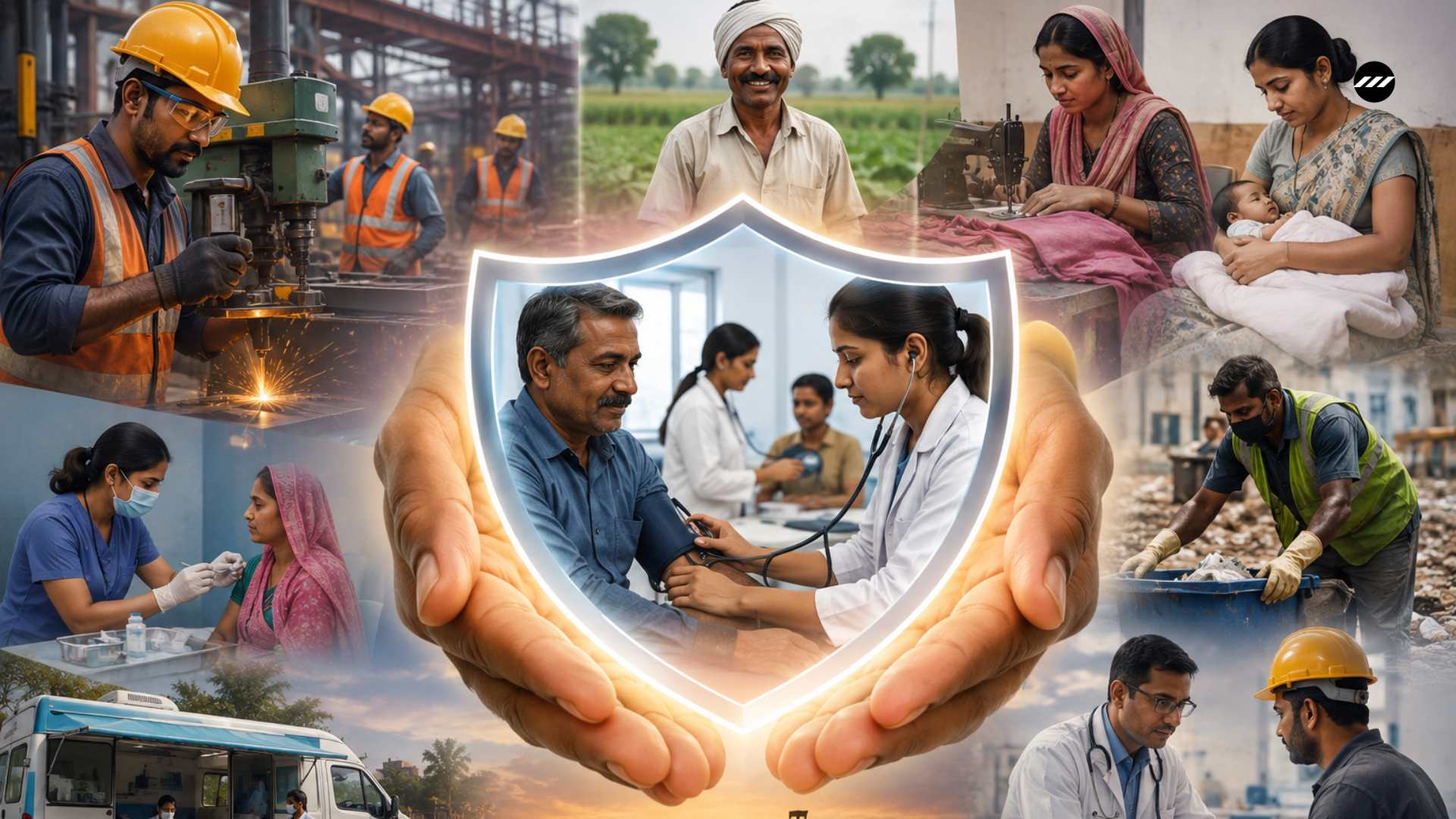
Free Annual Health Check-Ups for India's Workers: A Step Forward
 Surya
Surya
"The government must meet workers where they are — otherwise, any scheme of this nature will not improve upon the already deficient system."
The Announcement
The Union Labour Ministry has announced free annual health check-ups for workers aged 40 years and above, drawing on an existing provision in the new Labour Codes. Implementation will be through the Employees' State Insurance Corporation (ESIC).
For workers in hazardous conditions — handling toxic chemicals, operating heavy machinery — check-ups are mandatory. If illness is detected, ESIC hospitals and dispensaries provide free treatment. Financing comes from the well-endowed ESI Fund, supplemented by PMJAY-empanelled facilities to shore up bed and doctor availability.
Existing Legal Framework
India already has workers' health obligations on paper:
Factories Act 1948              →  Health obligations, but only within factories
ESI Act 1948                    →  Covers insured workers under ESIC
OSH Code 2020                   →  Occupational Safety, Health & Working Conditions
                                    (stipulates health measures at workplaces for
                                     organised sector workers)
New Labour Codes                →  Basis for the current free check-up announcement
The new programme extends this framework — but execution remains the central question.
Why It Is Commendable
- Proactive health screening for a working population largely excluded from routine medical care
- Mandatory check-ups for hazardous occupations addresses a long-standing occupational health gap
- ESIC's financial strength provides a credible funding base
- Builds on existing statutory architecture rather than creating a parallel system
Where It Falls Short
1. Coverage gaps — who is actually reached?
- Only 31 crore of 94 crore workers are registered on the e-Shram portal
- Integration of e-Shram with ESIC is still in early stages in many states
- At present, insured workers will be the primary beneficiaries — the vast informal workforce remains outside the net
2. Women workers left behind
- Labour Minister Mansukh Mandaviya did not clarify how a woman working in a garment home unit or as a domestic worker — with no formal "employer" — can access extended maternity leave provisions
- Annual check-ups for women require specific medical staff; many ESIC camps are crowded and male-dominated
3. Opportunity cost — the silent barrier
- Workers must still contend with lost wages for time spent on check-ups
- The scheme does not compensate for this opportunity cost, a recurring failure of predecessor programmes
- An ESIC facility lacking resources may refer a worker elsewhere, leading to repeat visits, added travel, and further income loss
4. Disease coverage is narrow
Covered under new scheme        →  Non-communicable diseases
                                    (diabetes, hypertension)

Not explicitly covered          →  Heat-related illnesses
                                    (construction & agriculture workers most at risk)
                                    Infectious diseases
                                    (hepatitis, leptospirosis — waste-pickers,
                                     sanitation workers most at risk)

Vaccination                     →  Screening offered, proactive vaccination
                                    not mandated
5. Heat illness — a glaring omission
Heat-related illnesses are not recognised as occupational diseases under the ESI Act, even as construction and agricultural workers face mounting risk — a particularly urgent gap given India's climate trajectory.
Way Forward
- Mobile occupational health units — take screening to worksites, not the other way around; as the OSH Code 2020 itself stipulates for organised workers
- Wage tokens or compensation for time spent on check-ups, removing the opportunity cost barrier
- Expand disease coverage — formally recognise heat-related illness and infectious diseases as occupational hazards under the ESI Act
- Mandate proactive vaccination for high-risk categories — waste-pickers, sanitation workers, chemical handlers
- Accelerate e-Shram–ESIC integration across all states to widen the beneficiary base beyond currently insured workers
- Gender-sensitive infrastructure — dedicated women's health camps, female medical staff, outreach to home-based and domestic workers with no formal employer
Conclusion
The free health check-up initiative signals a welcome shift toward preventive occupational health — moving beyond reactive treatment to structured screening. But a scheme announced is not a scheme delivered. With nearly 63 crore workers still outside the e-Shram net, with heat illness unrecognised, with women workers structurally excluded, and with opportunity costs unaddressed, the programme risks repeating the fate of its predecessors: well-intentioned, under-executed, and out of reach for those who need it most. True labour welfare demands not just policy architecture, but last-mile delivery — meeting workers where they stand, not where the system finds it convenient.
Attribution
Original content sources and authors

Syllabus classification
How this article maps to GS papers
Main syllabus
GS3Jobs & Inclusive GrowthQuick Q&A
What are the key features of the Union Labour Ministry’s annual health check-up initiative for workers, and how does it relate to existing labour welfare laws in India?
Key features of the initiative include:
- Free annual health screening for workers above 40 years of age
- Mandatory health examinations for workers engaged in hazardous occupations such as chemical handling and heavy machinery operation
- Treatment support through ESIC hospitals and dispensaries if illnesses are detected
- Funding through the financially strong ESI fund
- Possible integration with PMJAY-empanelled hospitals to augment infrastructure and specialist care
The initiative builds upon earlier labour welfare legislation such as the Factories Act, 1948, the Employees’ State Insurance Act, 1948, and the OSH Code. However, these laws historically focused mainly on workers in the formal and factory sectors. The present scheme attempts to expand preventive healthcare measures, though operationally it still appears more accessible to insured and organised workers.
From a policy perspective, the programme reflects a shift from curative healthcare to preventive occupational healthcare. Early detection of diseases such as hypertension and diabetes can improve productivity and reduce long-term healthcare expenditure. However, implementation challenges such as inadequate medical personnel, weak integration of e-Shram data, and exclusion of informal workers may limit its transformative potential.
Why is occupational health an important component of labour welfare and economic development in India?
The importance of occupational health can be understood through multiple dimensions:
- Economic dimension: Poor worker health leads to productivity losses, reduced incomes, and increased public healthcare expenditure.
- Social justice dimension: Informal and vulnerable workers often lack access to healthcare and social security.
- Human capital development: Healthy workers enhance national competitiveness and demographic dividend utilisation.
- Public health dimension: Occupational diseases can spread into communities, especially infectious diseases among sanitation and waste workers.
For example, construction workers exposed to extreme heat are vulnerable to dehydration and heat strokes, while sanitation workers frequently face infectious diseases such as leptospirosis and hepatitis. Failure to address these issues increases long-term social and economic costs.
In the Indian context, occupational health has traditionally received inadequate policy attention due to the dominance of the informal sector. Although laws exist, enforcement remains weak. Therefore, initiatives like annual health screening are important because they recognise workers not merely as economic agents but as citizens entitled to dignity and healthcare protection. However, unless the State addresses issues like wage loss during treatment, lack of awareness, and healthcare accessibility, occupational health policies may remain symbolic rather than substantive.
Critically analyse the limitations of the proposed annual health check-up scheme for workers in India.
Major limitations include:
- Exclusion of informal workers: A large proportion of India’s workforce remains outside the formal social security network. Only around 31 crore workers are registered on the e-Shram portal out of nearly 94 crore workers.
- Gender barriers: Women working as domestic workers or in home-based garment units often lack identifiable employers, making access to maternity and healthcare benefits difficult.
- Opportunity cost of healthcare: Daily wage earners may avoid health check-ups because visiting medical centres results in income loss.
- Infrastructure constraints: ESIC hospitals frequently suffer from overcrowding, shortage of specialists, and inadequate diagnostic facilities.
- Narrow disease focus: The scheme primarily targets non-communicable diseases while under-recognising occupational risks such as heat stress and infectious diseases.
For instance, waste-pickers and sanitation workers face greater exposure to hepatitis and leptospirosis, but the programme does not mandate preventive vaccination drives. Similarly, heat-related illnesses affecting agricultural and construction workers are not adequately recognised under the ESI framework.
From a governance perspective, the scheme reflects the broader challenge of translating welfare legislation into accessible outcomes. Merely creating entitlements is insufficient without institutional capacity, decentralised outreach, and worker-centric implementation. Therefore, mobile occupational health units, workplace-based screenings, wage compensation mechanisms, and stronger informal sector inclusion are essential for the programme’s success.
How can the government improve the effectiveness and inclusiveness of occupational health programmes in India?
The government can improve occupational health programmes through the following measures:
- Strengthening e-Shram and ESIC integration: A unified worker database can improve identification and service delivery.
- Mobile occupational health units: Healthcare services should reach workers at construction sites, farms, factories, and urban settlements.
- Compensation for wage loss: Providing tokens or direct benefit transfers for time spent on health check-ups can encourage participation.
- Sector-specific health interventions: Heat protection measures for construction workers and vaccination drives for sanitation workers should be institutionalised.
- Gender-sensitive healthcare: Recruiting women medical staff and improving reproductive healthcare services are essential for women workers.
For example, countries such as Thailand and Brazil have successfully used community-based health outreach systems to improve worker health access among informal labourers. India can adapt similar decentralised models using ASHA workers, urban local bodies, and labour welfare boards.
Additionally, occupational health must be viewed as part of a broader social protection architecture. Coordination between labour ministries, health departments, municipal authorities, and employers is necessary. Investment in preventive healthcare can reduce future healthcare burdens and improve productivity. Ultimately, a worker-centric model that minimises bureaucratic barriers and takes healthcare directly to workplaces will make occupational health schemes more equitable and impactful.
Why do informal sector workers continue to remain excluded from labour welfare and healthcare schemes despite multiple legal provisions?
The major reasons for exclusion include:
- Lack of formal employer-employee relationships: Domestic workers, gig workers, and home-based labourers often have no identifiable employer.
- Weak worker registration systems: Many workers remain outside databases such as e-Shram due to digital illiteracy and migration.
- High labour informality: Nearly 90% of India’s workforce operates in the informal economy.
- Low awareness levels: Workers are frequently unaware of their legal entitlements.
- Administrative fragmentation: Multiple ministries and welfare boards create coordination gaps.
For example, a woman working from home in the garment sector may technically qualify for maternity protection under labour laws but practically cannot access benefits because there is no registered employer to enforce compliance.
The issue also reflects broader socio-economic inequalities. Informal workers prioritise immediate survival over preventive healthcare because taking leave often means losing wages. Migrant workers face additional barriers such as portability issues and language constraints. Therefore, legal rights alone are insufficient unless backed by accessible institutions, simplified procedures, universal registration, and portable social protection systems. India’s future labour reforms must move toward universal worker-centric welfare rather than employer-centric welfare models.
Suppose you are a district labour officer tasked with implementing the annual worker health check-up programme in a district with a large informal workforce. What practical measures would you adopt to ensure effective implementation?
The following measures would be prioritised:
- Mobile health camps: Organise periodic camps at construction sites, markets, industrial clusters, and rural areas.
- Worker registration drives: Integrate e-Shram enrolment with health camps to improve database coverage.
- Convergence with local bodies: Coordinate with municipalities, panchayats, self-help groups, and NGOs for outreach.
- Compensation mechanisms: Provide transport support or wage compensation tokens for workers attending check-ups.
- Sector-specific screening: Focus on heat stress among construction workers and infectious diseases among sanitation workers.
Special attention would be given to women workers by deploying female healthcare staff and ensuring privacy-sensitive services. Awareness campaigns in regional languages through community radio and labour unions would also be conducted.
From an administrative perspective, monitoring and grievance redressal mechanisms would be essential. Real-time digital tracking of health records and referrals could improve continuity of care. Partnerships with PMJAY-empanelled hospitals and medical colleges would help address specialist shortages. Ultimately, successful implementation requires a participatory and decentralised model where healthcare reaches workers rather than expecting vulnerable workers to navigate complex institutional systems.
Practice questions
2 questions for mains preparation