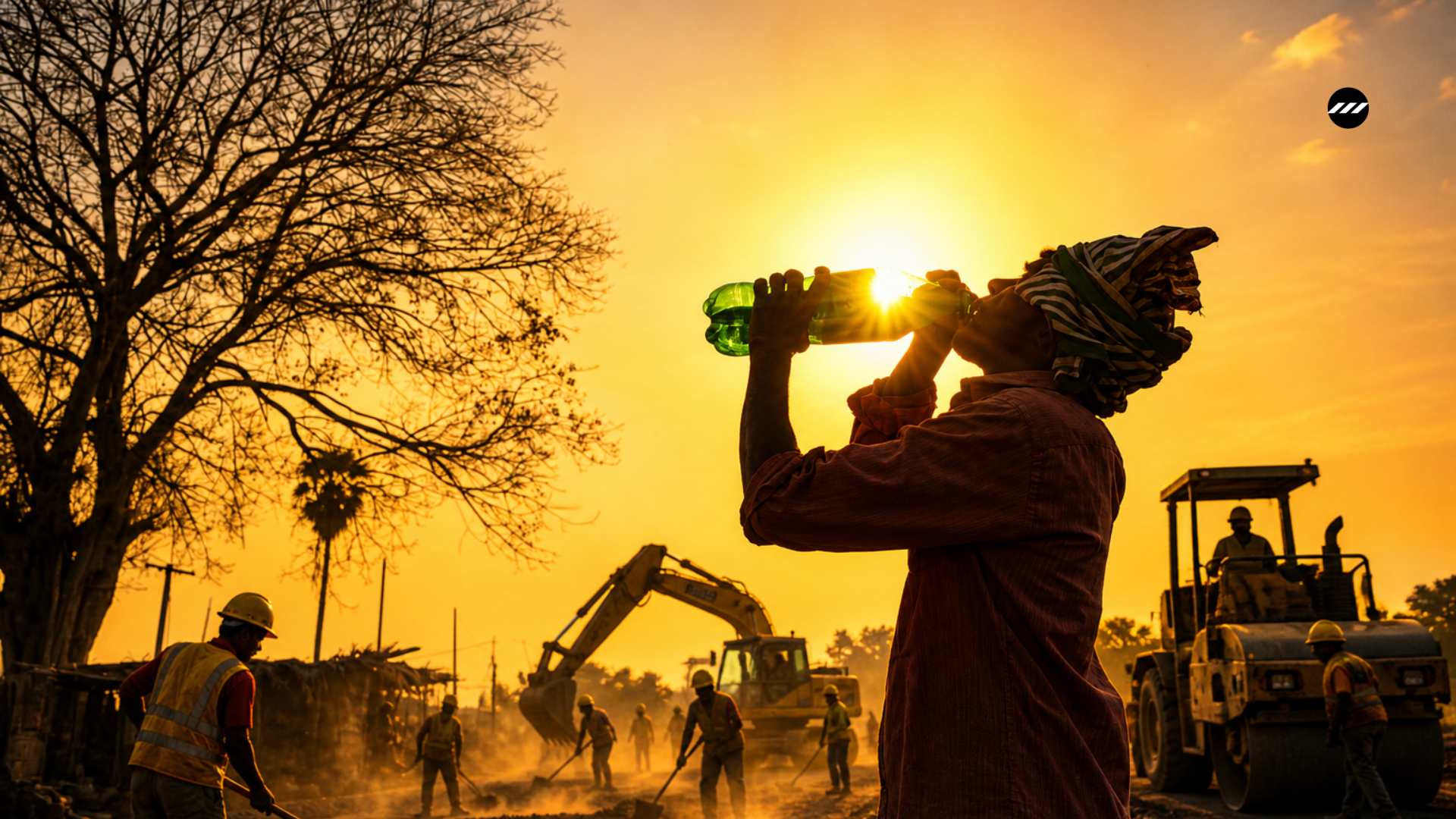
Informal Workers and Climate Impact

Introduction
-
India accounts for 80%+ of its workforce in the informal sector (Census 2011), yet has no universal legal framework mandating heat protection for outdoor workers.
-
As global temperatures rise — 2024 was 0.65°C above the 1991–2020 average — informal workers in construction, farming, sanitation, and vending bear the sharpest edge of climate change, with zero social security buffer and no choice but to work regardless of conditions.
"What workers call 'getting used to' is really just learning to ignore symptoms like headaches, dizziness, and fatigue. Those don't disappear — they simply become normalised." — Prof. Vidhya Venugopal, Sri Ramachandra Institute
Key Data
| Indicator | Figure |
|---|---|
| Informal workforce share (India) | ~82% (Census 2011) |
| AP non-agricultural informal workers | 45.2 lakh (32% of state workforce) |
| Human body heat tolerance threshold | Up to 37°C |
| AP heatstroke cases (2023) | 833 |
| AP heatstroke cases (2024) | 4,444 |
| AP heatstroke cases (2025) | 5,154 |
| AP heatstroke deaths (2015) | 1,369 |
| AP heatstroke deaths (2025) | 1 |
| Heatwave frequency increase (at 2°C warming) | 30x current levels (IIT Gandhinagar) |
Key Concepts
Heat Stress vs. Heat Stroke Heat stress is cumulative physiological strain from prolonged heat exposure — impairing cognition, causing dehydration, reducing productivity. Heat stroke is its acute, life-threatening endpoint. Informal workers chronically experience the former without recognising it as a medical condition.
Wet Bulb Temperature The combined effect of heat and humidity determines actual physiological burden — not dry temperature alone. Heat-stress disorders can occur even at 37–38°C when humidity is high and exposure is prolonged, making coastal Andhra Pradesh particularly dangerous.
Normalisation of Suffering A critical sociological phenomenon — workers misread chronic heat illness symptoms as normal fatigue because the condition is universal among peers. This leads to systematic underreporting, delayed treatment, and compounding health damage.
Vulnerability Framework
Why Informal Workers Are Most Exposed
- No paid sick leave, no week offs — absence means zero income
- No employer-mandated protective equipment (caps, gloves, cooling breaks)
- No formal employment contract — cannot invoke occupational safety laws
- Piece-rate and daily wage structures penalise slowdowns regardless of heat
- Low health literacy — over-the-counter self-medication instead of clinical care
- Last-mile warning gap — heatwave alerts don't reach those without media access
Intersectionality of Vulnerability
| Worker Type | Additional Vulnerability Layer |
|---|---|
| Women farm labourers | Supervisor pressure, no break flexibility |
| Widows/sole earners | Cannot afford even one day's absence |
| Sanitation workers (outsourced) | No benefits, no protective gear, no sick leave |
| Aged workers (55+) | Reduced physiological heat tolerance |
| Construction migrants | Unfamiliar climate zone, no local support network |
Policy Response — Assessment
What Works: AP Heatwave Action Plan APSDMA's annual heatwave action plan — warning dissemination, peak-hour work avoidance (12–3 PM), continuous monitoring — has been demonstrably effective. Deaths fell from 1,369 in 2015 to just 1 in 2025 despite rising case counts, indicating improved emergency response even as exposure increases.
What Doesn't: Last-Mile Failure The same workers most at risk — daily wage labourers, farm workers in remote villages — are precisely those who do not receive warnings and cannot act on them even if they do. Warning systems designed around television and formal communication channels miss the most marginal workers entirely.
Structural Gap: No Legal Protection India's Factories Act, 1948 mandates occupational safety for registered factory workers. No equivalent statute covers outdoor informal workers — leaving the majority of the heat-exposed workforce outside the ambit of enforceable protection.
Climate-Development Nexus
Urban Heat Island Amplification Rapid urbanisation — reduced green cover, increased construction, impervious surfaces — raises urban temperatures above regional averages. Amaravati's construction boom is simultaneously creating heat and exposing construction workers to it — a cruel developmental irony.
Productivity-Poverty Trap Higher temperatures → reduced work capacity → lower daily earnings → inability to afford medical care → return to work while ill → further productivity decline. This cycle deepens inter-generational poverty among informal worker households.
MGNREGA as Partial Buffer — and Its Failure MGNREGA theoretically provides a heat-resilient income floor. In practice, delayed payments (as experienced by Lakshmi) force workers back into informal farm labour under worse conditions — undermining the scheme's social protection purpose.
Way Forward
- Extend Factories Act protections to outdoor informal workers — mandatory cooling breaks, water provision, shade structures at worksites
- Heat-indexed MGNREGA — automatic work suspension with wage compensation when temperature exceeds 40°C
- Timely MGNREGA payments — delayed wages eliminate the scheme's function as a climate safety net
- Community-level warning systems — ASHA workers, gram sabhas, and local contractors as last-mile alert channels
- Occupational heat illness registry — mandatory reporting by all employers, formal and informal
- Urban greening mandates in infrastructure projects to mitigate urban heat island effects
Conclusion
-
Heat stress among informal workers is not merely a public health problem — it is a climate justice and labour rights failure at the intersection of inadequate social protection, absent occupational safety law, and accelerating global warming.
-
Andhra Pradesh's experience demonstrates that early warning systems can dramatically reduce mortality — but cannot address the structural compulsion that sends workers into 40°C heat regardless.
-
India's climate adaptation strategy cannot be complete without a legal and financial architecture that makes it possible for the most vulnerable workers to actually stay home on dangerous days — rather than choosing between heatstroke and hunger.
Attribution
Original content sources and authors

Syllabus classification
How this article maps to GS papers
Main syllabus
GS3Jobs & Inclusive GrowthQuick Q&A
What is heat stress and how does it affect informal workers in India?
For informal workers in India, such as construction labourers, farm workers, sanitation staff, and street vendors, heat stress is a significant occupational hazard. These workers often operate in open environments with little or no protective infrastructure. For instance, labourers in Amaravati continue road-laying and welding work even at temperatures nearing 39°C, often with minimal protective gear. This exposure leads to impaired cognitive function, fatigue, and reduced productivity, directly affecting their earning capacity.
Moreover, informal workers frequently normalize symptoms such as headaches, dizziness, and exhaustion, perceiving them as part of daily life rather than indicators of heat-related illness. This lack of awareness, combined with limited access to healthcare and financial pressures, exacerbates their vulnerability. Thus, heat stress is not merely a health issue but a multidimensional challenge affecting productivity, livelihoods, and long-term well-being.
Why is heat stress among informal workers an important policy concern in the context of climate change?
From a climate change perspective, the situation is alarming. Studies indicate that even a marginal increase in global temperature can significantly reduce labour productivity and increase economic hardship. For instance, projections suggest that severe heatwaves could increase manifold by the end of the century, intensifying the burden on vulnerable populations. This directly affects economic output, especially in labour-intensive sectors such as construction and agriculture.
From a governance standpoint, addressing heat stress is essential for achieving inclusive growth and social justice. Despite the Andhra Pradesh State Disaster Management Authority (APSDMA) implementing heatwave action plans, gaps in awareness and implementation persist, as seen in the case of workers unaware of heat advisories. Therefore, targeted policy interventions—such as adaptive work schedules, social protection mechanisms, and improved healthcare access—are crucial to mitigate the long-term socio-economic impacts of climate change on informal workers.
How do rising temperatures impact labour productivity and economic outcomes?
This reduction in productivity translates into economic consequences at both individual and macro levels. At the individual level, informal workers—who are typically paid on a daily wage basis—face income losses if they reduce working hours or are forced to take breaks due to heat-related illness. For example, workers like Govindam in Amaravati continue 12-hour shifts despite extreme conditions to meet targets, highlighting the trade-off between health and income.
At the macroeconomic level, decreased labour productivity can affect sectors such as agriculture, construction, and infrastructure development, ultimately slowing economic growth. Additionally, increased healthcare costs due to heat-related illnesses further strain public resources. Therefore, addressing heat stress is not only a public health imperative but also an economic necessity, requiring integrated strategies such as climate-resilient infrastructure, occupational safety regulations, and technological interventions to sustain productivity.
What are the reasons behind the low risk perception of heat stress among informal workers?
Another significant factor is economic compulsion. Informal workers rely on daily wages for survival, leaving them with little choice but to continue working regardless of weather conditions. For instance, labourers like Lakshmi and Hussainbi prioritize earning a livelihood over their health, even when experiencing severe physical strain. The absence of social security, paid leave, or alternative income sources reinforces this behavior.
Additionally, lack of awareness and ineffective communication of government advisories contribute to the problem. Despite the existence of heatwave action plans, many workers remain unaware of precautionary measures or early warning systems. Limited access to media, literacy barriers, and inadequate last-mile delivery of information further widen this gap. Addressing these underlying causes requires a multi-pronged approach involving awareness campaigns, behavioural change strategies, and strengthened social protection systems.
Can you illustrate the real-world impact of heat stress through examples from the informal workforce?
Similarly, the case of Lakshmi, a farm worker from Kurnool district, demonstrates the cumulative health effects of prolonged exposure to heat. Engaged in chilli harvesting, she worked long hours with minimal breaks, leading to health issues such as headaches, diarrhoea, and chronic pain. Financial pressures forced her to resume work even after medical advice, underscoring the absence of social safety nets. Her experience also highlights systemic issues such as delayed payments under schemes like MGNREGA.
Another example is sanitation workers like Parvathi, who face extreme conditions without basic protective equipment such as gloves or caps. These cases collectively reveal that heat stress is not an isolated phenomenon but a widespread issue affecting multiple sectors. They underscore the urgent need for policy interventions, improved working conditions, and targeted welfare measures to safeguard vulnerable populations.
Critically analyse the effectiveness of heatwave action plans in mitigating the impact of extreme heat on vulnerable populations.
However, the effectiveness of HAPs is uneven, particularly among informal workers. A major limitation is the gap in last-mile connectivity and awareness. As seen in the article, many workers are either unaware of heat advisories or unable to act on them due to economic compulsions. Furthermore, the recommendations—such as avoiding work during peak hours—are often impractical for daily wage earners who lack financial security.
Another challenge lies in the lack of enforcement and institutional support. Informal workers are not covered by strict labour regulations, and employers may not provide necessary facilities such as rest breaks, hydration, or protective gear. To enhance the effectiveness of HAPs, there is a need for integrating them with labour policies, ensuring social protection, and leveraging local governance mechanisms for better implementation. Thus, while HAPs are a step in the right direction, their impact remains limited without addressing structural vulnerabilities.
As a district administrator, how would you design a local intervention to reduce heat stress among informal workers?
Secondly, I would implement adaptive work policies in coordination with local employers and contractors. This could include rescheduling work hours to avoid peak heat periods, mandating rest breaks, and ensuring access to drinking water and shaded rest areas at worksites. For government schemes like MGNREGA, guidelines can be strictly enforced to protect workers’ health without compromising wages.
Finally, social protection and healthcare access must be enhanced. This includes setting up temporary health camps, providing free medical check-ups, and ensuring availability of oral rehydration solutions (ORS). Financial support mechanisms, such as compensation for lost work hours due to extreme heat, can also be introduced. By integrating climate adaptation with labour welfare policies, such interventions can effectively reduce vulnerability and build resilience among informal workers.
Practice questions
2 questions for mains preparation