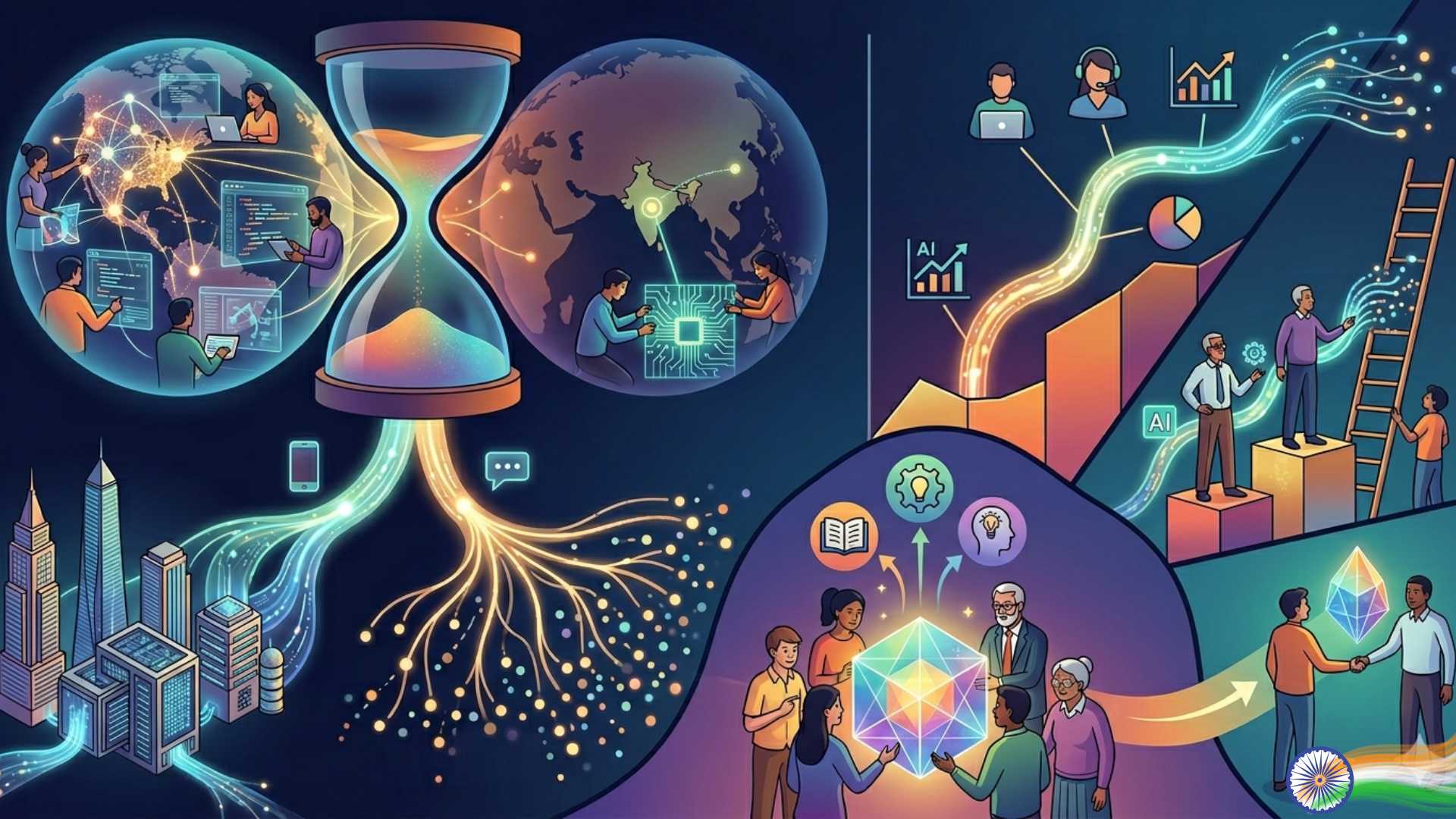
Gauging Disruption: AI's Impact on Labour-Market Inequalities
Introduction
Artificial Intelligence — particularly Large Language Models (LLMs) — is reshaping labour markets globally, with adoption concentrated in high-income countries and high-skill occupations. Two recent studies by Anthropic reveal that while AI has not yet triggered systematic unemployment, it is already slowing entry-level hiring in exposed sectors and deepening the global skill divide. For India, ranked 98th out of 116 countries in Claude usage, the stakes are especially high — the very sectors powering India's export economy (IT services, BPO, routine cognitive work) are among the most vulnerable to AI-driven automation.
"AI is not replacing workers — it is replacing tasks. But when enough tasks are replaced, jobs transform beyond recognition."
| Indicator | Figure |
|---|---|
| India's Claude usage rank | 98th out of 116 countries |
| Top 20 countries' share of per capita AI usage | 48% |
| Sectors most exposed to LLMs | IT, Finance, Legal, Management |
Key Concepts
| Term | Meaning |
|---|---|
| LLM (Large Language Model) | AI systems trained on vast text data to perform language-based tasks (e.g., ChatGPT, Claude) |
| Skill-Biased Technological Change | Technology that raises productivity of skilled workers disproportionately, widening wage inequality |
| Task Exposure | Degree to which an occupation's tasks can theoretically be performed by AI |
| Learning-by-Doing | Productivity gains from repeated, hands-on experience — currently accruing faster to experienced AI users |
| AI Augmentation | Using AI to enhance human productivity rather than replace workers outright |
Global AI Adoption: Key Findings
Pattern 1: Concentrated Early Use, Diversifying Later
Early adopters of LLMs favour specific high-value tasks — primarily coding, financial analysis, and legal research. As adoption widens, use cases diversify into lower-value personal queries, reducing the average economic value per interaction. This mirrors the typical technology diffusion curve.
Pattern 2: Geographic Inequality in Adoption
LLM usage is heavily concentrated in high-income countries. The top 20 countries account for 48% of per capita usage, reflecting differences in digital infrastructure, English-language proficiency, and workforce skill levels. This uneven adoption risks widening the global AI divide alongside domestic skill divides.
Pattern 3: Labour Market Effects — Subtle but Structural
No systematic rise in unemployment has been recorded yet. However, a measurable slowdown in entry-level hiring in AI-exposed occupations is already visible — a leading indicator of deeper structural shifts to come.
Occupations Most Exposed to AI Disruption
Anthropic's study identifies occupations where LLMs can theoretically handle a majority of tasks:
- Computer programmers and software developers
- Customer service representatives
- Financial analysts
- Legal researchers and paralegals
- Management consultants
The key qualifier: only a fraction of theoretical potential is currently being realised in practice, due to regulatory, organisational, and trust barriers.
India's Specific Vulnerability
The Concentration Problem
India's workforce is heavily concentrated in precisely the sectors most exposed to AI:
- IT services and software exports (~$250 billion industry)
- Business Process Outsourcing (BPO) — routine cognitive and voice-based tasks
- Entry-level knowledge work — data entry, basic coding, back-office operations
Early Warning Signals
- IT stocks are facing valuation pressure as analysts factor in AI-driven revenue erosion.
- Demand for entry-level IT roles is slowing as AI tools handle tasks previously requiring junior human teams.
- Indian users predominantly use AI for coding, debugging, design, and academic assistance — suggesting productivity-oriented use, but also signalling substitutability.
The Skill Divide Risk
Experienced users derive greater gains from AI through learning-by-doing, while less experienced workers lag behind. If entry-level roles — the traditional pathway for skill accumulation — shrink, the pipeline for developing the next generation of skilled workers itself gets disrupted.
Implications for India
Economic: Revenue erosion in IT/BPO exports if AI automates tasks handled by Indian offshore teams; potential slowdown in high-skilled job creation.
Social: Deepening inequality between AI-literate and AI-illiterate workers; urban-rural digital divide amplified.
Educational: Mismatch between current curriculum and AI-era skill requirements; need for rapid reconfiguration of technical education.
Governance: Need for proactive labour policy — reskilling frameworks, social safety nets for displaced workers, regulation of AI in hiring.
Policy Responses & Way Forward
1. Large-Scale Upskilling
AI is a skill multiplier — workers who integrate it effectively are already more productive and resilient. Upskilling must go beyond coding to include problem-solving, critical thinking, and human-AI collaboration.
2. Curriculum Reform
- CBSE's introduction of AI and computational thinking at school level is a timely and necessary intervention.
- Higher education institutions must embed AI-related courses across disciplines — not just engineering.
- National Education Policy (NEP) 2020 provides the framework; implementation must accelerate.
3. Industry-Academia Linkages
Apprenticeship models, industry-embedded curricula, and real-world AI project exposure can help bridge the gap between education and employment.
4. Social Protection for Transition
Workers in highly exposed occupations need targeted reskilling support, portable benefit systems, and income support during transitions — drawing lessons from global best practices.
Conclusion
AI's impact on labour markets is not a distant threat — its early signals are already reshaping hiring patterns, skill premiums, and sectoral valuations. For India, the challenge is especially acute: a large, young workforce concentrated in AI-exposed sectors, combined with low overall AI adoption and a widening skill divide. The window to act is narrow. India must treat AI literacy as a national infrastructure priority — as fundamental as roads or electricity for the knowledge economy. The demographic dividend can only be harvested if the workforce is equipped not just to coexist with AI, but to leverage it. The choice is not between humans and machines — it is between prepared and unprepared human capital.
Attribution
Original content sources and authors
Syllabus classification
How this article maps to GS papers
Main syllabus
GS3Jobs & Inclusive GrowthQuick Q&A
What do recent studies by Anthropic reveal about the current usage patterns of Large Language Models (LLMs)?
Nature of Tasks and Adoption Trends: Initially, LLMs were primarily used for high-value specialized tasks such as coding and software development. However, as adoption widens, their application has diversified into areas like personal assistance, academic queries, and design work. This diversification has led to a marginal decline in the average economic value of tasks performed, as more routine and low-value tasks are incorporated.
Implications: The findings suggest that while LLMs are becoming more accessible, their transformative impact is still concentrated in specific sectors. For instance, developers using AI tools like Claude or GitHub Copilot significantly enhance productivity. However, broader usage patterns indicate that the technology is transitioning from a niche productivity tool to a general-purpose utility, raising questions about its long-term economic impact.
Why can the uneven adoption of AI technologies deepen inequalities in the labour market?
Labour Market Polarisation: AI disproportionately benefits workers who possess complementary skills such as coding, analytical thinking, and AI integration. For example, experienced professionals who use AI tools effectively gain significantly higher productivity gains compared to entry-level workers. This creates a widening skill divide, where the benefits of AI are not evenly distributed.
Global and Domestic Implications: Globally, countries with advanced digital infrastructure gain a competitive advantage. Domestically, sectors like IT and finance may see increased productivity but also reduced demand for routine roles. For instance, customer service automation through AI chatbots can reduce entry-level hiring. Thus, without targeted policy interventions like upskilling and digital inclusion, AI adoption risks reinforcing both inter-country and intra-country inequalities.
How is AI currently impacting labour markets, particularly in terms of employment and hiring trends?
Emerging Labour Market Trends: Contrary to fears of массов unemployment, current evidence suggests that AI has not yet led to a systematic rise in job losses. Instead, a more subtle shift is occurring: reduced hiring in entry-level roles. For example, companies are increasingly relying on AI tools to perform routine coding or data analysis tasks, thereby reducing the need for junior employees.
Case Example: In the IT sector, firms are using AI-assisted coding tools to enhance the productivity of existing employees rather than expanding workforce size. This leads to a phenomenon known as “jobless productivity growth”. Over time, this could disrupt traditional career pathways, where entry-level jobs serve as stepping stones for skill development, potentially reshaping labour market dynamics.
How is India uniquely positioned in terms of AI adoption and usage, and what are its implications?
Implications for the Workforce: This trend suggests that AI is being used as a skill and productivity multiplier in India. For instance, software engineers using AI tools can complete tasks faster and with greater accuracy. However, experienced professionals tend to benefit more due to learning-by-doing advantages, which can widen the skill gap between novice and experienced workers.
Sectoral Vulnerabilities: India’s heavy reliance on IT services, back-office operations, and routine cognitive tasks makes it particularly vulnerable to AI-driven automation. For example, AI tools can now perform tasks like code debugging or data entry, which were traditionally outsourced to Indian firms. This has already begun to reflect in pressure on IT stocks and revenue projections, highlighting the need for strategic adaptation.
Critically analyse the potential risks and opportunities posed by AI for India’s labour market.
Risks and Challenges: However, the risks are equally substantial. A key concern is the displacement of routine cognitive jobs, particularly in sectors where India has a comparative advantage. Additionally, the reduction in entry-level roles can disrupt the traditional skill acquisition pipeline. This could lead to a structural imbalance in the labour market, where workers lack opportunities to gain experience.
Balancing the Trade-offs: The challenge lies in managing this transition. Policymakers must focus on reskilling and upskilling initiatives, strengthening digital infrastructure, and promoting innovation ecosystems. A balanced approach that leverages AI’s benefits while mitigating its adverse effects is essential for ensuring inclusive growth. Without such measures, AI could exacerbate existing inequalities rather than alleviate them.
Consider a scenario where entry-level IT jobs decline due to AI adoption. How should India respond to this challenge?
Policy and Institutional Response: India must prioritize large-scale upskilling initiatives that focus not only on coding but also on critical thinking, problem-solving, and AI collaboration. Educational reforms are crucial. For instance, the introduction of AI and computational thinking in CBSE curricula is a step in the right direction. Higher education institutions must also integrate AI-focused courses and practical training modules.
Industry and Individual Strategies: At the industry level, companies should invest in continuous learning programs for employees. Individuals, on the other hand, must adopt a mindset of lifelong learning and adaptability. For example, a software engineer could transition into roles involving AI model supervision or prompt engineering. Such adaptive strategies can help India transform this challenge into an opportunity for building a future-ready workforce.
AI adoption is widening the global skill divide, reshaping labour markets, and posing unique challenges for India's workforce.
Practice questions
1 question for mains preparation