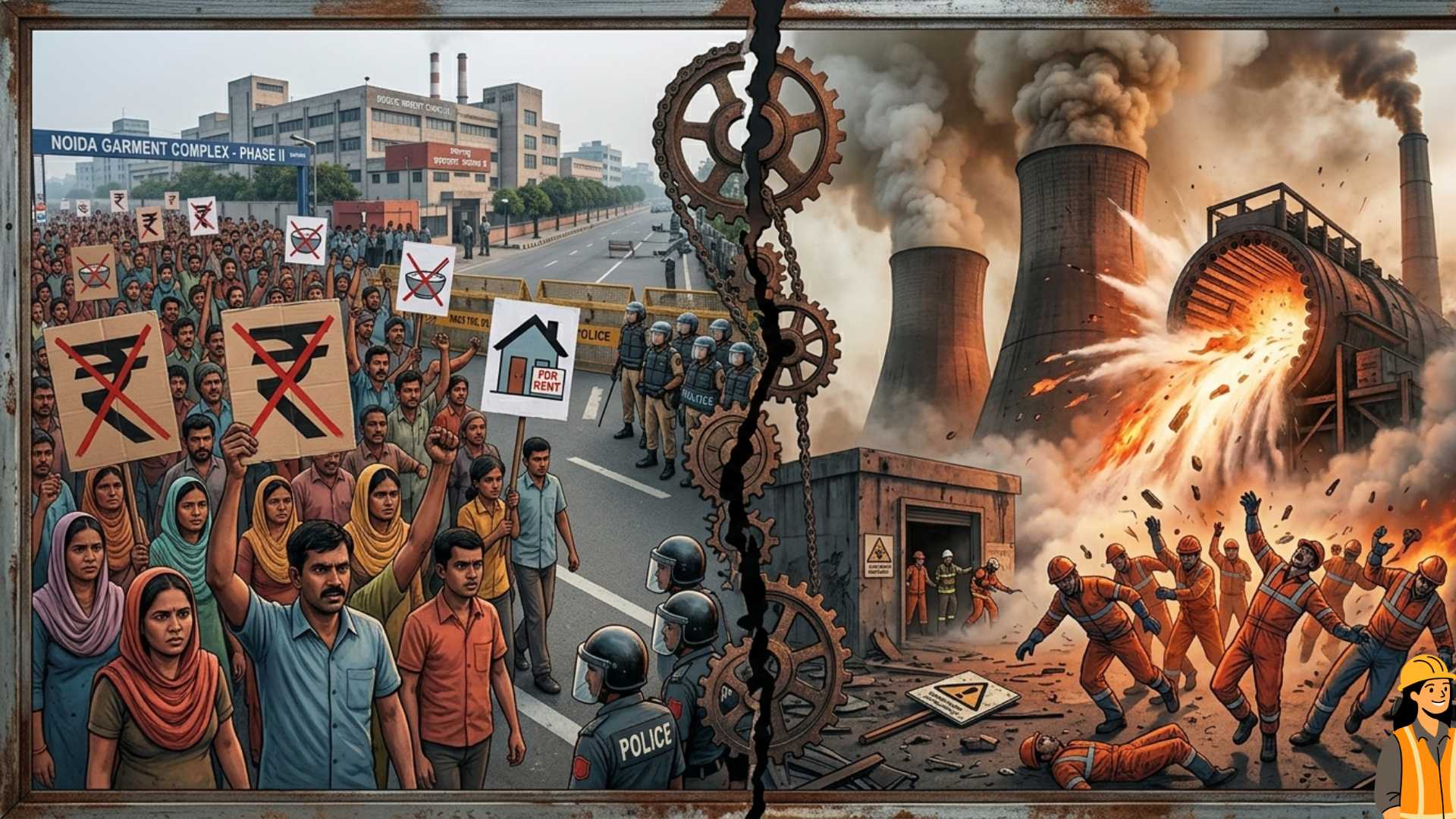
Labour Reforms in India: Between Rationalisation and Regression

1. Context
Two events in April 2026 diagnosed the state of Indian labour more sharply than any official review:
- April 10: Thousands of garment workers at Noida's Hosiery Complex walked out of nearly 300 factories demanding ₹20,000 minimum monthly wage. By April 13, over 1,200 security personnel had been deployed; lathi charges followed and nearly 400 workers were detained.
- April 14: A high-pressure steam tube ruptured at Vedanta's Singhitarai thermal plant in Chhattisgarh, killing 20 workers and injuring 15 — all contract workers, none direct employees.
One protest was about the price of labour. The other, about the price of being alive while performing it. Both answer the same question: what has India's labour reform actually produced?
2. Key Issues
(A) Wage Inequality
- Haryana notified a 35% hike — unskilled wages raised to ₹15,220/month from April 1, 2026
- Across the border in Noida, identical work fetched ₹435/day vs ₹585/day in Haryana
- UP offered an interim 21% hike — ₹13,690 for unskilled, ₹16,868 for skilled — workers rejected it
- The gap between ₹16,868 and ₹20,000 is not a bargaining position — it is the distance between what a family pays for rent, gas, and school fees in the NCR and what the state is willing to call a dignified minimum
- Core failure: Minimum wage has never caught up with living wage; inflation has done the rest
(B) Occupational Safety Crisis
- 3,331 factory deaths between 2018–2020 — three every day — yet only 14 imprisonments under the Factories Act in the same period
- Chhattisgarh alone recorded 296 industrial deaths over three years
- IndustriALL counted 400+ workplace fatalities in India in 2024; chemical sector alone: 220
- Sigachi Industries, Telangana (July 2025): 44 killed — mostly migrant workers — at a plant the state fire department found had no fire alarms or heat sensors
- Singhitarai preliminary report attributed the explosion to "repeated negligence in equipment upkeep" — an FIR has been registered against Vedanta's Chairman Anil Agarwal and others under the Bharatiya Nyaya Sanhita
- Core failure: Enforcement was broken before the codes arrived; the codes have made it structurally weaker
(C) Informalisation and Contractualisation
- At Singhitarai, the 20 dead worked for subcontractor NGSL — not Vedanta directly
- At Sigachi, the 44 dead were migrant contract workers
- At Noida, workers from different companies assembled together because no single employer was accountable
- NITI Aayog estimates 7.7 million platform workers in 2020 — projected to reach 23.5 million by 2030
- The words 'gig' and 'platform' do not appear once in the Industrial Relations Code 2020
- Core failure: Contractualisation is not a loophole — it is the operating architecture of liability avoidance
3. Labour Codes 2020 — Overview
India replaced 29 central labour laws with 4 codes, which came into force on November 21, 2025 — without any transition period and without convening the Indian Labour Conference (apex tripartite forum, last met in 2015):
- Code on Wages
- Industrial Relations Code
- Social Security Code
- Occupational Safety, Health and Working Conditions (OSHWC) Code
4. Critical Analysis
(A) Pro-Employer Tilt
- Retrenchment permission threshold raised from 100 to 300 workers — restoring the pre-1982 position, reversing an Emergency-era protection enacted after mass layoffs affected over half a million workers
- An estimated majority of India's factory units fall below 300 workers — they can now retrench without any administrative scrutiny
(B) Reduced Safety Coverage
- Factory definition raised from 10 to 20 workers (with power) and 20 to 40 (without power)
- This removes an entire tier of textile, garment, hosiery, metal, and food-processing units — where India's actual manufacturing employment is concentrated — from mandatory safety oversight
- Most small manufacturing units employ fewer than 20 workers; the reclassification is not a technical adjustment — it is a coverage exclusion
(C) Inspection Became Facilitation
- Unannounced inspections replaced by Inspector-cum-Facilitator model with randomised web-based allocation via Shram Suvidha portal and employer self-certification
- The ILO's India Labour Inspection Profile notes this may contravene ILO Convention No. 81, which mandates independent, unannounced inspections
- When inspection is announced in advance and compliance is self-reported, Singhitarai is not an accident — it is a forecast
(D) Collective Action Strangled
- 60-day strike notice mandatory — four times the 15-day requirement of the 1929 Trade Disputes Act, the bill Motilal Nehru had already called the "Slavery of India Bill"
- Strikes banned during conciliation proceedings, for 7 days after, during Tribunal proceedings, and for 60 days after those conclude
- Mass casual leave by more than 50% of workforce now legally deemed a strike
- Between notice periods and cooling-off clauses, an employer can keep a workforce in procedural suspension without end
- Ten central trade unions observed a "Black Day" on November 26, 2025 — calling the codes a "deceptive fraud on the working class"
5. The Structural Problem
Reform that raises statutory thresholds in almost every operative clause is not rationalising protection — it is removing it. The codes answered a genuine need — consolidating 29 laws built for jute mills and railway workshops into a framework fit for the 21st century — with the wrong instrument. Every threshold raised, every inspection softened, every strike procedurally strangled. When a framework moves consistently in one direction, it is not balance. It is a position.
6. Constitutional and Institutional Anchors
- Article 21 — Right to life extends to safe and dignified working conditions
- Article 23 — Prohibition of forced labour; contractualisation that traps workers in precarity tests this boundary
- Article 39 (DPSP) — State shall secure adequate means of livelihood for all workers
- Article 42 (DPSP) — Just and humane conditions of work and maternity relief
- Article 43 (DPSP) — Living wage, not merely minimum wage, as the constitutional aspiration
- ILO Convention No. 81 — Independent, unannounced factory inspections; potentially contravened by current inspection model
Attribution
Original content sources and authors


Syllabus classification
How this article maps to GS papers
Main syllabus
GS3Jobs & Inclusive GrowthQuick Q&A
What do the recent incidents in Noida and Singhitarai reveal about the current state of labour conditions in India?
On the other hand, the Singhitarai thermal plant accident exposes severe occupational safety failures. The death of 20 contract workers due to a boiler explosion caused by negligence in maintenance underscores systemic issues such as outsourcing of labour, weak enforcement of safety norms, and inadequate accountability mechanisms. Notably, most victims were not direct employees but subcontracted workers, reflecting the precarious nature of modern labour arrangements.
Taken together, these incidents illustrate a dual crisis:
- Economic vulnerability due to stagnant or insufficient wages
- Physical insecurity due to unsafe working conditions
Why is the distinction between minimum wage and living wage important in the context of the Noida labour unrest?
In the Noida case, even after a 21% wage hike, workers rejected the revised wage of ₹13,690 because it fell short of meeting basic living expenses in the NCR. The demand for ₹20,000 was not arbitrary but rooted in real consumption needs in an urban economy marked by inflation and rising costs. This highlights that statutory wages often lag behind market realities, especially in rapidly urbanizing regions.
The implications are significant:
- Social unrest: Persistent wage inadequacy leads to strikes and protests
- Labour productivity: Poor wages can reduce worker motivation and efficiency
- Economic inequality: A gap between wages and living costs exacerbates inequality
How have the new labour codes altered the regulatory framework for worker protection in India?
For instance, the Industrial Relations Code raised the threshold for requiring government approval for layoffs and retrenchment from 100 to 300 workers. This effectively allows a majority of firms—since most employ fewer than 300 workers—to downsize without prior scrutiny. Similarly, the OSHWC Code increased the definition threshold of factories, excluding smaller establishments from mandatory safety regulations.
Another major shift is in inspection mechanisms. The traditional system of unannounced inspections has been replaced by an Inspector-cum-Facilitator model, relying on randomized digital allocation and self-certification by employers. Key consequences include:
- Reduced regulatory oversight in small and medium enterprises
- Increased reliance on employer compliance
- Potential weakening of enforcement of safety and labour standards
Critically analyze whether the new labour codes represent rationalization or dilution of labour protections in India.
However, a closer examination suggests elements of systematic dilution. The raising of thresholds for layoffs and factory definitions effectively removes a large segment of workers from regulatory protection. Similarly, restrictions on strikes—such as mandatory 60-day notice and prohibition during conciliation—limit collective bargaining power. These changes tilt the balance in favor of employers.
Critical concerns include:
- Exclusion effect: Smaller units escape safety and labour regulations
- Weak enforcement: Self-certification reduces accountability
- Labour disempowerment: Procedural barriers to strikes weaken unions
What real-world examples illustrate the consequences of weak labour protections in India?
Another notable case is the Sigachi Industries explosion in Telangana (2025), where 44 workers—mostly migrants—lost their lives. The plant reportedly lacked basic fire safety infrastructure such as alarms and heat sensors. These incidents reflect a pattern where cost-cutting measures and weak inspections compromise worker safety.
Broader data reinforces this trend. According to official statistics, India recorded over 3,300 factory deaths between 2018 and 2020, yet only a handful of convictions occurred under the Factories Act. This indicates:
- Poor enforcement of existing laws
- Low deterrence due to minimal penalties
- Vulnerability of contract and migrant workers
As a policymaker, how would you address the dual challenges of wage adequacy and workplace safety highlighted in the article?
Second, on workplace safety, there is a need to restore robust inspection mechanisms. While digital tools can improve transparency, they should complement—not replace—unannounced physical inspections. The coverage of the OSHWC Code should be expanded to include smaller enterprises, where risks are often higher. Strict penalties and fast-track courts for industrial accidents can enhance accountability.
Additional reforms could include:
- Formalization of contract labour: Ensuring equal safety and wage standards for subcontracted workers
- Capacity building: Training workers and employers on safety protocols
- Tripartite dialogue: Reviving forums like the Indian Labour Conference for consensus-based policymaking
Practice questions
1 question for mains preparation