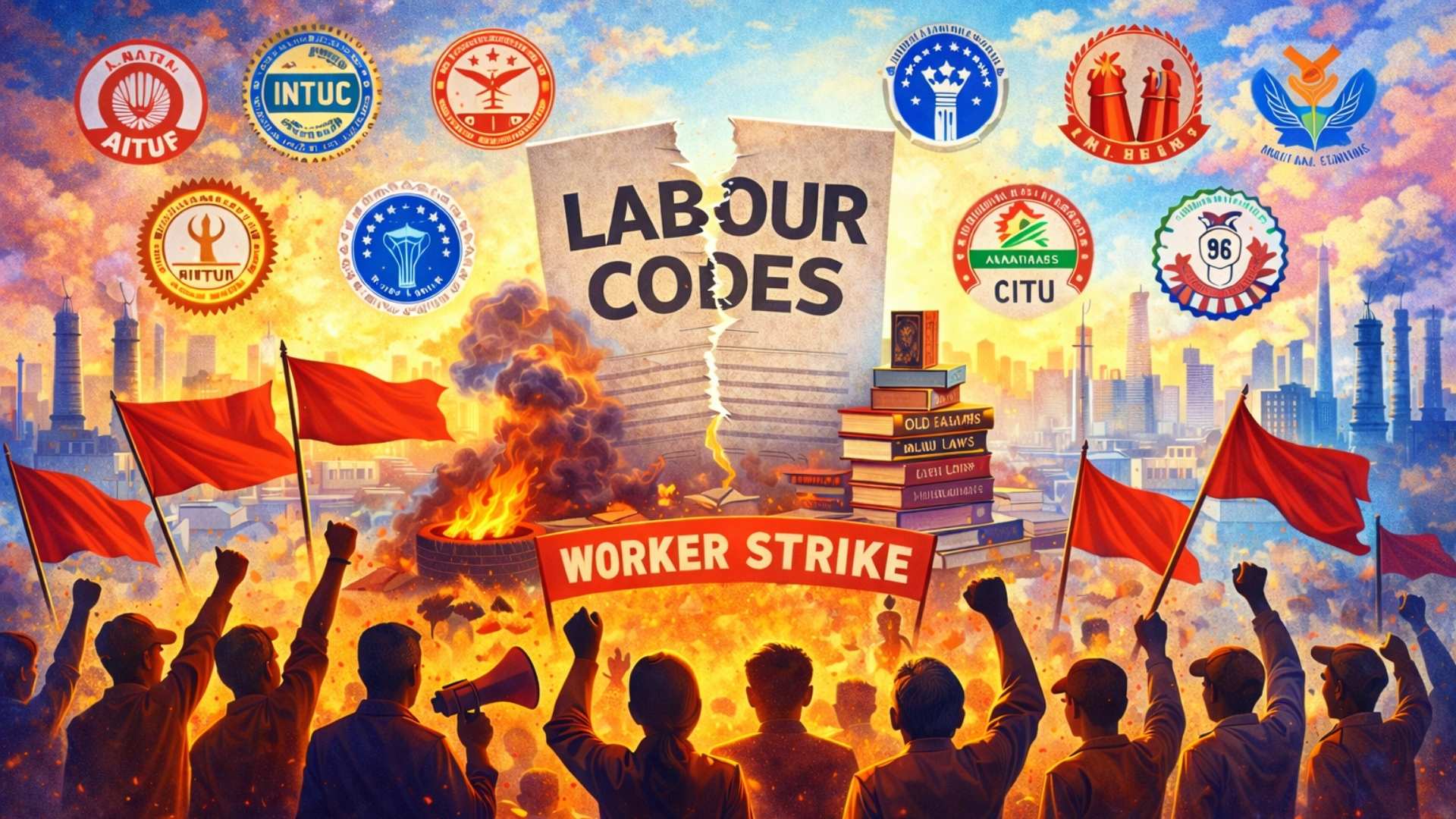
1. Context: Trade Union Strike and Opposition to Labour Codes
Ten central trade unions have jointly called for a one-day nationwide strike, demanding the repeal of the four Labour Codes and restoration of the earlier framework of 29 labour laws. This collective action signals organised labour’s resistance to recent labour reforms undertaken by the Union government.
The unions’ opposition, however, is broad-based and non-specific. Rather than identifying particular clauses or provisions for amendment, the demand is for complete repeal, limiting the scope for constructive dialogue or evidence-based policy correction.
This approach matters because labour reforms directly affect employment generation, industrial relations, and formalisation of the workforce. Blanket opposition without specificity weakens institutional consultation mechanisms and delays reform outcomes.
“Reform is not an event but a process.” — World Bank
2. Composition and Breadth of the Protest Platform
The Joint Platform of Central Trade Unions has extended its protest beyond labour Codes to include issues such as FDI in insurance, education policy, nuclear power legislation, pollution, and regional environmental concerns. Sectoral bodies like electricity employees’ associations have also joined.
Notably, except for the Bharatiya Mazdoor Sangh, most major unions—including INTUC and AICCTU—are part of the strike. Even the Samyukt Kisan Morcha has joined, despite labour laws largely excluding agriculture.
This breadth dilutes the core labour reform debate and blurs issue-specific accountability. When multiple unrelated grievances are combined, policy focus and reform sequencing become harder to achieve.
3. Core Criticism: Hiring and Retrenchment Thresholds
A major criticism relates to the increase in the threshold for requiring government permission for retrenchment, closure, or layoffs—from 100 workers to 300 workers. Critics argue this weakens worker protection.
The counter-argument is that such permissions distort employer–employee relationships by treating them as state-mediated contracts rather than workplace arrangements. Retaining less productive workers can disrupt production efficiency and harm overall outcomes.
Rather than adjusting numerical thresholds, an alternative approach is to remove permission requirements altogether and shift protection towards unemployment insurance.
“Labour is not a commodity.” — ILO Declaration of Philadelphia, 1944
4. Codification of 29 Laws into Four Codes: Power Concerns
Another criticism is that consolidating 29 labour laws into four Codes concentrates power in the executive, as rules framed under Codes are easier to amend than parliamentary statutes.
While it is true that rules shape implementation, they remain legally subordinate to the parent law and cannot override statutory intent. At the same time, administering 29 separate laws imposes high compliance costs and regulatory fragmentation.
Simplification is therefore unavoidable, though the current Codes themselves remain complex and require further rationalisation rather than repeal.
5. Industrial Relations and Union Recognition Provisions
The new Codes prioritise engagement with the largest recognised union instead of mandating negotiations with multiple unions. This aims to streamline collective bargaining and reduce coordination failures.
Multiple-union negotiations often delay dispute resolution, raise transaction costs, and increase the role of intermediaries. Single-union engagement improves accountability and decision-making efficiency.
Resistance arises because such provisions reduce the bargaining leverage of unions with limited representation.
6. Other Criticisms Raised Against Labour Codes
Beyond retrenchment and union recognition, critics point to concerns such as reduced strike flexibility, stricter union registration norms, and limited consultation during formulation.
However, unions have not demanded selective modification of these provisions, opting instead for wholesale rejection of the Codes. This all-or-nothing stance limits opportunities for incremental correction.
Frequently cited concerns include:
- Reduced ability to call strikes
- Greater government oversight in union affairs
- Alleged non-alignment with certain ILO conventions
7. Labour Codes and Economic Transformation
The article situates labour reform within the context of technological disruption and changing work patterns. Automation, platform work, and flexible employment require adaptive regulatory frameworks.
Rigid labour laws can inhibit formal job creation and delay transitions from informal to formal employment. Flexible frameworks, combined with social security, can improve workforce resilience.
“The future of work is being shaped by technology, demography and globalisation.” — ILO
8. Role and Structure of Trade Unions
The article critiques the internal functioning of trade unions, noting leadership concentration among long-serving, often retired individuals. This raises concerns about representativeness and responsiveness to current worker needs.
Unions are portrayed as organisationally stagnant, focusing on preserving influence rather than adapting to evolving labour markets.
Such institutional inertia weakens unions’ capacity to negotiate reforms that balance worker welfare with economic competitiveness.
9. Way Forward: Reforming Labour Codes and Union Ecosystem
Rather than repealing the Codes, the article advocates further simplification through an empowered commission. This includes easing rules on overtime, work allocation, and workplace safety costs, especially for women.
Simultaneously, a comprehensive overhaul of trade union functioning is proposed, including internal democracy, leadership tenure limits, and potential public funding aligned with reform objectives.
Suggested reforms include:
- Further simplification of the four Labour Codes
- Introduction of unemployment insurance
- Internal democracy and tenure limits in unions
- Reorientation of unions towards skilling and formalisation
“In the long run, we are all dead.” — John Maynard Keynes
Conclusion
The debate over India’s Labour Codes reflects deeper tensions between economic reform and institutional adaptation. Repealing the Codes risks restoring regulatory fragmentation, while ignoring the need for union reform sustains outdated labour representation. A calibrated approach—simplifying labour laws further while modernising trade unions—is essential for improving productivity, accelerating formalisation, and supporting India’s long-term economic competitiveness.