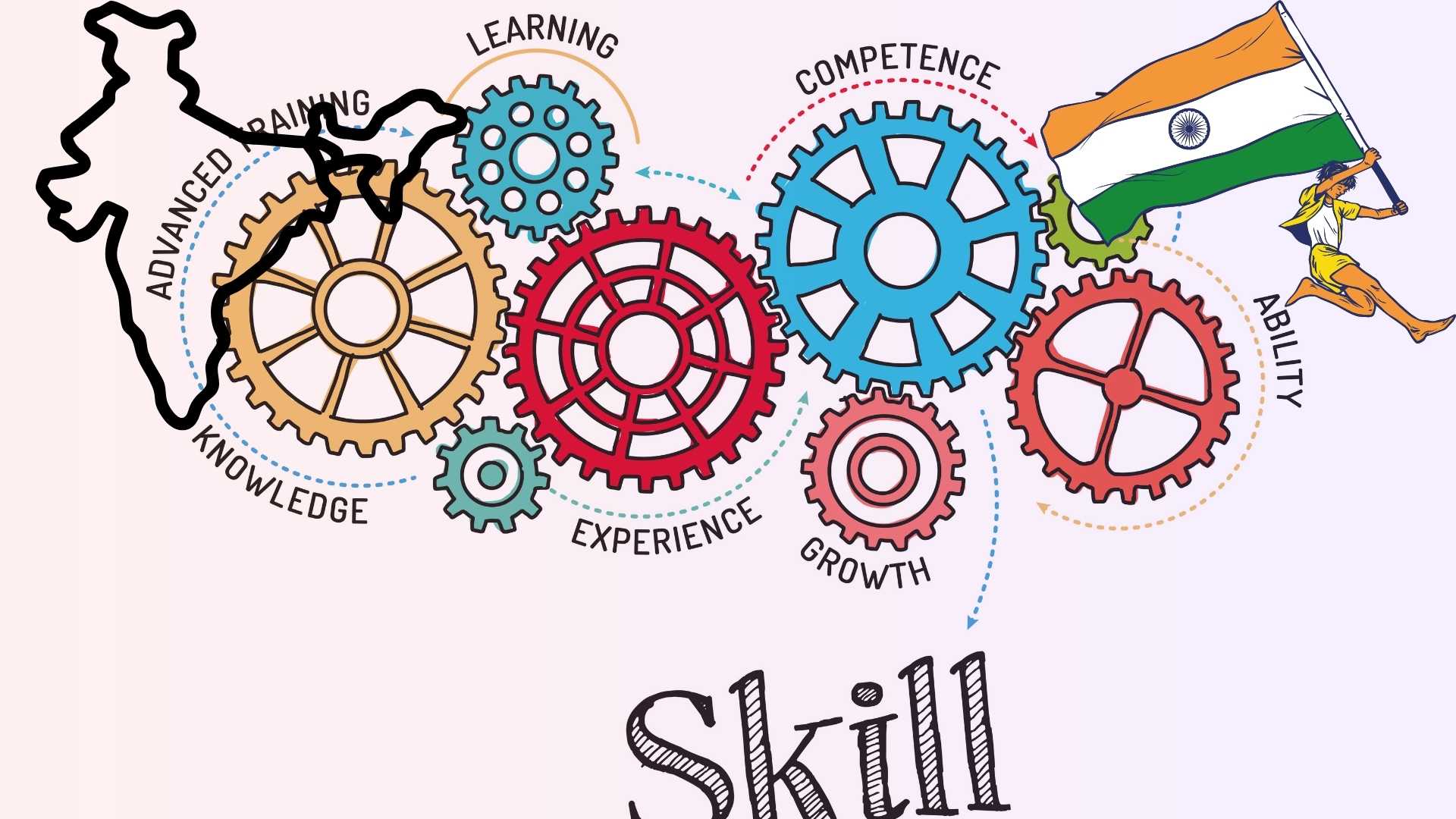
1. Demographic Dividend and the Structural Weakness of India’s Skill Ecosystem
India’s demographic dividend, expected to last until 2040, represents a narrow but historic opportunity for economic transformation. A young workforce can accelerate growth, improve productivity, and enhance global competitiveness—provided it is adequately skilled. However, this window is time-bound and irreversible.
Globally, countries such as China and members of the European Union have institutionalised vocational education. Around 50% of secondary-level students in these countries are enrolled in vocational streams. In contrast, India’s share is just 1.3%, reflecting decades of neglect in school and vocational education—schooling reforms gained traction only after 1990, and vocational education after 2006.
India’s National Education Policy (NEP) 2020 set a target that 50% of learners will be exposed to vocational education by 2025. However, the term “exposed” indicates limited integration rather than full mainstreaming. This reflects deeper attitudinal and systemic challenges in treating vocational education as secondary to academic degrees.
The demographic dividend can convert into a demographic burden if employability gaps persist. Without structural reforms in vocational education, India risks high youth unemployment, skill mismatches, and underutilised human capital.
Key Data
-
Demographic dividend window: till 2040
-
Vocational enrolment:
- EU/China: ~50%
- India: 1.3%
-
NEP 2020 target: 50% exposure to vocational education by 2025
GS Linkages
- GS2: Education policy, human resource development
- GS3: Employment, economic growth, demographic dividend
- Essay: “Education as an instrument of social and economic transformation”
2. Financing Gaps and Policy Inconsistencies in Skill Development
Globally, vocational education receives around 2% of education budgets, while in countries like China and Germany, it is nearly 11%. India lacks publicly consolidated data on vocational financing due to fragmented schemes across ministries, indicating weak institutional coordination.
India’s approach remains budget-announcement driven. Schemes are frequently launched but often underperform in implementation. For instance, the FY2026 internship scheme reportedly utilised only 5% of allocated funds, indicating design and execution weaknesses.
The absence of stable, predictable funding mechanisms creates discontinuity in training delivery, undermines industry confidence, and weakens institutional capacity. Skill development remains supply-driven and state-financed, rather than demand-responsive and industry-aligned.
Inconsistent financing leads to fragmented outcomes. Without stable and accountable funding frameworks, long-term institutional credibility and private sector participation remain limited, weakening employability gains.
Comparative Perspective
- China & Germany: ~11% of education budget to vocational education
- Global average: ~2%
- India: No consolidated public data
Implications
- Weak accountability
- Limited industry ownership
- Policy volatility
- Reduced return on public investment
3. Governance Failures: Insights from CAG Audits
The Comptroller and Auditor General (CAG) audited the flagship Pradhan Mantri Kaushal Vikas Yojana (PMKVY) for 2015–22. Earlier audits (2015) flagged issues of delayed financial reporting and unclear accountability.
The 2025 CAG report revealed serious irregularities:
- 94.5% of bank accounts were invalid
- Only 41% of short-term trainees achieved placement
Over a decade, the ecosystem has prioritised training numbers rather than employment outcomes. The initial vision of creating a vibrant public-private skill market has diluted into a quantity-driven, compliance-oriented framework.
Governance deficits reduce public trust and dilute the economic impact of skill programmes. Without accountability and outcome-based monitoring, financial allocations fail to translate into employability gains.
Key Concerns Raised by CAG
- Financial impropriety
- Weak monitoring systems
- Poor placement outcomes
- Ineffective oversight mechanisms
GS Linkages
- GS2: Accountability institutions (CAG)
- GS3: Employment generation, skill mismatch
4. Skill Loans: Shifting from Supply-Driven to Demand-Driven Financing
A proposed reform is to convert annual PMKVY expenditure—estimated at over ₹10,000 crore annually—into skill loans for students instead of direct operational funding to institutions.
Under this model:
- Funds follow the student, not the institution
- Institutions compete on quality and placement outcomes
- Demand-driven skill development is incentivised
This approach mirrors educational loan frameworks and could involve banks and non-banking financial companies (NBFCs). The risk of non-performing assets (NPAs) exists but is manageable through existing financial tools.
Currently, the National Skill Development Corporation (NSDC), initially conceived as a financing entity, has evolved into a scheme-implementing body, diluting its original market-oriented role.
When purchasing power shifts to learners, market discipline improves. Institutions must align training quality with labour market outcomes, thereby increasing accountability and efficiency.
Potential Advantages
- Increased student choice
- Improved institutional quality
- Greater accountability
- Reduced bureaucratic discretion
5. Skill Vouchers: Promoting Flexibility and Lifelong Learning
Skill vouchers allocate public funds directly to individuals, allowing them to choose accredited training providers. Unlike institution-based funding, vouchers incentivise outcomes and competition.
Countries such as Singapore and Croatia have successfully implemented voucher-based systems. These models encourage lifelong learning and targeted upskilling, especially relevant in the context of AI-driven transitions, digitalisation, and green skills.
Vouchers can also:
- Promote women’s workforce participation
- Enable foreign language learning for global labour markets
- Encourage school leavers to pursue vocational tracks instead of defaulting to degrees
Voucher-based financing aligns with NEP’s emphasis on lifelong learning. By empowering learners, the system shifts from bureaucratic allocation to market-based accountability.
Advantages
- Trainee-centric financing
- Increased competition
- Better alignment with industry demand
- Adaptability to emerging sectors (AI, digital, green skills)
Policy Relevance
- Supports NEP 2020 goals
- Enhances labour market mobility
- Reduces tertiary enrolment inflation
6. Skill Levies and Reimbursable Industry Contribution (RIC)
Skill levies are used in over 90 countries worldwide. These involve mandatory contributions from organised industry, often linked to payroll or firm size, which are reimbursed when firms conduct certified training.
The proposed Reimbursable Industry Contribution (RIC) model aims to:
- Ensure stable, non-budgetary funding
- Increase employer ownership of training
- Insulate skill financing from political cycles
Countries across Latin America, Germany, Singapore, South Africa, and South Korea have institutionalised such systems.
India’s current system reflects employer engagement but not employer ownership. A levy-based approach can deepen industry participation and reduce fiscal volatility.
Stable financing anchored in industry participation enhances sustainability and responsiveness. Without employer ownership, skill systems risk remaining misaligned with labour market needs.
Benefits of Skill Levies
- Sustainable funding
- Industry accountability
- Reduced fiscal burden
- Improved alignment with employment demand
7. Labour Market Information Systems (LMIS) and Real-Time Data
Effective skill planning requires real-time labour market data. Periodic skill-gap studies are insufficient in a dynamic economy shaped by technological disruption.
The article proposes mandating online job boards to share anonymised aggregate data to help build a functional Labour Market Information System (LMIS). Data mining and AI modelling can provide predictive insights.
The National Career Service (NCS) portal could act as a public repository of aggregated data. India’s earlier attempts to build an LMIS have not materialised effectively.
Without accurate labour demand signals, training programmes risk producing unemployable graduates. Real-time data ensures alignment between skills supply and market needs.
Reform Measures
- Mandatory anonymised data sharing
- AI-based labour demand modelling
- Public access via NCS portal
- Continuous monitoring instead of one-off studies
8. Conclusion
India’s demographic dividend offers a limited-time structural opportunity. However, fragmented financing, governance lapses, weak industry ownership, and poor labour market intelligence constrain outcomes.
Reforms such as skill loans, vouchers, industry levies, and real-time labour market data systems can shift India from a supply-driven, state-funded model to a demand-responsive, industry-owned ecosystem.
A calibrated course correction before 2040 can transform skill development into a pillar of economic competitiveness, employment generation, and inclusive growth.