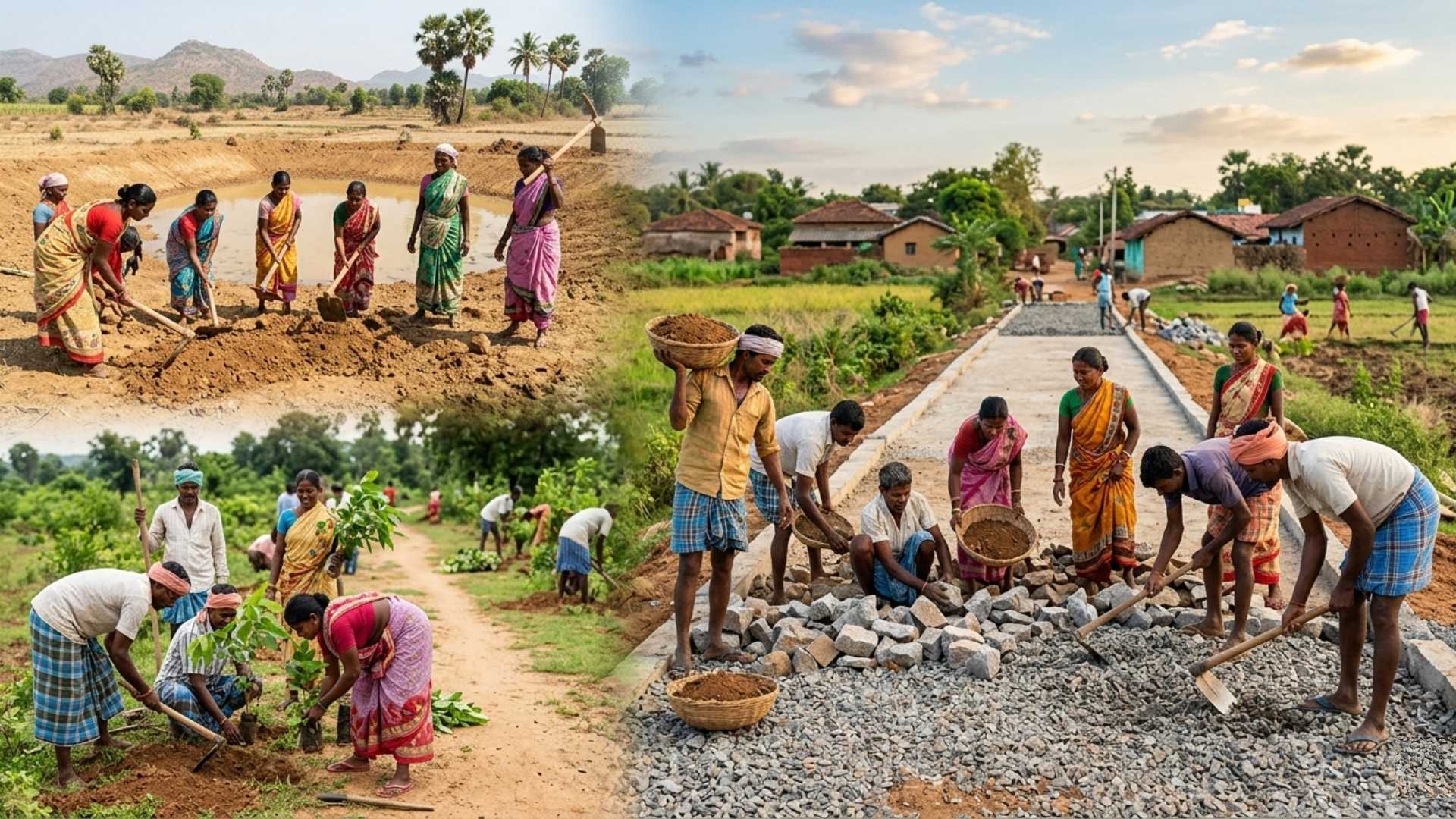
24 States and U.T.s Allocate Funds for New Rural Jobs Scheme

Despite the Centre's inaction, 24 states earmark funds for rural employment, using past MGNREGA expenditures as a baseline amidst financial concerns.
G
Gopi
3 mins read
Rural jobs scheme expands, but funding formula uncertainty persists

INTRODUCTION

  • Rural employment remains central to India’s social protection architecture, with MGNREGA generating over 300 crore person-days annually in recent years.
  • The Viksit Bharat Guarantee for Rozgar and Ajeevika Mission (Gramin) Act, 2025 seeks to expand this framework by increasing guaranteed workdays from 100 to 125 days.
  • With the Centre allocating ₹95,652 crore (2026–27) and States bearing 40% of the cost, fiscal federalism concerns have emerged.
  • Notably, over ₹31,000 crore has already been earmarked by 24+ States/UTs, even as the Centre’s allocation formula remains pending.

BACKGROUND AND CONTEXT

  • The new Act builds upon MGNREGA, aiming to strengthen rural livelihoods and consumption demand.
  • It introduces an expanded employment guarantee alongside a revised cost-sharing model.
  • However, delay in notifying the “normative allocation formula” has created uncertainty in fiscal planning.

KEY FEATURES OF THE ACT

FeatureDetails
Employment GuaranteeIncreased from 100 to 125 days
Cost Sharing60:40 (Centre:State); relaxed for NE, hilly States, J&K
Allocation MechanismAnnual State-wise allocation based on “objective parameters”
FocusRural employment, livelihood security, inclusive growth

NORMATIVE ALLOCATION: CONCEPT AND SIGNIFICANCE

Definition

  • Allocation of funds based on objective, measurable indicators such as poverty, population, and demand for work.

Rationale

  • Ensures equity across States, especially for economically weaker regions.
  • Addresses concerns that poorer States receive lower per capita funding.

Legal Mandate

  • Section 4(5) requires annual determination of State-wise allocations by the Centre.

CURRENT DEVELOPMENTS

State Preparedness

  • 27 States/UTs making budgetary provisions; 24 States have disclosed allocations (~₹31,000 crore).
  • States using MGNREGA expenditure as baseline due to lack of clarity.

Illustrative Example: Rajasthan

  • MGNREGA expenditure: ₹7,597 crore
  • Estimated 40% share: ~₹3,038 crore
  • Budgeted: ₹4,000 crore (accounting for uncertainty and expanded workdays)

Outliers

  • Karnataka identified as a major exception in allocation preparedness.

FISCAL FEDERALISM DIMENSIONS

Increased State Burden

  • States must finance 40% of expenditure, raising concerns for fiscally stressed States.

Vertical Imbalance

  • Centre controls revenue sources, while States bear significant implementation costs.

Horizontal Imbalance

  • Without a clear formula, poorer States risk under-allocation.

Political Economy

  • Divergence in State responses reflects Centre-State political dynamics.

CHALLENGES AND CONCERNS

Absence of Allocation Formula

  • Creates uncertainty in budgeting and implementation.

Fiscal Stress on States

  • States with high debt may struggle to mobilize additional resources.

Implementation Risks

  • Delays in fund flow may affect timely wage payments and employment generation.

Equity Concerns

  • Risk of uneven distribution without objective criteria.

COMPARISON: MGNREGA VS NEW ACT

AspectMGNREGANew Act (2025)
Workdays100 days125 days
Cost SharingMostly Centre-driven60:40 model (States bear more)
Allocation BasisDemand-drivenNormative + objective parameters
Fiscal BurdenLower on StatesHigher on States

EXPERT INSIGHT

  • The Second Administrative Reforms Commission (ARC) emphasized that “fiscal transfers must be predictable and formula-based to ensure cooperative federalism.”
  • NITI Aayog has also highlighted the need for data-driven allocation mechanisms in welfare schemes.

IMPLICATIONS FOR GOVERNANCE AND ECONOMY

Positive

  • Strengthens rural safety nets and boosts consumption demand.
  • Enhances inclusive growth and poverty reduction.

Negative

  • May strain State finances, impacting other developmental expenditures.
  • Risks implementation inefficiencies without clear guidelines.

WAY FORWARD

Early Notification of Formula

  • Ensure transparency and predictability in allocations.

Balanced Cost Sharing

  • Consider greater central support for fiscally weaker States.

Data-Driven Governance

  • Use real-time labour demand, poverty indices, and migration data.

Strengthening Federal Cooperation

  • Institutional dialogue through Inter-State Council/NITI Aayog.

CONCLUSION

  • The new rural employment law represents a significant expansion of India’s welfare architecture, but its success hinges on clarity in fiscal design and cooperative federalism.
  • A transparent, equitable allocation formula will be crucial to balancing State capacity with national development goals, ensuring that expanded guarantees translate into real livelihood security.

UPSC MAINS QUESTION (250 WORDS)

  • “The effectiveness of rural employment guarantee programmes depends not only on design but also on fiscal federalism arrangements.” Discuss in the context of the Viksit Bharat Rozgar Act, 2025.

Quick Q&A

Everything you need to know

The Viksit Bharat Guarantee for Rozgar and Ajeevika Mission (Gramin) Act, 2025 is a rural employment initiative aimed at strengthening livelihood security by expanding the scope and scale of wage employment in rural areas. It builds upon the framework of MGNREGA but introduces key modifications such as increasing the guaranteed employment from 100 days to 125 days and restructuring financial responsibilities between the Centre and States.

Key differences from MGNREGA include:

  • Enhanced employment guarantee: 125 days compared to 100 days under MGNREGA.
  • Cost-sharing model: States are required to bear 40% of expenditure, unlike MGNREGA where the Centre bore a larger share.
  • Normative allocation mechanism: A new system based on objective parameters to determine State-wise fund distribution.

This shift reflects an attempt to make States more accountable and involved in rural employment generation. However, it also raises concerns about fiscal capacity, especially for economically weaker States.

In essence, the Act represents a transition from a centrally driven welfare scheme to a more cooperative federal model, aiming to balance fiscal responsibility with developmental needs.

The normative allocation formula is crucial because it determines how funds are distributed among States based on objective and equitable criteria. Section 4(5) of the Act mandates this approach to address long-standing concerns that poorer States receive disproportionately lower funding despite having greater needs.

Its significance lies in:

  • Equity: Ensures that backward regions receive adequate resources based on need rather than historical expenditure.
  • Transparency: Reduces arbitrariness in fund allocation, thereby improving trust between Centre and States.
  • Efficiency: Encourages better targeting of resources to areas with higher unemployment or poverty levels.

For example, under MGNREGA, States with better administrative capacity often utilized more funds, leading to higher allocations in subsequent years. This created a vicious cycle of inequality. The new formula seeks to break this pattern.

However, the delay in notifying the formula has created uncertainty, forcing States to rely on past expenditure as a proxy. This undermines the intended reform and highlights the importance of timely policy clarity in strengthening cooperative federalism.

Despite the absence of a clear normative allocation formula, many States have proactively earmarked funds for the scheme, demonstrating administrative preparedness and political commitment. As per the data, at least 24 States and Union Territories have allocated over ₹31,000 crore collectively.

States are adopting pragmatic strategies such as:

  • Using MGNREGA expenditure as a baseline: Past spending patterns are being used to estimate future requirements.
  • Accounting for additional workdays: States are factoring in the increase from 100 to 125 days.
  • Creating financial buffers: Allocations are often higher than calculated shares to accommodate uncertainty.

For instance, Rajasthan, which spent ₹7,597 crore under MGNREGA, has allocated ₹4,000 crore under the new scheme—higher than its estimated 40% share—to manage uncertainties.

This approach reflects both fiscal prudence and risk management. However, it may strain State finances, particularly in fiscally weaker regions. The situation underscores the need for timely Central guidance to ensure uniform implementation and avoid inefficiencies.

The requirement for States to bear 40% of the scheme's expenditure marks a significant shift in India's fiscal federal structure. While it promotes shared responsibility, it also raises concerns about fiscal sustainability and equity among States.

Positive implications include:

  • Greater State ownership: Encourages States to design and implement context-specific employment strategies.
  • Improved accountability: Financial contribution may lead to better monitoring and reduced leakages.

However, challenges are substantial:
  • Fiscal stress: Poorer States may struggle to mobilize resources, leading to uneven implementation.
  • Regional disparities: Wealthier States may perform better, widening inter-State inequalities.
  • Political resistance: Opposition from States may affect cooperative federalism.

For example, while Himachal Pradesh has allocated funds despite opposition, Karnataka remains an outlier, reflecting varied State responses.

In conclusion, while the policy aims to strengthen federal cooperation, its success depends on balancing fiscal responsibility with adequate Central support and flexibility for weaker States.

In the absence of a notified normative allocation formula, States have turned to MGNREGA expenditure patterns as a practical reference point. This approach is driven by both administrative convenience and financial necessity.

Key reasons include:

  • Data availability: MGNREGA provides reliable historical data on labour demand and expenditure.
  • Continuity: The new scheme is structurally similar, making past trends relevant.
  • Risk mitigation: Using known figures reduces uncertainty in budget planning.

For example, Rajasthan calculated its expected share based on its ₹7,597 crore expenditure under MGNREGA and adjusted for the additional 25 workdays. This ensures a realistic estimation of future needs.

However, this method has limitations. It may perpetuate past inefficiencies and fail to address emerging needs or regional disparities. States with historically low utilization may continue to receive lower allocations, contrary to the objective of equitable distribution.

Thus, while the approach is pragmatic in the short term, it underscores the urgency of implementing a robust, data-driven allocation formula.

Rajasthan provides a useful case study to understand State-level planning under the new Act. The State has historically been one of the largest implementers of MGNREGA, with expenditure exceeding ₹7,597 crore in the current financial year.

Planning approach:

  • Baseline estimation: Rajasthan used its MGNREGA expenditure to estimate its financial obligation.
  • Adjustment for expanded scope: Factored in the increase to 125 days of guaranteed employment.
  • Buffer allocation: Allocated ₹4,000 crore, higher than its estimated 40% share of ₹3,038 crore.

This demonstrates a proactive and cautious fiscal strategy, accounting for uncertainties in Central allocations and potential increases in labour demand.

Key insights from the case:
  • States with strong administrative capacity are better positioned to adapt.
  • Financial buffers are essential in the absence of policy clarity.
  • Past experience with MGNREGA plays a crucial role in planning.

Overall, Rajasthan’s approach highlights both the opportunities and challenges of decentralized implementation, emphasizing the need for clear guidelines and robust Centre-State coordination.

Attribution

Original content sources and authors

Sign in to track your reading progress

Comments (0)

Please sign in to comment

No comments yet. Be the first to comment!