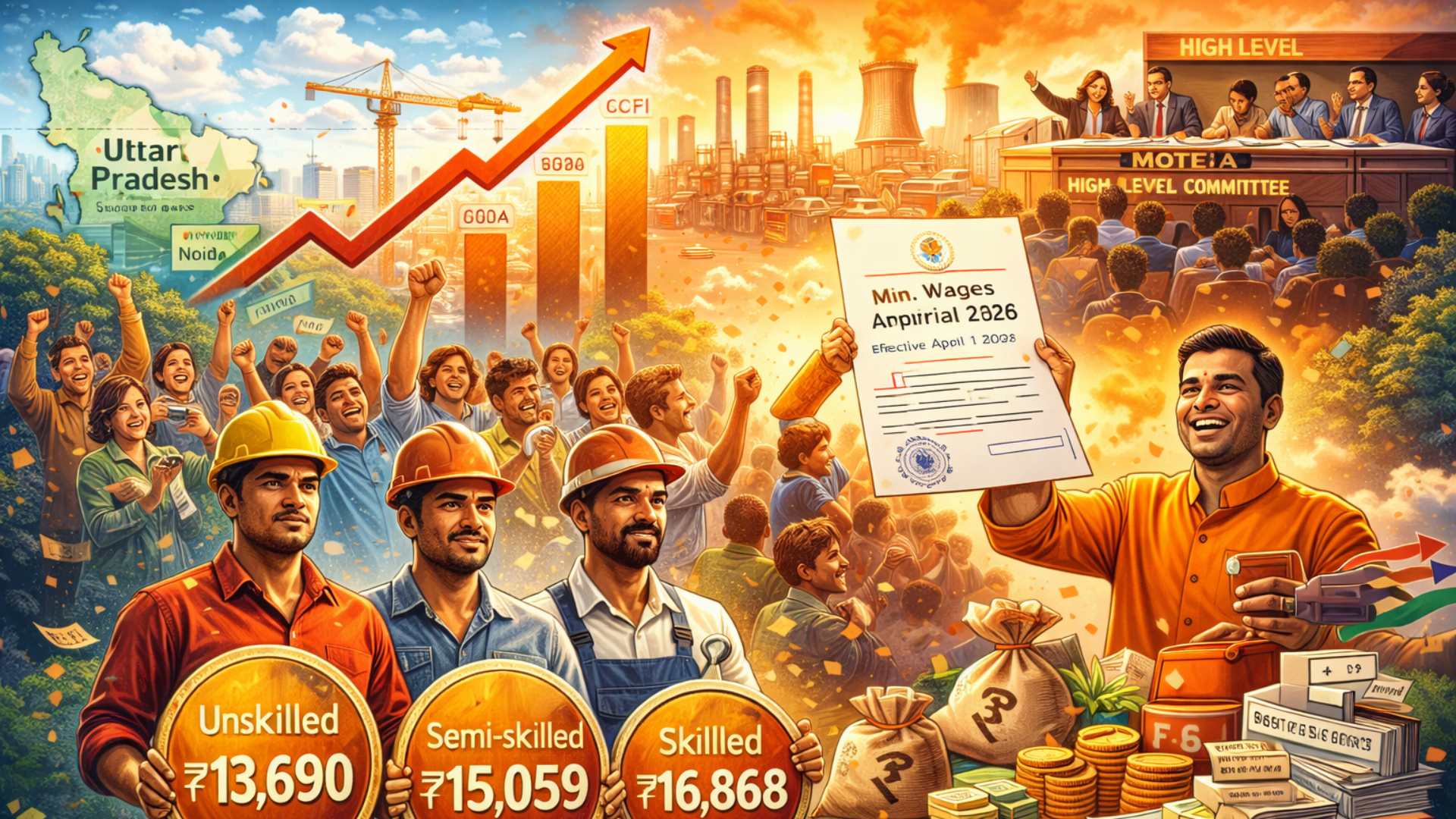
Decoding U.P.'s Minimum Wage Revision and Its Implications

"The present revision is aimed at responding to current economic realities while simultaneously rectifying a longstanding problem that occurred in previous years." — UP Government Notification, April 2026
India's minimum wage framework governs the earnings of an estimated 50 crore workers across formal and informal sectors. Yet the Noida industrial unrest of April 2026 — triggered partly by years of missed wage revisions — exposed a structural failure: minimum wages in India are revised reactively, in response to unrest, rather than proactively through robust institutional mechanisms. The UP government's interim notification, revising wages with retrospective effect from April 1, 2026, is both a partial remedy and a symptom of a deeper systemic problem.
| Indicator | Data |
|---|---|
| Legal basis | Minimum Wages Act, 1948 |
| Overarching framework | Code on Wages, 2019 |
| CPI index (previous base) | 216 |
| CPI index (2025 average) | 425 |
| CPI increase since last revision | ~97% |
| UP Category I unskilled wage (post-revision) | ₹13,690/month |
| UP Category I semi-skilled wage | ₹15,059/month |
| UP Category I skilled wage | ₹16,868/month |
| Revision due dates missed | 2019 and 2024 |
Background & Context
The Minimum Wages Act, 1948 requires periodic revision of minimum wages across scheduled employments, taking into account the All-India Consumer Price Index (CPI). The Variable Dearness Allowance (VDA) — a component of the wage structure — is directly linked to CPI fluctuations to protect real wages against inflation.
In practice, however, revision cycles are routinely missed. UP's 2026 notification acknowledges that revisions due in 2019 (based on 2017 CPI averages) and 2024 (based on 2023 CPI averages) were never carried out — allowing a near-doubling of the CPI to go uncompensated in workers' wages for nearly a decade.
Legal and Institutional Framework
Minimum Wages Act, 1948
Mandates wage floors for scheduled employments. State governments have power to fix and revise minimum wages for employments listed in the State schedule. Revision is to be carried out at intervals not exceeding five years.
Code on Wages, 2019
Consolidates four central wage laws — Minimum Wages Act, Payment of Wages Act, Payment of Bonus Act, and Equal Remuneration Act — into a single framework:
Code on Wages, 2019
        ↓
Allows States to fix differential minimum wages
→ By region (geographic variation)
→ By skill level (unskilled/semi-skilled/skilled)
→ By cost of living (category-wise)
        ↓
National Floor Wage — planned
→ Baseline below which no State can go
→ Key instrument for inter-State
  wage harmonisation
→ Not yet notified
        ↓
State rules under Code — pending in most States
→ UP interim notification is a stopgap
  pending permanent Code implementation
UP Wage Notification, 2026 — Structure and Features
Three-Tier Geographic Classification
| Category | Coverage | Rationale |
|---|---|---|
| Category I | Gautam Buddha Nagar, Ghaziabad | High industrial concentration, high cost of living |
| Category II | Municipal Corporation districts | Moderate urbanisation and living costs |
| Category III | Remaining districts | Lower cost of living, rural and semi-urban |
Wage Structure Logic
Total Minimum Wage
        =
Basic Wage
(corrects structural deficiency —
 addresses years of missed revision)
        +
Variable Dearness Allowance (VDA)
(linked to CPI — protects real wages
 against future inflation automatically)
        ↓
Two-component structure ensures:
Basic → historical correction
VDA  → forward-looking inflation protection
Why the Revision Was Overdue
Revision due 2019 → based on 2017 CPI average
→ MISSED
        ↓
Revision due 2024 → based on 2023 CPI average
→ MISSED
        ↓
CPI rose from 216 → 425 (nearly doubled)
        ↓
Wages remained frozen
→ Real wages collapsed silently over years
        ↓
Cost of living pressure accumulated
→ Noida protests — visible outcome
  of invisible wage erosion
Minimum Wage vs Living Wage
A critical distinction obscured in political discourse:
| Concept | Definition | Current Status in India |
|---|---|---|
| Minimum Wage | Statutory floor — bare subsistence | Legally mandated, inconsistently revised |
| Fair Wage | Above minimum — allows saving and participation in social life | No statutory recognition |
| Living Wage | Covers all basic needs with dignity — food, housing, healthcare, education | Constitutional aspiration, not yet operationalised |
The Supreme Court in Workmen vs Reptakos Brett (1992) identified five components of a living wage: food, clothing, housing, fuel and lighting, and education. India's minimum wages, even after revision, typically fall short of this standard.
Implications of the 2026 Revision
FOR WORKERS
→ Partial relief on cost-of-living pressure
→ Minimum wage ≠ living wage — gap persists
→ Informal sector workers may not benefit:
  weak enforcement, no written contracts
→ Retrospective effect from April 1, 2026
  — back wages theoretically owed

FOR EMPLOYERS
→ Rising labour costs → margin compression
→ Small and informal units most stressed
→ Risk of labour substitution with automation
→ Larger firms — cost absorbed more easily

FOR THE STATE
→ Enforcement challenge in informal sector
→ Interim notification — not a permanent fix
→ Wage Board constitution pending
→ State rules under Code on Wages not notified
→ Political economy: revision reactive,
  not institutionally driven
Structural Problems in India's Wage Architecture
1. Multiplicity and Fragmentation Before the Code on Wages, over 40 different minimum wage rates existed in some States — by sector, region, and skill — creating administrative complexity and enforcement gaps.
2. Revision Cycle Failures Statutory five-year revision cycles are routinely missed. Workers bear the entire cost of administrative delay through real wage erosion — with no automatic compensation mechanism.
3. Enforcement in Informal Sector The majority of minimum wage violations occur in the informal and contractual workforce — precisely where workers have least bargaining power and inspectors visit least frequently.
4. Absence of National Floor Wage Without a notified national floor wage, inter-State wage competition allows some States to maintain artificially low wages to attract investment — a race to the bottom that harms workers across the country.
5. Minimum vs Living Wage Gap Even revised minimum wages remain well below the living wage standard — providing subsistence but not dignity, leaving workers perpetually vulnerable to cost-of-living shocks.
Way Forward
- Automatic CPI indexation of the basic wage component — removing administrative discretion from revision cycles and preventing real wage erosion between formal revisions
- Notify national floor wage under Code on Wages immediately — establishing a genuine nationwide baseline
- Notify State rules under Code on Wages in all States — replacing fragmented legacy frameworks with the unified structure
- Constitute Wage Boards with genuine tripartite representation — workers, employers, and government — for sector-specific wage determination
- Strengthen enforcement through digitised wage payment systems, surprise inspections, and worker grievance portals
- Progressive move toward living wage — adopt the Supreme Court's five-component standard as the long-term minimum wage target
Conclusion
India's minimum wage framework is architecturally sound in design but chronically weak in execution. The Code on Wages, 2019 provides the legislative foundation for a unified, responsive, and equitable wage system — but its potential remains unrealised as long as State rules go unnotified, national floor wages remain unannounced, and revision cycles are missed for years at a stretch. The Noida unrest is not merely a law-and-order problem — it is the visible consequence of a decade of invisible wage erosion. A state that waits for workers to protest before revising wages has, in effect, transferred the cost of its own administrative failure onto its most economically vulnerable citizens.
Attribution
Original content sources and authors

Syllabus classification
How this article maps to GS papers
Main syllabus
GS3Jobs & Inclusive GrowthQuick Q&A
What are the key features of the Uttar Pradesh minimum wage revision notification of April 2026?
Key structural elements include:
- Three-tier regional classification: Category I (industrial hubs like Noida and Ghaziabad), Category II (municipal corporation areas), and Category III (remaining regions).
- Skill-based wage differentiation: Wages are divided into unskilled, semi-skilled, and skilled categories.
- Dual wage structure: A combination of basic wages and Variable Dearness Allowance (VDA).
For instance, in Category I, unskilled workers receive ₹13,690, while skilled workers earn up to ₹16,868 per month. The VDA component ensures that wages adjust dynamically with inflation trends.
Importantly, the notification is interim in nature, indicating that it is a stop-gap arrangement pending comprehensive reforms such as the formation of a Wage Board and implementation of the Code on Wages. Thus, it represents both a corrective and transitional policy measure.
Why was the revision of minimum wages necessary in Uttar Pradesh at this juncture?
Underlying structural reasons include:
- Wage stagnation: Delays in periodic revisions led to wages not keeping pace with inflation.
- Rising cost of living: A sharp increase in the Consumer Price Index (CPI), which rose from 216 to 425 by 2025.
- Inter-state disparities: Workers in Uttar Pradesh were earning less compared to counterparts in more industrialised states.
Additionally, the revision aims to correct past administrative delays. Wage revisions due in 2019 and 2024 were not implemented, leading to a widening gap between nominal wages and real purchasing power.
From a governance perspective, the move also reflects responsiveness to stakeholder consultations via a High-Level Committee comprising government officials, employers, and worker representatives. Hence, the revision is not merely reactive but also an attempt to restore institutional credibility and economic balance.
How does the Variable Dearness Allowance (VDA) mechanism help in maintaining real wages?
The mechanism operates as follows:
- Indexation: VDA is calculated based on CPI fluctuations, reflecting changes in the cost of essential goods and services.
- Periodic revision: It is updated at regular intervals, ensuring timely compensation for inflation.
- Flexibility: Unlike fixed basic wages, VDA adjusts dynamically without requiring legislative overhaul.
For example, if inflation rises significantly—as seen with CPI increasing to 425 by 2025—the VDA component ensures that workers’ purchasing power does not erode drastically.
However, limitations exist. The effectiveness of VDA depends on timely updates and accurate CPI measurement. In cases of administrative delays, even VDA fails to fully protect real wages. Thus, while VDA is a vital tool, it must be complemented by regular revision of basic wages and robust institutional mechanisms.
Critically analyse the potential economic and social implications of the revised minimum wages in Uttar Pradesh.
Positive implications include:
- Enhanced worker welfare: Better wages can improve living standards and reduce income inequality.
- Industrial stability: Addressing labour unrest can ensure smoother industrial operations.
- Boost to consumption: Higher incomes may increase aggregate demand in the local economy.
However, there are economic trade-offs:
- Increased labour costs: Employers may face reduced profit margins or shift towards automation.
- Informalisation risk: Firms may resort to informal hiring to bypass wage regulations.
- Implementation challenges: Enforcement in the informal sector remains weak.
From a policy standpoint, the interim nature of the revision raises concerns about long-term sustainability. Without systemic reforms such as a functional Wage Board and better data systems, these gains may remain limited. Thus, while the revision is necessary, its success depends on effective implementation and complementary reforms.
How can the Uttar Pradesh wage revision be understood as a case study in balancing economic growth with labour welfare?
Key dimensions of this balance include:
- Worker welfare: The revision aims to address grievances related to low wages and rising living costs.
- Industrial competitiveness: Maintaining lower labour costs has historically been a factor in attracting investment.
- Policy trade-offs: Increasing wages may deter investment or encourage automation.
For example, similar wage hikes in states like Maharashtra have led to improved worker conditions but also increased compliance costs for industries. Uttar Pradesh’s approach of categorisation and VDA reflects an attempt to customise solutions based on regional realities.
Ultimately, the case highlights the need for a nuanced policy framework that integrates economic efficiency with social justice. Sustainable growth requires not just investment-friendly policies but also equitable income distribution and robust labour protections.
What are the reasons behind delays in minimum wage revisions, and what impact do such delays have?
Key reasons include:
- Bureaucratic delays: Complex procedures and inter-departmental coordination issues.
- Political hesitation: Concerns over industry backlash and electoral implications.
- Data limitations: Inadequate or outdated economic data for accurate wage fixation.
In the case of Uttar Pradesh, revisions due in 2019 and 2024 were not implemented, leading to a significant gap between wages and inflation-adjusted levels.
The impact of such delays is substantial:
- Erosion of real wages: Workers’ purchasing power declines over time.
- Labour unrest: Protests and strikes disrupt industrial activity.
- Economic inefficiency: Reduced worker productivity and morale.
Thus, timely wage revisions are not just a legal requirement but an economic necessity. Strengthening institutional mechanisms and ensuring periodic updates can help mitigate these adverse effects.
Practice questions
1 question for mains preparation