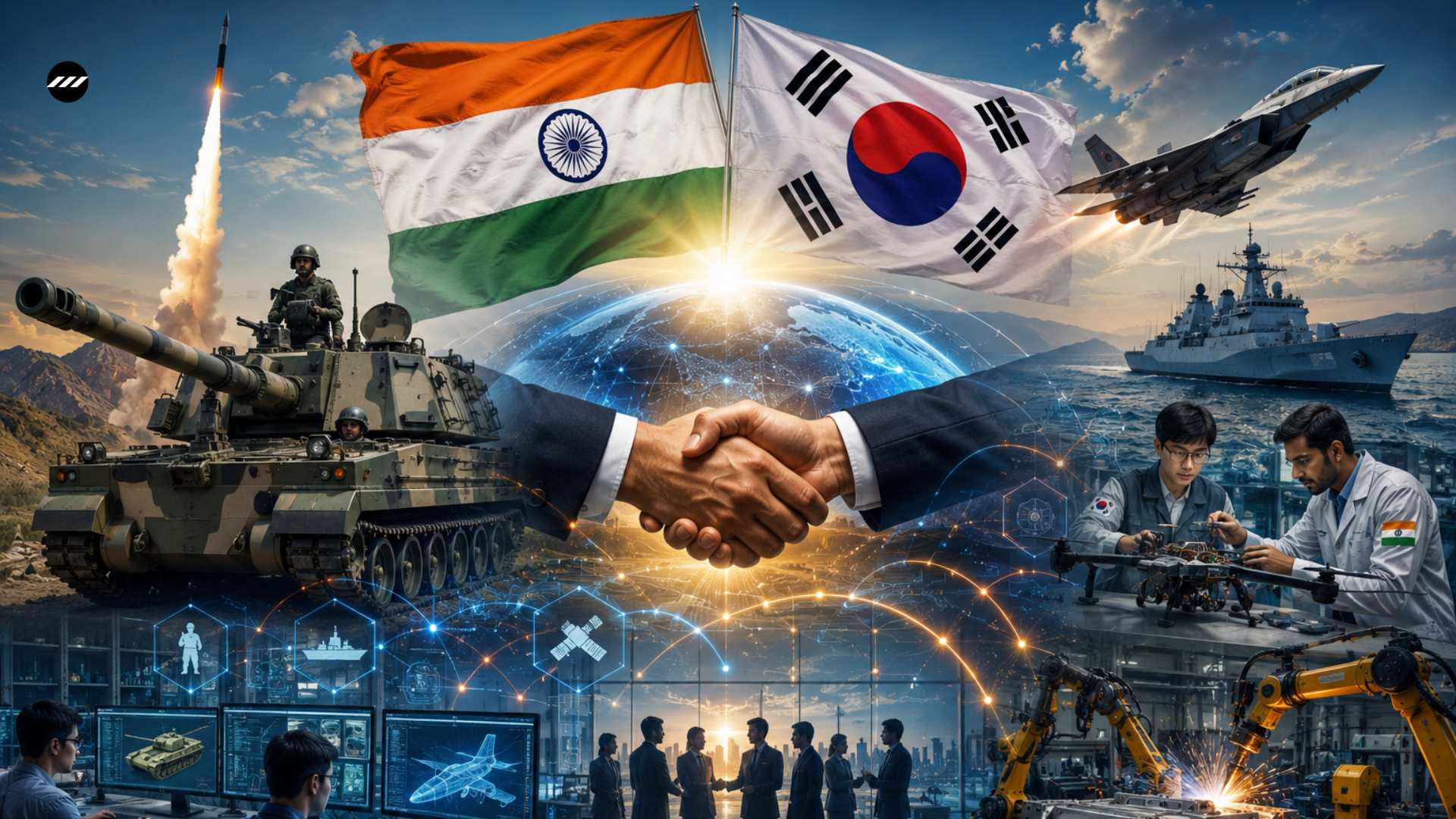
Advancing India-South Korea Defence Innovation Ties

KIND-X: India and South Korea Build a Defence Innovation Bridge
"The onus is now upon both defence ministries to curate tangible deliverables under KIND-X, clarifying its steering template, funding mechanisms and areas of joint innovation."
The Foundation: Five Decades of Defence Ties
India and South Korea established diplomatic relations in 1973. Their defence partnership has evolved steadily through successive agreements:
2005   →  MoU on Defence Industry & Logistics
            (production, R&D, procurement)

2010   →  Two separate five-year MoUs
            → Defence Cooperation (training, visits, joint exercises)
            → Defence R&D (marine, electronics, intelligent systems)
               DRDO ↔ South Korean defence industry

2015   →  Elevated to Special Strategic Partnership

2020   →  Roadmap for Defence Industries Cooperation
            (land, naval, aero, guided weapon systems,
             technology transfer, defence industrial corridors)
A landmark outcome of this partnership is the K9 Vajra-T — a self-propelled artillery system manufactured in India by L&T and Hanwha Aerospace under Make in India, whose success led to a follow-on production contract.
The New Platform: KIND-X
On April 20, 2026, at the India-South Korea Summit between Prime Minister Narendra Modi and President Lee Jae Myung, a new defence innovation platform was announced — the Korea-India Defence Accelerator (KIND-X).
As part of the Joint Strategic Vision, KIND-X aims to connect:
- Businesses and investors
- Defence start-ups and incubators
- Universities and think tanks
- Academia and R&D institutions
from both countries into a joint defence innovation and industrial ecosystem.
KIND-X is not an entirely new model. It mirrors existing frameworks:
INDUS-X    →  India-U.S. Defense Acceleration Ecosystem
FRIND-X    →  France-India Defence Startup Excellence
KIND-X     →  Korea-India Defence Accelerator (new, 2026)
KIND-X is expected to be led by South Korea's DAPA (Defense Acquisition Program Administration) and India's DIO (Defence Innovation Organisation) — both of which already run domestic defence start-up ecosystems: South Korea's specialised innovation enterprise system and India's iDEX (Innovations for Defence Excellence).
What KIND-X Can Unlock
- Joint challenges and grants by DAPA and DIO for start-ups to innovate in areas under the 2020 Roadmap
- Access to testing facilities through universities and laboratories in both countries
- Joint certification and standardisation processes for co-produced defence equipment
- Accelerator and incubator programmes connecting investors and innovators from both sides
- Workshops to help stakeholders navigate export control regimes, funding models, intellectual property, and licensing for technology transfer
- Annual KIND-X Summit — modelled on the INDUS-X summit — convening defence ministries, industry, universities, and think tanks in Seoul, New Delhi, and major industrial hubs; also enabling Track 1.5 dialogues to assess progress
Industrial Corridors and Innovation Clusters
KIND-X's success will depend on connecting existing ecosystems:
South Korea's clusters     →  Changwon, Daejeon, Gumi
India's defence corridors  →  Tamil Nadu, Uttar Pradesh
India's aerospace hubs     →  Bengaluru, Chennai, Hyderabad
Key firms expected to participate:
- South Korea: Hanwha, LIG, Kangnam, Hyundai
- India: L&T, Tata Advanced Systems, Mahindra, Bharat Forge
The K9 Vajra-T partnership serves as the template for future co-production ventures under KIND-X.
Emerging Technology Areas
Aligning with India's Defence Forces Vision 2047 and South Korea's Defence Innovation 4.0, KIND-X's potential technology focus areas include:
- AI platforms for military applications
- Autonomous weapon systems and robotics
- Joint satellite development for ISR (Intelligence, Surveillance, Reconnaissance)
- Space Situational Awareness (SSA) and navigation
- Critical mineral supply chains
- Defence semiconductor fabrication
With both countries expanding defence exports, KIND-X can also serve as a facilitator for third-market opportunities — a dimension that extends beyond bilateral cooperation.
Way Forward
- Clarify the steering template — clear governance structure between DAPA and DIO with defined roles
- Establish funding mechanisms — joint grant frameworks for start-ups, similar to INDUS-X challenge models
- Leverage existing co-production — use K9 Vajra-T as a replicable template, not a one-off success
- Deepen convergences — draw on parallel deepening ties in shipbuilding, AI, space, critical minerals, and semiconductors to feed into KIND-X's defence innovation agenda
- Ensure SME and start-up participation — large firms alone cannot drive innovation; iDEX-linked start-ups must have structured entry points into KIND-X
Conclusion
KIND-X arrives at a moment when both India and South Korea are actively internationalising their defence industries. India brings scale, a growing start-up ecosystem, and strategic demand; South Korea brings proven defence technology, advanced manufacturing, and export experience. The K9 Vajra-T showed what co-production can look like when political will meets industrial capability. KIND-X is the institutional architecture to make that the rule, not the exception. Whether it delivers will depend on how quickly both governments move from announcement to tangible, time-bound deliverables.
Attribution
Original content sources and authors

Syllabus classification
How this article maps to GS papers
Main syllabus
GS3Science & TechnologyQuick Q&A
What is the Korea-India Defence Accelerator (KIND-X), and how does it reflect the evolution of India-South Korea defence cooperation?
KIND-X represents the next phase in the evolution of India-South Korea defence ties, which began formally with the 2005 MoU on Defence Industry and Logistics. Over time, bilateral cooperation expanded through agreements on defence R&D, training, joint exercises, and technology transfer. The elevation of ties to a Special Strategic Partnership in 2015 and the 2020 Roadmap for Defence Industries Cooperation further deepened collaboration in land systems, naval technologies, aerospace, and guided weapon systems.
One of the major achievements of this cooperation has been the K9 Vajra-T self-propelled artillery system, jointly manufactured by Larsen & Toubro and South Korea’s Hanwha Aerospace under the ‘Make in India’ initiative. This project demonstrated how foreign collaboration can strengthen domestic defence manufacturing and create indigenous production capabilities.
KIND-X mirrors innovation frameworks such as INDUS-X with the United States and FRIND-X with France. However, its significance lies in integrating India’s rapidly growing defence start-up ecosystem under iDEX with South Korea’s advanced technological and manufacturing capabilities. It aims to create an institutionalised innovation bridge that promotes joint grants, testing facilities, accelerator programmes, and policy coordination.
Strategically, KIND-X reflects a transition from traditional buyer-seller defence relations toward collaborative defence industrial ecosystems. It aligns with India’s objective of defence indigenisation and South Korea’s ambition to emerge as a major global defence exporter. Therefore, KIND-X is not merely a defence agreement but a long-term strategic innovation partnership.
Why is KIND-X strategically important for India’s defence modernisation and self-reliance goals?
The initiative is important for several reasons:
- Access to advanced technologies: South Korea possesses strong capabilities in shipbuilding, electronics, robotics, semiconductors, and aerospace systems.
- Strengthening defence manufacturing: Joint production models can expand India’s domestic industrial capacity.
- Boosting start-up ecosystems: Collaboration between iDEX and South Korean innovation enterprises can create opportunities for defence start-ups.
- Enhancing strategic autonomy: Diversifying defence partnerships reduces excessive dependence on any single supplier nation.
- Improving defence exports: Co-produced systems can be marketed globally, strengthening India’s defence export ambitions.
For example, the success of the K9 Vajra-T artillery programme demonstrated how collaborative manufacturing can generate domestic industrial expertise while meeting operational requirements of the Indian Army. KIND-X seeks to replicate such success stories in emerging domains like Artificial Intelligence, autonomous systems, and defence semiconductors.
From a geopolitical perspective, the initiative also aligns with India’s Indo-Pacific strategy. South Korea is an important regional partner with advanced technological capabilities and shared concerns regarding regional security and supply chain resilience. Defence cooperation with South Korea therefore strengthens India’s strategic balancing efforts in Asia.
Ultimately, KIND-X is significant because it shifts defence cooperation from transactional procurement to long-term technological collaboration, thereby enhancing India’s innovation capacity, industrial competitiveness, and strategic preparedness.
How can KIND-X facilitate defence innovation, co-development, and technology transfer between India and South Korea?
The platform can facilitate cooperation through several mechanisms:
- Joint innovation challenges and grants: Defence agencies such as India’s DIO and South Korea’s DAPA may fund start-ups working on emerging technologies.
- Shared testing facilities: Universities and laboratories in both countries can provide access to testing and certification infrastructure.
- Accelerator and incubator programmes: These can connect innovators with venture capital and industrial partners.
- Technology transfer frameworks: Workshops and policy coordination can simplify intellectual property, licensing, and export control procedures.
- Annual innovation summits: Similar to INDUS-X, these can bring together policymakers, defence firms, academia, and think tanks.
Potential cooperation areas include Artificial Intelligence for military applications, autonomous systems, robotics, space-based ISR, satellite communication, critical minerals, and semiconductor manufacturing. Such cooperation is especially important because future warfare increasingly depends on dual-use and deep-tech capabilities.
For instance, South Korea’s expertise in semiconductors and advanced electronics can complement India’s growing software and aerospace capabilities. Similarly, India’s defence corridors in Tamil Nadu and Uttar Pradesh can integrate with South Korean industrial clusters such as Changwon and Daejeon to create transnational production networks.
Importantly, successful technology transfer requires trust, standardisation, and institutional continuity. Therefore, KIND-X must establish clear governance structures, funding models, and deliverables. If implemented effectively, the initiative can create a sustainable ecosystem for collaborative defence innovation rather than isolated defence projects.
Critically analyse the opportunities and challenges associated with the implementation of KIND-X.
Key opportunities include:
- Expansion of defence industrial ecosystems: Integration of start-ups, academia, and major defence firms can strengthen innovation.
- Technology co-development: Collaboration in AI, robotics, semiconductors, and space technologies can reduce technological dependence.
- Supply chain resilience: Joint work in critical minerals and semiconductors can diversify strategic supply chains.
- Defence export growth: Co-produced platforms can improve global competitiveness.
- Strategic convergence: Both countries share Indo-Pacific interests and concerns about regional security.
However, several challenges may hinder implementation:
- Differences in regulatory systems: Export controls, procurement rules, and technology-sharing policies may create friction.
- Intellectual property concerns: Disagreements over ownership and licensing of jointly developed technologies may emerge.
- Funding uncertainties: Sustained innovation requires long-term investments and institutional support.
- Bureaucratic delays: Defence procurement and approvals often face administrative bottlenecks.
- Geopolitical sensitivities: Regional security dynamics involving China and North Korea could affect cooperation priorities.
For example, while the K9 Vajra-T project succeeded due to clear industrial roles and operational demand, more advanced areas such as AI-enabled autonomous systems involve greater technological sensitivity and regulatory complexity.
Critically, KIND-X must avoid becoming a symbolic diplomatic platform without measurable outcomes. The initiative requires transparent governance, joint funding mechanisms, clear timelines, and accountability structures. Furthermore, ensuring participation of start-ups alongside large corporations will be crucial for innovation diversity.
Therefore, while KIND-X presents transformative potential, its long-term success depends on institutional coordination, political commitment, and the ability to convert strategic intent into tangible technological and industrial deliverables.
How does the K9 Vajra-T project illustrate the potential of India-South Korea defence industrial cooperation?
The project highlights several important dimensions of defence cooperation:
- Technology transfer: South Korean expertise was adapted to Indian operational and climatic conditions.
- Indigenous manufacturing: Production within India enhanced local industrial capacity and employment generation.
- Operational effectiveness: The system improved the Indian Army’s artillery modernisation efforts.
- Industrial ecosystem development: Indian suppliers and ancillary industries benefited from the project.
- Long-term partnership building: The success led to additional production contracts and deeper trust.
The K9 Vajra-T also demonstrated the practical viability of combining foreign technological expertise with Indian manufacturing capabilities. Instead of remaining dependent solely on imports, India gained valuable experience in assembly, adaptation, maintenance, and future upgrades.
Strategically, the project provides a template for future cooperation under KIND-X. Similar co-development models can be explored in areas such as autonomous systems, naval platforms, drones, and space technologies. By involving Indian defence corridors and South Korean industrial hubs, both countries can create integrated defence production networks.
Moreover, the project aligns with India’s broader goal of becoming a global defence manufacturing hub. Successful co-production enhances credibility in international markets and can contribute to defence exports. Therefore, the K9 Vajra-T is not merely an artillery platform but an example of how collaborative defence industrialisation can advance technological self-reliance, economic growth, and strategic partnership simultaneously.
Suppose you are part of India’s Defence Innovation Organisation (DIO) tasked with operationalising KIND-X. What policy and institutional measures would you recommend for its effective implementation?
The following measures would be prioritised:
- Creation of a joint steering committee: Representatives from DIO, DAPA, industry, academia, and defence ministries should oversee implementation.
- Dedicated innovation fund: Both countries should establish co-financed grants for defence start-ups and university research.
- Sector-specific working groups: Focus areas such as AI, robotics, semiconductors, space technologies, and naval systems should have specialised teams.
- Simplified regulatory frameworks: Streamlining export controls, certification procedures, and intellectual property mechanisms is essential.
- Industry-academia collaboration: Universities and think tanks should be integrated into innovation programmes.
An annual KIND-X Summit should also be institutionalised to review progress, facilitate networking, and identify emerging strategic priorities. Indian defence corridors in Tamil Nadu and Uttar Pradesh can be linked with South Korean industrial clusters to support joint manufacturing and supply chains.
From a strategic perspective, the initiative should align with India’s Defence Vision 2047 and South Korea’s Defence Innovation 4.0 strategy. Focus should be placed on dual-use technologies that have both civilian and military applications. Encouraging start-up participation alongside major firms like Tata Advanced Systems, Hanwha, Hyundai, and Bharat Forge will ensure innovation diversity.
Finally, monitoring and accountability mechanisms are essential. Clearly defined milestones, timelines, and evaluation indicators must be established. If implemented effectively, KIND-X can become a model for next-generation defence diplomacy based on innovation, co-development, and strategic technological partnerships.
Practice questions
2 questions for mains preparation