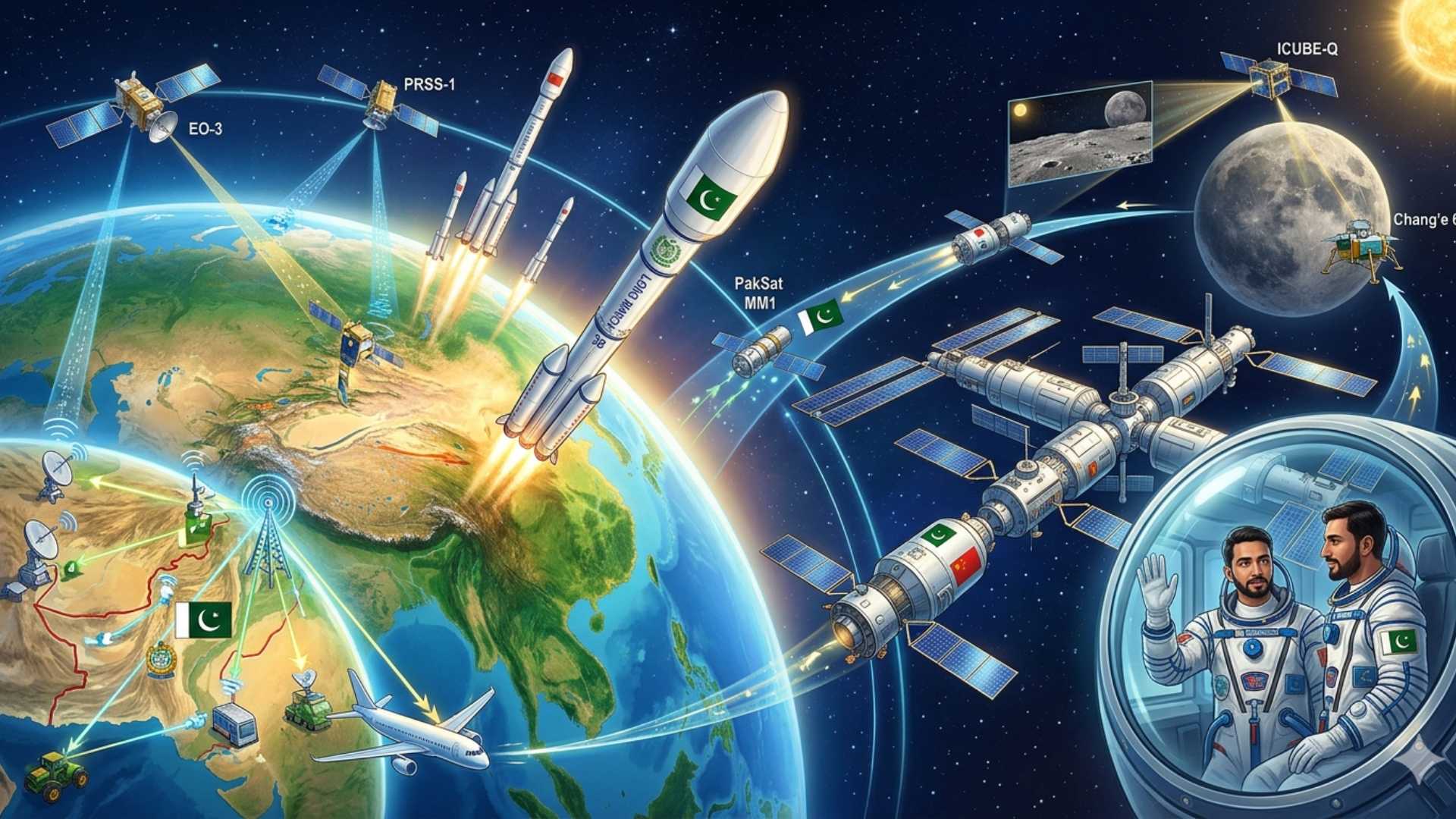
The Evolution of China-Pakistan Space Cooperation

Introduction
- Space is increasingly becoming a domain of strategic competition and cooperation, with over 90 countries operating satellites globally.
- China’s rapid space rise since 1970 and its collaboration with Pakistan reflect the dual-use nature of space technology (civil + military).
- Space capabilities today define both technological power and strategic influence.
“In the 21st century, space is not just a frontier of exploration, but a domain of power projection.”
Background / Context
-
China has developed a comprehensive space ecosystem:
- Satellite launches
- Space station (Tiangong)
- Navigation system (BeiDou)
- Planned manned Moon mission by 2030
-
Under the Belt and Road Initiative (BRI), China promotes a “Space Silk Road”, extending space infrastructure and services to partner countries.
-
Pakistan has emerged as a key partner, reflecting deepening strategic and defence ties.
Key Concept: Space as a Strategic Domain
| Dimension | Significance |
|---|---|
| Civil Use | Communication, disaster management, urban planning |
| Military Use | Surveillance, navigation, missile guidance |
| Strategic Power | Influence, alliances, data control |
👉 Space technology is inherently dual-use, making cooperation geopolitically significant.
Evolution of China–Pakistan Space Cooperation
1. Early Phase (1990s–2000s)
- Began with China launching Pakistan’s Badr-I satellite (1990)
- Slow initial progress
2. Expansion Phase (2010s–Present)
-
Regular satellite launches by China for Pakistan
-
Development of:
- Communication satellites
- Remote sensing systems
-
Increasing technological dependency
Major Areas of Cooperation
1. Satellite Launch & Infrastructure
China has become Pakistan’s primary launch partner, enabling rapid space capability development.
-
Multiple satellites launched:
- Remote sensing (PRSS series)
- Communication (PakSat series)
- Electro-optical satellite (EO-3 in 2026)
👉 Impact:
-
Enhances Pakistan’s:
- Surveillance capability
- Communication infrastructure
- Strategic monitoring
📌 Remote sensing satellites provide:
- Day-night imaging
- Cloud-penetrating observation
2. Space Station Collaboration
-
Agreement between:
- China Manned Space Engineering Office (CMSEO)
- Pakistan’s SUPARCO
-
Pakistani astronaut to visit Tiangong space station
👉 Significance:
- Technology transfer
- Skill development
- Symbolic strategic partnership
3. Lunar Exploration Cooperation
-
ICUBE-Q CubeSat (2024):
- Jointly developed by Pakistan & Chinese institutions
- Studied far side of the Moon
👉 Importance:
- Entry into deep space exploration
- Scientific capability building
4. Navigation System: BeiDou
-
China’s BeiDou Navigation Satellite System (BDS):
-
Alternative to GPS
-
Accuracy up to:
- 2 cm (standard)
- 5 mm (post-processing)
-
-
Pakistan:
- First foreign adopter (2014)
- Military integration completed
👉 Applications:
- Disaster management
- Traffic systems
- Military navigation
Strategic Implications
1. Military Advantage for Pakistan
-
Access to:
- Satellite surveillance
- Precision navigation
-
Enhances:
- Defence capabilities
- Situational awareness
2. China’s Regional Influence
-
Strengthens China’s presence in:
- South Asia
-
Gains access to:
- Regional data
- Strategic positioning
3. Space Diplomacy & Soft Power
-
China uses:
- Launch services (Long March rockets)
-
Builds:
- Technological dependency
- Strategic partnerships
Challenges & Concerns
1. Militarisation of Space
-
Increasing use of space for:
- Defence and surveillance
2. Strategic Dependency
-
Pakistan increasingly dependent on China for:
- Space infrastructure
- Technology
3. Regional Security Concerns
-
Implications for:
- India’s security
- South Asian balance of power
4. Dual-use Technology Risks
-
Civil technology can be used for:
- Military purposes
Comparative Insight
| Aspect | China–Pakistan | India |
|---|---|---|
| Space Capability | Dependent (Pakistan) | Indigenous (ISRO-led) |
| Navigation | BeiDou-based | NavIC |
| Strategy | Bilateral dependence | Strategic autonomy |
Implications for India
-
Need to:
- Strengthen ISRO capabilities
- Expand NavIC usage
- Enhance space diplomacy
-
Focus on:
- Regional partnerships
- Technological leadership
Way Forward
1. Strengthen Indigenous Capabilities
India must continue investing in:
- Satellite technology
- Launch systems
- Space-based applications
2. Expand Space Diplomacy
-
Collaborate with:
- Global South
- Indo-Pacific partners
3. Develop Space Security Framework
-
Address:
- Militarisation
- Space governance
4. Promote Civilian Applications
-
Use space for:
- Development
- Disaster resilience
Conclusion
China–Pakistan space cooperation highlights the growing importance of space as a strategic and technological domain. While it enables Pakistan to rapidly build capabilities, it also deepens dependency and raises regional security concerns. For India, this underscores the need to pursue technological self-reliance, strategic partnerships, and robust space governance frameworks to maintain balance in the evolving space order.
Attribution
Original content sources and authors


Syllabus classification
How this article maps to GS papers
Main syllabus
GS3Science & TechnologyQuick Q&A
What are the key features of China's space programme, and how has it evolved over time?
- Development of the Long March rocket series for reliable satellite launches
- Creation of the BeiDou Navigation Satellite System (BDS) as an alternative to GPS
- Successful human spaceflight missions and spacewalks
- Establishment of the Tiangong space station
- Advancement toward a manned lunar mission by 2030
Strategic evolution: China has shifted from being a technology importer to a global space leader that exports services. It has integrated space capabilities with its broader geopolitical ambitions, particularly under the Belt and Road Initiative (BRI), often termed the “Space Silk Road.” This involves building satellite networks and ground infrastructure in partner countries.
Broader implications: China’s programme reflects a blend of technological self-reliance, strategic influence, and commercial outreach. By offering launch services and satellite infrastructure to developing countries, China not only strengthens diplomatic ties but also creates technological dependencies, thereby enhancing its global standing in both civilian and military domains.
Why is China-Pakistan space cooperation strategically significant for both countries?
- Development of communication and remote sensing satellites
- Access to space-based intelligence and surveillance
- Training opportunities, such as participation in the Tiangong space station mission
For China, the partnership offers geopolitical advantages. It strengthens its footprint in South Asia and complements the Belt and Road Initiative. Pakistan serves as a strategic partner for expanding the Space Silk Road, enabling China to access regional data and enhance its global navigation network.
Strategic implications: This cooperation has dual-use implications, meaning it serves both civilian and military purposes. For instance, remote sensing satellites can be used for disaster management as well as military reconnaissance. However, it also raises concerns about growing dependency, as Pakistan becomes increasingly reliant on Chinese technology, potentially limiting its strategic autonomy while deepening China’s influence in the region.
How does satellite and navigation cooperation between China and Pakistan enhance their capabilities?
Key areas of enhancement include:
- Remote sensing: Enables monitoring under all weather conditions for agriculture, disaster management, and defence surveillance
- Communication: Satellites like PakSat improve broadcasting, internet connectivity, and telecommunication infrastructure
- Navigation: Integration with the BeiDou Navigation Satellite System (BDS) provides high-precision positioning (up to centimetre-level accuracy)
Military and civilian convergence: The dual-use nature of these technologies allows Pakistan to strengthen both its civilian infrastructure and defence preparedness. The establishment of a BeiDou-enabled CORS network further enhances geospatial capabilities.
Example: The launch of ICUBE-Q, a lunar CubeSat, demonstrates collaborative innovation and scientific advancement. Such projects not only build technical expertise but also position Pakistan within global space research networks, albeit with strong Chinese support.
Critically analyse the benefits and challenges of China-Pakistan space cooperation.
- Technology transfer: Pakistan gains access to advanced space technologies at relatively low cost
- Capacity building: Joint projects and astronaut training enhance human capital
- Strategic advantage: Improved surveillance, navigation, and communication capabilities strengthen national security
However, challenges are equally significant:
- Dependency risk: Pakistan’s reliance on Chinese infrastructure may limit its independent decision-making
- Geopolitical concerns: This partnership may intensify regional competition, particularly with India
- Dual-use dilemma: Civilian technologies can be repurposed for military use, raising concerns about militarisation of space
Critical perspective: While the cooperation appears mutually beneficial in the short term, it creates an asymmetrical relationship where China holds technological dominance. This could lead to long-term strategic vulnerabilities for Pakistan.
Conclusion: A balanced approach would require Pakistan to diversify partnerships and invest in indigenous capabilities, while China must ensure transparency to mitigate global concerns about its expanding space influence.
What are some key examples of China-Pakistan collaboration in space, and what do they illustrate?
- Badr-I (1990): China’s first satellite launch for Pakistan, marking the beginning of cooperation
- PRSS-1 (2018): A Chinese-built remote sensing satellite providing all-weather monitoring capabilities
- PakTES-1A: Developed indigenously by Pakistan but launched by China, showing growing domestic capacity
- ICUBE-Q (2024): A collaborative lunar CubeSat mission exploring the moon’s far side
- EO-3 (2026): An indigenous electro-optical satellite launched from China
Human spaceflight cooperation: The selection of Pakistani astronauts for training and potential participation in the Tiangong space station represents a new phase of collaboration.
What these illustrate: These examples demonstrate a transition from dependency to partial capability-building. While Pakistan still relies heavily on Chinese launch systems, it is gradually developing its own technological base.
Broader significance: These collaborations underscore how space partnerships can serve as tools of diplomacy, capacity-building, and strategic alignment, especially for developing countries seeking to enter the space domain.
As a policymaker, how would you assess the implications of China-Pakistan space cooperation for regional security in South Asia?
Key concerns include:
- Enhanced reconnaissance: Remote sensing satellites improve Pakistan’s ability to monitor borders and military movements
- Navigation precision: Access to BeiDou enables accurate missile guidance and troop deployment
- Data sharing: China may gain access to sensitive geospatial data from the region
Regional implications: This cooperation could trigger a competitive response, particularly from India, leading to increased investments in space and defence technologies. It may also contribute to the militarisation of outer space, an emerging global concern.
Policy response: Countries in the region should focus on strengthening their own space capabilities, enhancing international cooperation, and advocating for norms governing responsible use of space. Confidence-building measures and transparency in space activities can also help mitigate tensions.
Conclusion: While the cooperation offers developmental benefits, its security implications require careful management to ensure that space remains a domain of peaceful exploration rather than conflict.
Practice questions
1 question for mains preparation