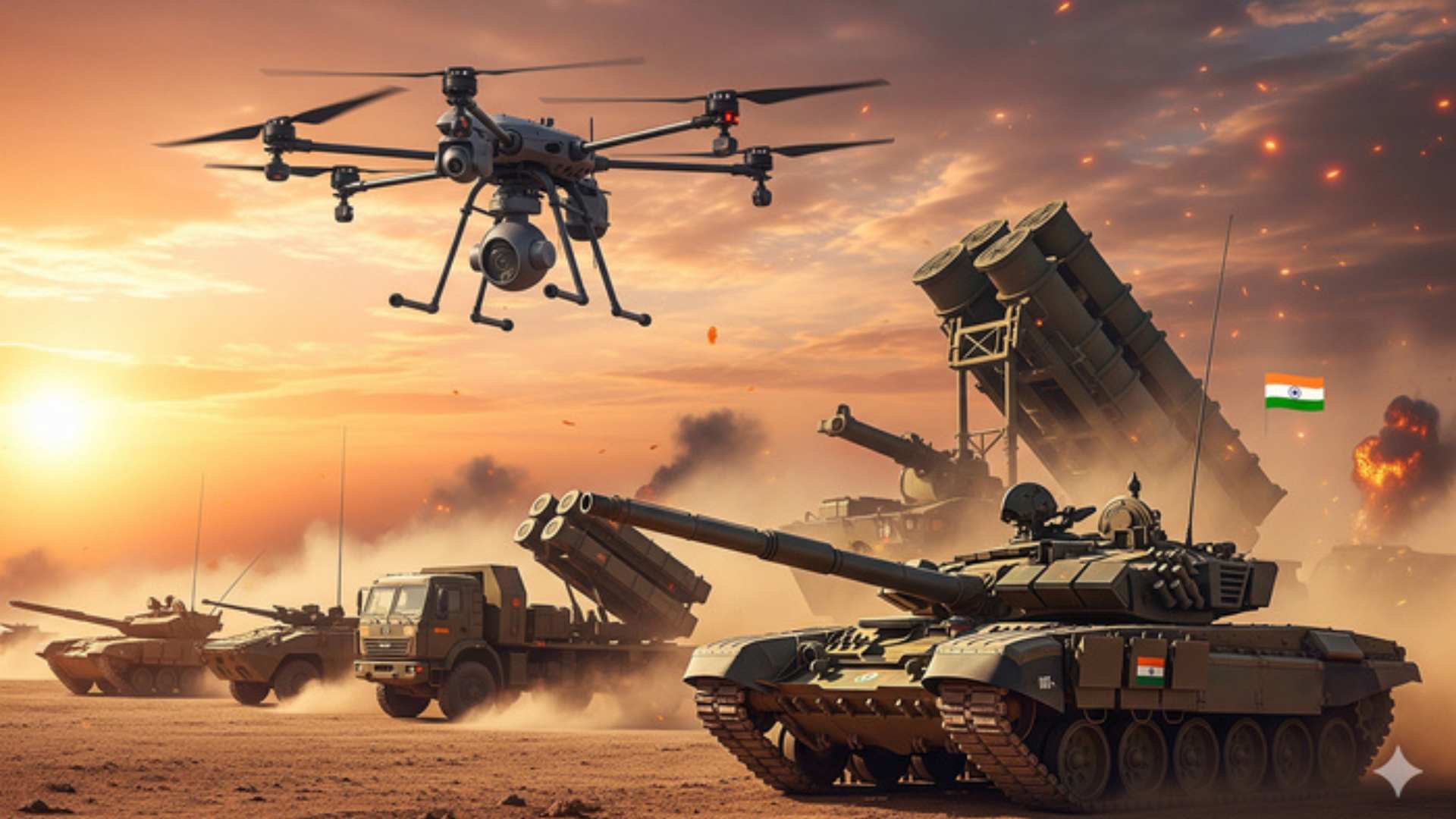
India Unveils Defence Vision 2047 for a Future-Ready Military

The roadmap aims to transform the armed forces into an integrated, technology-driven and multi-domain force by 2047.
S
Surya
5 mins read
Vision 2047 roadmap for future-ready Indian military

Defence Forces Vision 2047: Roadmap for a Future-Ready Indian Military

The Government of India has unveiled a long-term strategic blueprint titled “Defence Forces Vision 2047: A Roadmap for a Future-Ready Indian Military.” The document outlines the reforms, technological upgrades, and organisational changes required to modernise India’s armed forces by the centenary of India’s independence in 2047.

Prepared by the Headquarters Integrated Defence Staff (HQ IDS) and released by Defence Minister Rajnath Singh, the document seeks to transform India’s military into a modern, integrated and technologically advanced force capable of responding effectively to emerging security challenges.


Context Behind the Vision Document

The release of the vision document comes at a time when the global and regional security environment is rapidly evolving. Modern conflicts increasingly involve multiple domains such as land, air, sea, cyber and space, requiring armed forces to adapt their strategies and capabilities.

The document was also developed in the context of the recent military conflict between India and Pakistan in May, which lasted from May 7 to May 10. After the conflict, the three services were directed to analyse operational experiences and incorporate lessons learned into future planning.

This experience reinforced the importance of joint operations, faster decision-making and improved technological capabilities.


Objective of Defence Vision 2047

The core objective of the vision document is to transform India’s armed forces into a future-ready military capable of protecting national interests in a rapidly changing strategic environment.

The roadmap aims to build a force that is:

  • Integrated across all services
  • Technologically advanced
  • Agile and adaptable
  • Capable of operating across multiple domains of warfare

Such transformation is considered essential to support India’s broader goal of becoming a “Viksit Bharat” (developed nation) by 2047.


Emphasis on Jointness and Integration

One of the central themes of the vision document is greater integration among the Army, Navy and Air Force.

Traditionally, the three services have operated with significant institutional autonomy. However, modern warfare increasingly requires coordinated operations across different domains and services.

The vision document therefore emphasises:

  • Joint planning of military operations
  • Coordinated capability development
  • Integrated command structures
  • Shared training and operational doctrines

Improved coordination among services can enhance operational efficiency and enable faster responses to emerging threats.


Multi-Domain Warfare Capability

Modern conflicts are no longer limited to traditional battlefields. Warfare now extends into new domains such as cyberspace, outer space, electronic warfare and information warfare.

The vision document recognises this shift and proposes the development of a multi-domain military force capable of operating across these different environments.

Such capabilities would allow India to respond to threats across the full spectrum of conflict, ranging from conventional warfare to hybrid and technological threats.


Role of Advanced Technology and Innovation

Technological advancement is another major focus area of the vision document. The military plans to incorporate emerging technologies into its operational framework to enhance its effectiveness.

Key technological areas include:

  • Artificial intelligence and autonomous systems
  • Cybersecurity and cyber warfare capabilities
  • Space-based surveillance and communication systems
  • Advanced electronic warfare technologies

Modern training systems and simulation technologies are also expected to improve the preparedness of military personnel for future conflicts.


Promotion of Self-Reliance in Defence

The document strongly emphasises the need for self-reliance in defence production. India has historically depended on imports for a significant portion of its military equipment.

Strengthening domestic defence manufacturing is expected to achieve several objectives:

  • Reduce dependence on foreign suppliers
  • Improve the availability of critical military equipment
  • Encourage technological innovation within the country
  • Support the growth of India’s defence industry

Promoting indigenous technology development aligns with broader national initiatives such as Atmanirbhar Bharat (self-reliant India).


Strengthening Defence Manufacturing Ecosystem

The vision also highlights the importance of building a strong domestic defence industrial base.

Expanding defence manufacturing capabilities can contribute not only to national security but also to economic development and technological advancement.

A stronger defence ecosystem could:

  • Create high-skilled employment
  • Encourage research and development
  • Increase exports of defence equipment
  • Strengthen strategic autonomy

Phased Implementation Strategy

The vision document adopts a phased and calibrated approach to achieving its objectives.

It outlines clearly prioritised goals across three time horizons:

  • Short-term goals focusing on immediate capability improvements and reforms
  • Medium-term goals aimed at expanding technological capabilities and integration
  • Long-term goals designed to build a fully modern and integrated military by 2047

This structured approach allows gradual transformation while maintaining operational readiness.


Whole-of-Nation Approach to National Security

The document recognises that modern security challenges cannot be addressed by military strength alone. It advocates a whole-of-nation approach, integrating multiple dimensions of national power.

These include:

  • Military capability
  • Diplomatic engagement
  • Technological advancement
  • Economic strength

Coordinating these elements can enhance India’s ability to safeguard its strategic interests in an increasingly complex global environment.


Institutional Leadership and Release of the Vision

The release of the vision document was attended by senior military and government officials, reflecting its importance for national security planning.

Key participants included:

  • Chief of Defence Staff (CDS) General Anil Chauhan
  • Chief of the Naval Staff Admiral Dinesh K Tripathi
  • Chief of the Air Staff Air Chief Marshal A. P. Singh
  • Defence Secretary Rajesh Kumar Singh
  • Vice Chief of the Army Staff Lt. Gen. Pushpendra Singh

Their presence underscores the collaborative nature of the vision and the role of integrated leadership in implementing it.


Conclusion

The Defence Forces Vision 2047 represents a comprehensive roadmap for modernising India’s military in line with future security challenges. By emphasising joint operations, technological innovation, indigenous defence production and integrated national power, the document seeks to prepare India’s armed forces for the evolving nature of warfare.

If implemented effectively, the roadmap can help transform India into a technologically advanced, combat-ready and globally respected military power by the centenary of its independence, while strengthening the broader objective of building a secure and resilient Viksit Bharat.

Quick Q&A

Everything you need to know

Defence Forces Vision 2047: A Roadmap for a Future-Ready Indian Military is a strategic blueprint released by the Government of India to guide the long-term transformation of the armed forces by the centenary of India’s independence in 2047. Prepared by the Headquarters Integrated Defence Staff (HQ IDS), the document outlines reforms, capability enhancements and organisational restructuring required to build a modern and technologically advanced military. Its overarching aim is to align India’s defence capabilities with the broader national goal of achieving ‘Viksit Bharat’ (Developed India) by 2047.

The document envisions transforming India’s armed forces into an integrated, multi-domain and agile force capable of responding to modern warfare challenges. Multi-domain capability refers to coordinated operations across land, air, sea, space and cyber domains. In an era where warfare increasingly involves cyber attacks, satellite disruption and electronic warfare, traditional military strength alone is insufficient. The vision therefore emphasises integrating emerging technologies such as artificial intelligence, unmanned systems, electronic warfare and advanced surveillance platforms into military planning and operations.

Another major objective is strengthening self-reliance in defence production through the development of indigenous technologies and domestic defence manufacturing. The document also stresses the importance of institutional reforms, better coordination among the Army, Navy and Air Force, and a calibrated roadmap with short-, medium- and long-term capability goals. Together, these measures aim to create a globally respected, technologically advanced and combat-ready military capable of protecting India’s expanding strategic interests.

The transformation of India’s military into a multi-domain and integrated force is essential because modern warfare has evolved significantly beyond conventional battlefield engagements. Contemporary conflicts increasingly involve operations across multiple domains including cyber space, outer space, electronic warfare, and information warfare. Military success now depends on the ability to coordinate operations simultaneously across these domains rather than relying solely on traditional land, air or naval power.

Recent global conflicts illustrate this shift. For example, the Russia-Ukraine war has highlighted the importance of drones, satellite surveillance, cyber warfare and precision-guided weapons. Similarly, electronic warfare systems capable of disrupting communications and radar networks have become critical components of modern military strategy. In this evolving environment, armed forces must be capable of integrating technological capabilities with conventional forces to maintain operational superiority.

For India, the need for integration is further reinforced by its complex security environment, including tensions along the Line of Actual Control (LAC) with China and the Line of Control (LoC) with Pakistan. Coordinated operations among the Army, Navy and Air Force are essential for effective deterrence and rapid response to emerging threats. A multi-domain approach ensures that India’s military can operate seamlessly across land, sea, air, cyber and space, thereby enhancing its ability to safeguard national security in an increasingly unpredictable geopolitical landscape.

One of the central pillars of the Defence Forces Vision 2047 document is strengthening jointness and synergy among the Army, Navy and Air Force. Historically, India’s armed services have operated with a relatively high degree of institutional autonomy. While this structure allowed each service to focus on its specialised domain, it also created challenges in coordinating large-scale joint operations. The Vision 2047 roadmap aims to overcome these limitations by promoting integrated planning, capability development and operational coordination.

A key mechanism for achieving this integration is the strengthening of institutions such as the Chief of Defence Staff (CDS) and the Headquarters Integrated Defence Staff. These institutions are designed to facilitate joint decision-making, harmonise procurement processes and ensure that defence strategies reflect a unified national security approach. The proposed creation of theatre commands, where forces from different services operate under a single command structure, is another major reform aimed at improving operational efficiency and reducing duplication of resources.

Integration will also involve joint training programmes, interoperable communication systems and coordinated acquisition of military platforms. For example, network-centric warfare requires real-time sharing of intelligence and surveillance data between different services. By promoting jointness in doctrine, training and operational planning, the roadmap seeks to create a military structure capable of conducting coordinated multi-domain operations in future conflicts.

Several strategic and technological factors are driving the urgent need for modernisation of India’s defence forces. One major factor is the rapid pace of technological change in warfare. Emerging technologies such as artificial intelligence, autonomous drones, cyber warfare tools and advanced missile systems are fundamentally reshaping military capabilities. Countries that fail to adopt these technologies risk falling behind in terms of deterrence and operational effectiveness.

Another factor is the evolving geostrategic environment. India faces security challenges across multiple fronts, including territorial disputes, cross-border terrorism, maritime security concerns in the Indian Ocean Region, and increasing competition among major powers in the Indo-Pacific. These challenges require a military that is flexible, technologically advanced and capable of responding to both conventional and non-conventional threats.

Lessons from recent conflicts have also highlighted the importance of innovation and adaptability. The integration of unmanned systems, cyber defence mechanisms and electronic warfare capabilities has become critical for maintaining battlefield advantage. Therefore, the Vision 2047 roadmap emphasises the development of a modern training ecosystem, advanced technological capabilities and continuous innovation. These measures are intended to ensure that India’s armed forces remain capable of addressing future security challenges effectively.

Self-reliance in defence manufacturing, often referred to as ‘Atmanirbhar Bharat in defence’, is a key pillar of India’s long-term military strategy. Developing indigenous defence technologies reduces dependence on foreign suppliers and ensures that the armed forces have access to equipment tailored to India’s specific operational requirements. Domestic production can also enhance strategic autonomy by enabling India to maintain military readiness even during geopolitical tensions or supply disruptions.

Another important advantage of self-reliance is its contribution to economic growth and technological development. The defence sector has strong linkages with advanced manufacturing, research and development, and high-technology industries. Initiatives such as the Defence Production and Export Promotion Policy, increased participation of private sector firms, and defence start-ups under the Innovations for Defence Excellence (iDEX) programme are helping to build a robust defence industrial ecosystem in India.

However, achieving complete self-reliance presents several challenges. Indigenous development of advanced platforms such as fighter aircraft, submarines or missile systems requires substantial investments in research, skilled manpower and technological infrastructure. Delays in domestic projects and limited private sector participation have historically slowed progress. Therefore, while promoting self-reliance, India must also pursue strategic partnerships, technology transfers and international collaborations. A balanced approach combining domestic innovation with global cooperation can strengthen India’s defence capabilities more effectively.

Emerging technologies are transforming the nature of warfare by enabling faster decision-making, greater precision and enhanced situational awareness. Artificial intelligence (AI), for instance, can process vast volumes of battlefield data from satellites, drones and sensors to provide commanders with real-time intelligence. AI-driven systems can also assist in predictive analysis, enabling military planners to anticipate enemy movements and optimise operational strategies.

Unmanned aerial vehicles (UAVs) and drones have become particularly influential in modern conflicts. They can perform surveillance, reconnaissance and precision strike missions without exposing soldiers to direct risk. Recent conflicts such as the Russia-Ukraine war have demonstrated how relatively low-cost drones can significantly alter battlefield dynamics by targeting armoured vehicles, artillery systems and logistics infrastructure.

Similarly, cyber warfare and electronic warfare systems are increasingly important components of national defence. Cyber operations can disrupt communication networks, financial systems and critical infrastructure, while electronic warfare can interfere with radar and navigation systems. By integrating these technologies into its defence strategy, India can develop a more network-centric and technologically advanced military capability capable of addressing future warfare challenges.

In a scenario where India faces simultaneous threats across cyber, maritime and land domains, a multi-domain military structure would enable coordinated and rapid responses across different branches of the armed forces. Instead of each service operating independently, integrated commands would allow the Army, Navy and Air Force to share intelligence, coordinate operations and deploy resources efficiently. For example, cyber units could neutralise digital threats while naval forces secure maritime trade routes and land forces strengthen border defence.

A multi-domain approach also enables the use of advanced technologies for real-time situational awareness. Satellite surveillance systems can track enemy movements, while drones and reconnaissance aircraft provide tactical intelligence to commanders. Integrated communication networks ensure that this information is shared across all operational units, enabling faster decision-making and coordinated responses.

Such integration is particularly important for India due to its vast geographic and strategic landscape, which includes land borders, extensive coastlines and critical maritime trade routes. By adopting a multi-domain operational framework, India’s military can respond more effectively to complex security challenges and ensure that national security strategies remain resilient against evolving threats.

Attribution

Original content sources and authors

Sign in to track your reading progress

Comments (0)

Please sign in to comment

No comments yet. Be the first to comment!