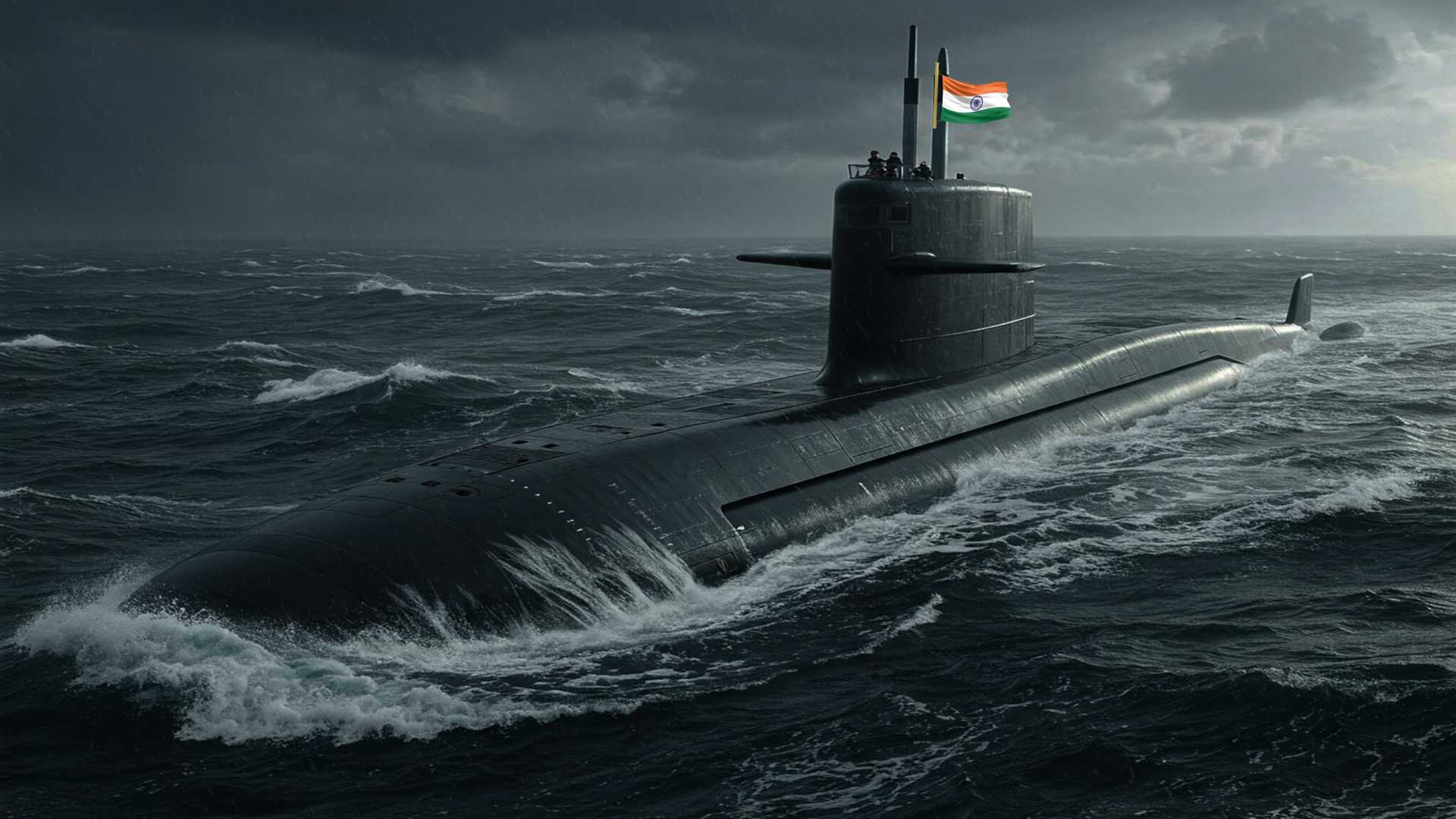
Strengthening Deterrence: India’s Submarine Capabilities

Exploring the significance of INS Aridhaman and India's nuclear triad in modern maritime warfare.
G
Gopi
4 mins read
INS Aridhaman boosts India’s nuclear triad and strengthens sea-based deterrence.

Introduction

Nuclear deterrence in the 21st century is no longer a static bilateral equation — it is a dynamic, multi-domain calculus shaped by technological advancement, shifting maritime balances, and the blurring of conventional and nuclear thresholds. India's apparent commissioning of INS Aridhaman, the third submarine in its SSBN (Ship Submersible Ballistic Nuclear) programme, marks a significant milestone in completing and consolidating India's nuclear triad — the capability to deliver nuclear weapons from land, sea, and air. Apart from India, only the P5 nations (USA, Russia, China, France, UK) possess credible nuclear triad capabilities. In the context of a deteriorating Indo-Pacific security environment, growing Chinese naval assertiveness in the Indian Ocean, and the lessons of Operation Sindoor (May 2025), sea-based deterrence has emerged as India's most critical strategic priority.

"The submarine is the capital ship of the future." — Admiral Hyman Rickover, father of the US nuclear Navy


India's SSBN Programme — Evolution

SubmarineClassCommissionedDisplacementKey Capability
INS ArihantArihant2016~6,000 tonnes12× K-15 Sagarika; 4× K-4 missiles
INS ArighatArihant2024~6,000 tonnes12× K-15 Sagarika; 4× K-4 missiles
INS AridhamanArihant (upgraded)2025 (likely)~7,000 tonnes24× K-15 Sagarika; 8× K-4/K-5 missiles
4th vessel (unnamed)ArihantExpected 2026~7,000 tonnesSimilar to Aridhaman
SSN (attack submarine)IndigenousTarget 2036TBDFirst fully indigenously designed nuclear attack submarine

Key Missile Systems

MissileTypeRangeSignificance
K-15 SagarikaSubmarine-launched ballistic missile (SLBM)~750 kmOperational; shorter range — regional deterrence
K-4SLBM~3,500 kmCovers most of China and Pakistan from Bay of Bengal
K-5SLBM (under development)~5,000+ kmIntercontinental reach — full second-strike credibility

Nuclear Triad — Strategic Significance

India's nuclear doctrine rests on three pillars:

1. No First Use (NFU) — India will not initiate a nuclear strike; retaliation only after absorbing a first strike

2. Credible Minimum Deterrence — maintaining the minimum arsenal necessary for assured retaliation

3. Massive Retaliation — any nuclear strike on India will be met with unacceptable damage to the adversary

The NFU doctrine's credibility depends entirely on survivable second-strike capability — the ability to absorb a nuclear first strike and still retaliate devastatingly. This is precisely where SSBNs are irreplaceable. Land-based missiles and air-delivered weapons are vulnerable to a disarming first strike; a submarine at depth is virtually undetectable and therefore the most survivable leg of the triad.

INS Aridhaman's commissioning means India now has continuous at-sea deterrence (CASD) — with one submarine always on patrol — a capability that permanently transforms the nuclear equation with both China and Pakistan.


Why Sea-Based Deterrence Is Now Critical

China factor:

  • China's growing presence in the Indian Ocean through research vessels, survey ships, and dual-use technology platforms constitutes a persistent intelligence-gathering threat
  • Chinese naval expansion — including its own SSBN fleet — necessitates a credible Indian underwater deterrent
  • India's K-4 and K-5 missiles fired from Bay of Bengal can reach deep into Chinese territory — restoring strategic balance

Pakistan factor:

  • Operation Sindoor (May 2025) demonstrated that a naval dimension to the conflict was a realistic possibility
  • Pakistan's partnership with Türkiye and Azerbaijan during the conflict — including alleged technological support — underlines the need for multi-domain deterrence options

Modern warfare reality:

  • The West Asia conflict (US-Israel strikes on Iran, 2025) showed how air campaigns rapidly acquire maritime dimensions — the Strait of Hormuz becoming the conflict's epicentre
  • Domain boundaries in modern warfare are porous — deterrence must span all domains simultaneously

Defence Self-Reliance Dimension

The SSBN programme is one of India's most significant achievements in indigenous defence production:

  • Designed and built at Ship Building Centre, Visakhapatnam — under strict secrecy
  • Reduces dependence on Russia (traditional defence supplier) whose supply chains are strained by the Ukraine war
  • Advances India's Aatmanirbhar Bharat in defence — the hardest technology domain to indigenise
  • Builds the industrial and engineering base for the SSN (nuclear attack submarine) programme targeting 2036

Challenges Ahead

  • Resource allocation: Balancing SSBN upgrades, SSN development, and conventional naval modernisation within budget constraints
  • Technology integration: Incorporating AI and autonomous systems into submarine design and operations — China is advancing rapidly in this area
  • Crew and operational readiness: Nuclear submarine operations require exceptional training pipelines — building human capital at scale
  • Maintaining NFU credibility: As arsenal expands, managing signalling to avoid misinterpretation by adversaries becomes more complex
  • China gap: PLAN (People's Liberation Army Navy) submarine fleet significantly outnumbers India's — parity remains a distant goal

Conclusion

INS Aridhaman is not merely a new vessel — it is a strategic statement. It signals that India's nuclear deterrence is maturing from a minimal, land-centric posture to a robust, survivable, multi-domain architecture. In an era where wars begin in one domain and spill rapidly into others, and where adversaries increasingly contest the Indian Ocean, the ability to threaten unacceptable retaliation from beneath the sea is not an option but a necessity. The road ahead — toward continuous at-sea deterrence, indigenous SSNs, and AI-integrated submarine operations — is long and resource-intensive. But the direction is clear, and INS Aridhaman marks a point of no return in India's journey toward genuine nuclear second-strike credibility.

Quick Q&A

Everything you need to know

INS Aridhaman is the third nuclear-powered ballistic missile submarine (SSBN) in India’s Arihant-class programme, representing a significant advancement in India’s strategic defence capabilities. As part of the sea-based leg of India’s nuclear triad, it enables the country to launch nuclear weapons from underwater platforms, complementing land-based missiles and air-delivered systems.

The nuclear triad refers to a country’s ability to deliver nuclear weapons through three platforms: land, air, and sea. With INS Aridhaman, India strengthens its second-strike capability, which is crucial for deterrence. Unlike land or air assets, submarines are stealthy and difficult to detect, ensuring survivability even after a first strike by an adversary.

Compared to earlier submarines, INS Aridhaman has enhanced missile capacity and range, making it a more potent deterrent. This development places India among a select group of nations with robust nuclear triad capabilities and reinforces its commitment to maintaining credible minimum deterrence under its ‘No First Use’ policy.

Sea-based nuclear deterrence is gaining prominence due to the evolving nature of global and regional security dynamics. Submarines like INS Aridhaman provide stealth, mobility, and survivability, making them the most secure component of a nuclear arsenal. In a scenario where land-based or air-based assets are vulnerable, sea-based platforms ensure a credible second-strike capability.

In the Indian context, the growing presence of China in the Indian Ocean Region (IOR), including surveillance and research vessels with dual-use capabilities, poses strategic challenges. Additionally, Pakistan’s naval modernization adds another layer of complexity. Strengthening sea-based deterrence helps India counter these threats and maintain strategic balance.

Furthermore, modern conflicts increasingly involve multiple domains, as seen in West Asia where maritime routes like the Strait of Hormuz have become critical. Thus, investing in sea-based deterrence is essential for safeguarding India’s maritime interests, trade routes, and national security in an interconnected and volatile world.

INS Aridhaman represents a technological upgrade over its predecessors, INS Arihant and INS Arighat. It is a larger 7000-tonne submarine with significantly enhanced missile carrying capacity. While earlier submarines could carry around 12 K-15 missiles and 4 K-4 missiles, INS Aridhaman can reportedly carry up to 24 K-15 missiles and 8 K-4/K-5 nuclear-tipped missiles.

This increased payload capacity enhances India’s deterrence by allowing more flexible and powerful strike options. The submarine is also believed to incorporate improved stealth features, propulsion systems, and operational endurance, making it more effective in long-duration missions.

Such advancements are part of India’s broader effort to incrementally upgrade its SSBN fleet. Similar evolutionary approaches have been adopted by countries like the United States and Russia in their submarine programmes. Thus, INS Aridhaman reflects India’s growing expertise in indigenous defence technology and strategic innovation.

Nuclear submarines play a pivotal role in modern deterrence strategies due to their stealth and survivability. As part of a nuclear triad, SSBNs ensure that a country retains the ability to retaliate even after suffering a nuclear attack, thereby strengthening deterrence. Their ability to remain undetected for long periods makes them a cornerstone of second-strike capability.

However, the increasing reliance on such platforms also raises concerns. The high cost of development and maintenance can strain defence budgets, especially for developing countries. Additionally, the deployment of nuclear submarines may contribute to arms races and regional instability, particularly in sensitive areas like the Indo-Pacific.

From a strategic perspective, while nuclear submarines enhance security, they also necessitate robust command-and-control systems to prevent accidental or unauthorized use. Therefore, their role must be balanced with diplomatic efforts, arms control measures, and confidence-building mechanisms to ensure strategic stability and global security.

India’s SSBN programme is a strong example of its commitment to Atmanirbhar Bharat (self-reliance) in defence. The development of nuclear-powered submarines involves complex technologies such as nuclear propulsion, missile integration, and advanced materials, which India has progressively mastered through indigenous efforts.

The programme gained momentum due to challenges in global defence supply chains, especially during conflicts like the Russia-Ukraine war. India’s reliance on Russia for defence equipment highlighted the need for domestic capabilities. The SSBN project, therefore, represents a strategic shift towards reducing dependency on foreign suppliers.

Looking ahead, India plans to develop nuclear attack submarines (SSNs) by 2036 and 2038, further strengthening its indigenous capabilities. Similar efforts in countries like China demonstrate how domestic production can enhance strategic autonomy. Thus, INS Aridhaman is not just a military asset but also a symbol of technological progress and strategic independence.

India faces several challenges in expanding its submarine-based deterrence capabilities. One of the primary issues is the high cost associated with building and maintaining nuclear submarines. Balancing defence spending between submarine programmes and other military needs remains a critical concern.

Technological challenges also persist, particularly in integrating advanced systems such as Artificial Intelligence, autonomous technologies, and next-generation propulsion. Keeping pace with global leaders like the United States and China requires sustained investment in research and development.

Additionally, geopolitical competition, especially with China, adds pressure on India to accelerate its naval modernization. The need for skilled manpower, robust infrastructure, and efficient project management further complicates the process. Addressing these challenges will require a comprehensive strategy focusing on innovation, resource optimization, and international collaboration.

Attribution

Original content sources and authors

Sign in to track your reading progress

Comments (0)

Please sign in to comment

No comments yet. Be the first to comment!