Introduction
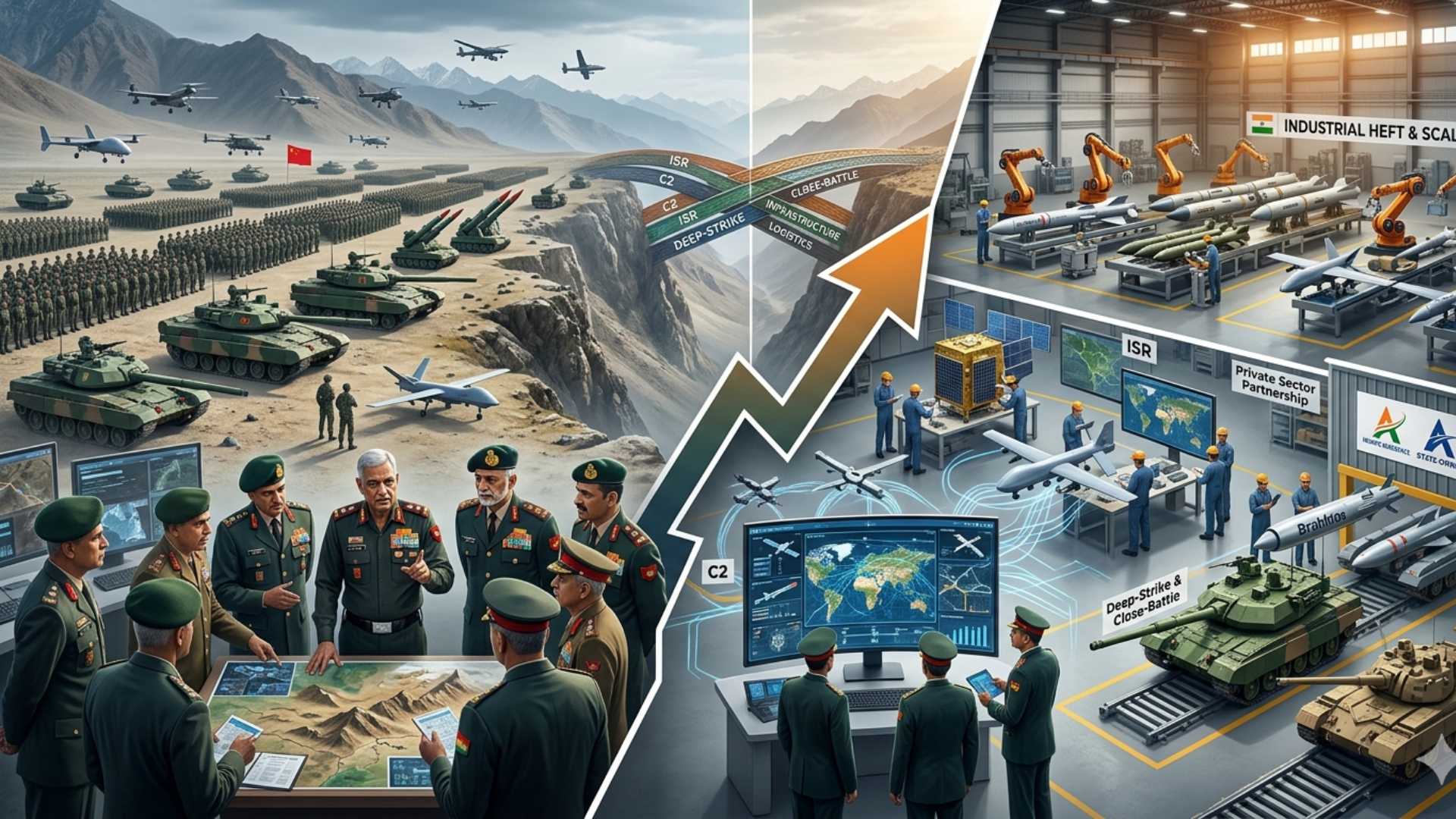
China's military modernisation has created a widening capability gap with India — doctrinal, industrial, and political as much as technological. The PLA fields a sophisticated multi-domain force while India faces a structural mismatch: military requirements exceed defence-industrial capacity to deliver.
"India needs to spend more, but spend smarter by making hard choices in prioritising key deterrent capabilities."
"The window for industrial reform is clearly shrinking."
| Domain | PLA Advantage | India's Status |
|---|---|---|
| Missiles & Munitions | Massive inventory; surge capacity | Inventory gap; limited surge |
| Drones & ISR | Operationalised at scale | Nascent; fragmented |
| C4ISR | Integrated; joint | Fragmented; service-specific |
| Cyber & Space | Advanced offensive capability | Developing |
| Defence Budget | World's 2nd largest | Significantly lower |
| Industrial Base | Speed and scale production | Constrained; PSU-dominated |
Background and Context
The Core Challenge: India's margin of deterrence against China is uncertain and shrinking. The PLA's multi-domain operational doctrine, massive missile inventory, and industrial surge capacity create asymmetries that cannot be addressed through procurement alone. India's defence-industrial base — dominated by public sector entities — is not structured to deliver at the speed and scale that modern conflict demands.
Key Structural Vulnerabilities:
- Fledgling C4ISR (Command, Control, Communications, Computers, Intelligence, Surveillance & Reconnaissance) network.
- Inadequate missile and munitions inventory relative to PLA stockpiles.
- Slow defence procurement system constraining force evolution.
- Limited private sector integration into defence production.
- Doctrinal lag — concepts like Multi-Domain Operations (MDO) are not yet operationalised.
Three Strategic Approaches: A Comparative Framework
| Approach | Core Logic | Strengths | Risks |
|---|---|---|---|
| Bold | Bet on new war-fighting technologies; leapfrog legacy platforms | Could reduce capability gap if successful | Implementation failure creates acute vulnerabilities; India lacks industrial scale |
| Conservative | Integrate emerging tech with in-service platforms; digitise battlespace | Feasible; improves existing force effectiveness | Does not alter balance of power; suited for Pakistan, not China |
| Middle Path | Retain legacy platforms + invest in critical enabling layers (C2, ISR, deep-strike, logistics) | Pragmatic; builds toward MDO incrementally | Slower transformation; requires sustained political will and budgetary stability |
Recommended Path: The Middle Path — building enabling layers progressively while maintaining existing force, allowing India's military to evolve into a syncretic multi-domain force over time.
Key Concepts
Multi-Domain Operations (MDO): Military operations conducted simultaneously across land, air, sea, cyber, space, and electromagnetic domains — designed to overwhelm adversary decision-making. The PLA has operationalised MDO; India is still in the doctrinal phase.
C4ISR — The Decisive Layer:
"Dominating the C4ISR battle is key: the side that can see can continue to fight."
C4ISR integrates command, control, communications, computers with intelligence, surveillance and reconnaissance. It is the nervous system of modern warfare — enabling rapid kill chains, real-time situational awareness, and coordinated multi-domain action. India's C4ISR remains fragmented across services with limited jointness.
Kill Chain Compression: Modern warfare requires shortening the cycle from target detection to engagement. Superior ISR + C2 + precision strike = compressed kill chains. China's advantage here is significant; India must invest in cheap, numerous ISR platforms and superior cyber/electronic warfare to degrade PLA ISR capacity.
Enabling Layers Framework: India's deterrence architecture should be built around six critical layers:
| Layer | Components | Current Status |
|---|---|---|
| C2 (Command & Control) | Joint operations centres, encrypted networks | Fragmented; service-specific |
| ISR | Drones, satellites, sensors, radar | Nascent; significant gaps |
| Deep-Strike | Missiles, long-range aircraft, armed drones | Improving (BrahMos, S-400) |
| Close-Battle | Tanks, guns, infantry fighting vehicles | Legacy-dependent; modernisation underway |
| Logistics | Supply chains, infrastructure, rear-zone integration | Weak for protracted conflict |
| Nuclear Deterrent | Credible second-strike capability | Established; needs conventional backup |
India's Defence-Industrial Challenge
The Core Problem: India's defence-industrial base is not structured to produce at speed and scale. The issue is not technological competence — it is organisational and structural. Public sector dominance (DRDO, DPSUs) has historically prioritised institutional continuity over delivery efficiency.
Urgent Industrial Priorities:
- Missiles, munitions, and drones — high consumption items in modern conflict.
- ISR platforms — cheap, attritable, producible in large numbers.
- C2 networks — software-intensive, requiring private sector agility.
- Shortfall in legacy platform spares and upgrades.
Reform Imperatives:
- Remove red tape in defence licensing and procurement.
- Provide long-term contracts for specialised platforms — ensuring industrial predictability.
- Ensure budgetary stability — annual budget uncertainty disrupts multi-year production programmes.
- Mindset shift: private players can build military systems more efficiently than the government sector.
- Expand the defence-industrial base through private sector integration under Atmanirbhar Bharat in Defence.
"The window for industrial reform is clearly shrinking."
The Missile Inventory Gap — A Critical Risk
China maintains a massive missile inventory with industrial capacity to produce thousands more during conflict. In a war scenario, PLA missile strikes on Indian forward positions, logistics nodes, and airfields could overwhelm India's limited air defence and deplete its own strike inventory rapidly.
India's surge capacity — the ability to rapidly scale production during conflict — is inadequate. This is not merely a procurement gap; it is a deterrence gap, as China may be tempted to initiate a conflict if it calculates India cannot sustain a protracted fight.
Implication: One-off budgetary allocations for missile production, munitions stockpiling, and drone manufacturing are not optional — they are deterrence investments.
Procurement System Reform
India's defence procurement system must evolve from a compliance-oriented, process-heavy model to an outcome-oriented, force-evolution model. Key changes needed:
- Procurement decisions must be rooted in doctrinal requirements, not service-specific wish lists.
- Prioritise enabling layers over platform-centric acquisitions.
- Theatre commands alone will not create multi-domain capability unless underpinned by deep doctrinal convergence across services.
- Military leadership must clearly communicate to political leadership: the costs of inaction and the trade-offs involved in capability choices.
Conclusion
India's deterrence challenge with China is fundamentally about creating uncertainty in Beijing's military calculus — making the costs of aggression unpredictable and unacceptable. No single exquisite capability will alter the balance; rather, it is the systematic construction of enabling layers — C4ISR, deep-strike, logistics, and nuclear backstop — that will build credible deterrence over time. The middle path is India's most realistic option: retain legacy platforms while investing urgently in enabling layers, reform the defence-industrial base to deliver at speed and scale, and build the broadest possible doctrinal consensus on what deterrence India needs and why. Technology will keep evolving — India's strategic institutions must evolve faster.