GS3 Science & Technology

India’s Digital Sovereignty: Reducing Dependence on Foreign Technology

Digital Sovereignty: Why India Must Control Its Critical Technology Infrastructure

Understanding the significance of digital sovereignty in safeguarding India's technological security and maintaining strategic autonomy
Gopi Gopi
4 mins read

"In the digital age, control over technology infrastructure is as important as control over physical territory."

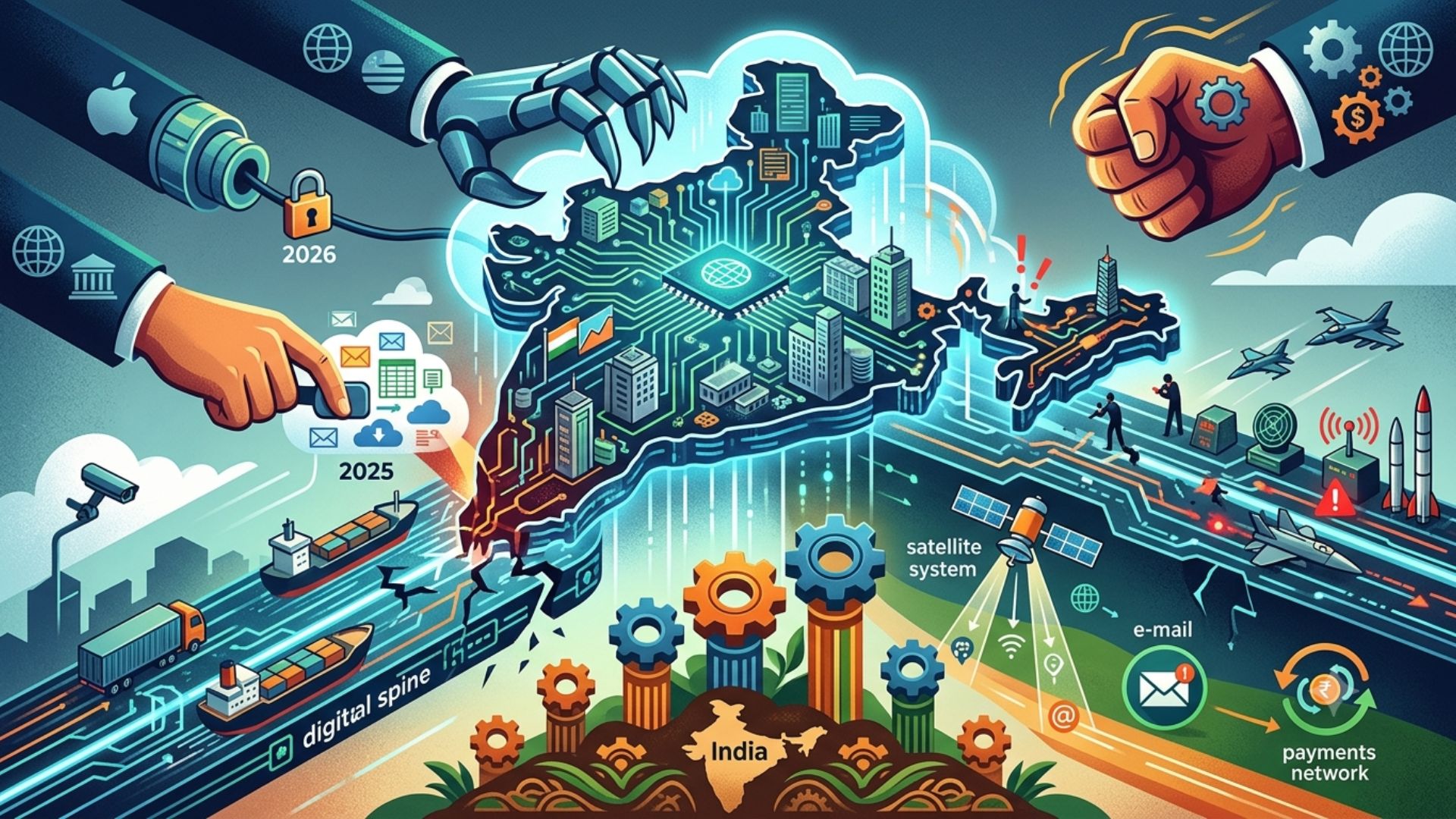
Recent incidents involving compromised CCTV networks and denial of access to critical digital services have highlighted growing concerns regarding India's digital and technological sovereignty. These developments raise important questions about the country's dependence on foreign-owned digital infrastructure and its implications for national security.


What Triggered the Concern?

Two recent incidents exposed India's technological vulnerabilities.

IncidentConcern
Compromise of Indian CCTV networks through Chinese software platform EseeCloudSecurity risk to strategic defence assets
Denial of access to Nayara Energy's email, cloud and collaboration tools due to EU sanctionsDependence on foreign technology platforms

These incidents demonstrate that access to critical digital services can potentially be influenced by foreign corporations and governments.


What is Digital Sovereignty?

Digital sovereignty refers to a nation's ability to control:

  • Its digital infrastructure
  • Data storage and access
  • Critical software platforms
  • Communication networks
  • Strategic technologies

"Control over digital infrastructure determines control over governance, commerce and national security."


Why is Foreign Dependence a Risk?

Many Indian organisations rely on foreign-owned:

• Cloud infrastructure
• Authentication systems
• Productivity suites
• Email platforms
• Collaboration tools
• Data storage services

Even when data is stored within India, foreign technology companies may be legally compelled by their home governments to provide access under existing global data governance regimes.

Potential Consequences

  • Disruption of government services
  • Interruption of trade and commerce
  • Manufacturing slowdowns
  • National security vulnerabilities
  • Loss of strategic autonomy

National Security Dimension

Modern warfare is increasingly software-defined.

Critical military capabilities depend on:

  • Embedded software
  • Navigation systems
  • Radar technologies
  • Battlefield intelligence platforms

A foreign manufacturer exercising software control could potentially:

• Reduce operational effectiveness
• Limit targeting accuracy
• Restrict system capabilities
• Influence intelligence flows

Historical Example

The 1999 Kargil conflict exposed India's dependence on foreign navigation systems when access to precise GPS support was restricted during a critical military operation.


Global Recognition of the Problem

Several countries are pursuing technological sovereignty.

Country/RegionInitiative
FranceSovereign video-conferencing platform by 2027
NetherlandsExploring alternatives to U.S. software
DenmarkReducing dependence on foreign platforms
GermanySeeking domestic software solutions
European UnionDeveloping independent cloud infrastructure
TürkiyeExpanding indigenous technology capabilities

The challenge is therefore not unique to India but part of a wider global trend.


India's Unique Strategic Context

The article places India's situation within the framework of Power Transition Theory.

Core Idea

When a rising power approaches parity with an established hegemon, the latter often seeks to constrain the former.

Examples include:

• U.S.–China technology competition
• Export controls
• Technology restrictions
• Supply-chain realignments

As India's economic and strategic influence grows, technological dependence could become a source of vulnerability.


Steps Already Taken by India

Several initiatives indicate a growing push towards technological self-reliance.

Indigenous Platforms

InitiativeSignificance
NavICIndigenous navigation system
UPIDomestic payment infrastructure
RuPayIndigenous card network
Zoho adoption in ministriesLocal digital platforms
Semiconductor ecosystem initiativesTechnology manufacturing capability

These examples demonstrate that dependence on foreign-controlled systems can be reduced.


Strengthening Defence Technology

India has traditionally relied heavily on public-sector defence production.

Key Challenge

Despite efforts since the 1980s:

  • India still lacks a fully indigenous modern fighter aircraft.

Learning from the U.S. Model

Government:
• Funds research
• Assures procurement

Private Sector:
• Develops technology
• Innovates rapidly
• Enhances competitiveness

The Advanced Medium Combat Aircraft (AMCA) programme's private-sector participation reflects movement in this direction.


Building Partnerships, Not Isolation

Digital sovereignty need not imply technological isolation.

Strategic Partnerships

InitiativeImportance
BrahMos (India-Russia)Joint technology development
Micron ATMP Facility, GujaratIndia-U.S. semiconductor cooperation
Pax Silica InitiativeTrusted AI and supply-chain partnerships

Such collaborations create mutual dependence and reduce the risk of unilateral technological coercion.


The R&D Challenge

A major concern remains India's low investment in research and development.

IndicatorValue
India's R&D expenditure (2000–2020 average)0.74% of GDP
Global average2.07% of GDP

This gap limits India's ability to develop critical technologies independently.

"The question is not whether India can afford technological sovereignty, but whether it can afford to forgo it."


Way Forward

  • Expand indigenous cloud and digital infrastructure.
  • Accelerate semiconductor manufacturing capabilities.
  • Increase R&D expenditure substantially.
  • Promote private-sector participation in strategic technologies.
  • Develop sovereign cybersecurity and authentication systems.
  • Strengthen trusted international technology partnerships.
  • Reduce dependence on single-country technology ecosystems.
  • Build resilient digital infrastructure for critical sectors.

Conclusion

Digital infrastructure has become a foundational pillar of economic growth, governance and national security. The recent security and technology access incidents reveal that dependence on foreign-controlled digital systems can create strategic vulnerabilities. India's experience with NavIC, UPI and RuPay demonstrates that technological self-reliance is achievable. Strengthening digital sovereignty through innovation, partnerships and greater investment in research will be essential for preserving India's strategic autonomy in an increasingly fragmented technological order.

Attribution

Original content sources and authors

Author Sthanu R Nair The Hindu Source The Hindu

Syllabus classification

How this article maps to GS papers

Main syllabus

GS3Science & Technology

Also covers

GS3Indian-Economy

Quick Q&A

What is digital and technological sovereignty, and why has it emerged as a strategic imperative for India in the twenty-first century?
Digital and technological sovereignty refers to the ability of a nation to independently control, develop, secure, and govern its critical digital infrastructure, technological ecosystems, and strategic data without excessive dependence on external entities. In the modern era, digital infrastructure functions as the backbone of commerce, governance, defence, and national security. Consequently, control over technology has become synonymous with strategic autonomy. Recent incidents have highlighted India's vulnerabilities. In April 2026, reports surfaced regarding the compromise of Indian CCTV networks through the Chinese software platform EseeCloud, raising concerns about espionage targeting strategic defence assets. Earlier, in July 2025, Nayara Energy reportedly lost access to Microsoft-managed corporate tools due to the enforcement of European Union sanctions linked to Rosneft's ownership stake. These events exposed how foreign technology companies and external sovereign decisions can influence Indian entities. Historically, the denial of precise GPS support during the 1999 Kargil conflict demonstrated the dangers of technological dependence. In response, India developed the NavIC satellite navigation system. More recently, indigenous initiatives such as UPI, RuPay, and migration of some government ministries to Zoho platforms reflect efforts to strengthen technological autonomy. For UPSC GS-III, this issue intersects with science and technology, cybersecurity, defence preparedness, and economic development. It also relates to GS-II topics such as governance and international relations. Debates continue between proponents of globalization and advocates of strategic self-reliance. However, most experts agree that technological sovereignty is not isolationism but the capability to safeguard national interests while participating in the global economy.
Why is reducing dependence on foreign digital infrastructure becoming increasingly important for India's economic competitiveness and strategic autonomy?
Reducing dependence on foreign digital infrastructure has become essential because modern economies and military capabilities are increasingly software-driven. Critical services such as cloud computing, authentication systems, productivity platforms, communication networks, and defence technologies often rely on foreign-owned infrastructure. Such dependence exposes countries to geopolitical pressures and external disruptions. The Nayara Energy episode in 2025 demonstrated how sanctions imposed by foreign governments could indirectly affect Indian businesses through multinational technology companies. Similarly, the alleged compromise of CCTV systems in 2026 revealed cybersecurity risks arising from dependence on imported technologies. The implications extend beyond economic concerns. In contemporary warfare, software controls targeting systems, radar installations, communication networks, and intelligence gathering. A hostile disruption or denial of service could undermine military readiness. Historical experiences such as the GPS limitations faced by India during the Kargil War of 1999 underscore this risk. Globally, countries are responding similarly. France plans to shift government departments away from Microsoft Teams and Zoom by 2027. Germany, Denmark, and the Netherlands are exploring sovereign alternatives to American cloud and software platforms, while the European Union is investing in independent digital infrastructure. For UPSC GS-III, this topic connects with cybersecurity, indigenization, and strategic technologies. It also has implications for GS-II concerning international relations and governance. Critics argue that complete self-sufficiency is unrealistic and costly. However, the objective is not technological isolation but risk mitigation through diversified partnerships, indigenous innovation, and trusted supply chains. Such measures are essential to preserve economic competitiveness and maintain India's strategic autonomy in an increasingly fragmented geopolitical order.
How can India build comprehensive technological sovereignty through indigenous innovation and trusted international partnerships?
India can achieve technological sovereignty through a balanced strategy that combines indigenous innovation with strategic international cooperation. Absolute self-sufficiency is neither economically feasible nor technologically desirable. Instead, India must focus on reducing vulnerabilities while remaining integrated with the global innovation ecosystem. One pillar of this strategy is promoting indigenous technological platforms. The success of UPI and RuPay demonstrates that India can create globally competitive digital infrastructure. Similar efforts can be extended to cloud services, e-commerce platforms, semiconductor manufacturing, authentication systems, and defence technologies. Second, enhancing private-sector participation is essential. The United States has built world-class defence capabilities through collaboration between government and private companies. India has recently moved in this direction by inviting private firms to participate in the development of the Advanced Medium Combat Aircraft (AMCA). Third, trusted international partnerships can create mutual dependencies that reduce the risks of unilateral actions. The BrahMos missile programme with Russia illustrates the benefits of co-development. Likewise, Micron Technology's semiconductor Assembly, Test, Marking and Packaging facility in Gujarat and India's participation in the U.S.-led Pax Silica initiative represent important steps toward trusted technology ecosystems. Fourth, strengthening domestic semiconductor capabilities, cybersecurity infrastructure, and research institutions is critical. Public procurement and financial incentives can encourage innovation. For UPSC GS-III, the topic relates to indigenization, science and technology, and economic development. It also has relevance for GS-II through strategic partnerships. The challenge lies in balancing self-reliance with globalization. India's objective should be resilient interdependence rather than technological isolation, ensuring both strategic autonomy and continued participation in global value chains.
What are the major reasons behind India's vulnerability in digital infrastructure and critical technology ecosystems?
India's technological vulnerabilities stem from a combination of historical, structural, and institutional factors. Although India has emerged as a leading digital economy, much of its critical infrastructure continues to rely on foreign technologies and platforms. One major reason is the persistent underinvestment in research and development. Between 2000 and 2020, India's gross expenditure on R&D averaged only 0.74% of GDP, significantly lower than the global average of 2.07%. This limited investment has constrained indigenous innovation and technological leadership. Second, India has traditionally depended on imported hardware, software, and defence technologies. This dependence creates strategic risks, particularly when geopolitical tensions affect access to critical systems. Third, excessive reliance on the public sector in defence manufacturing has often resulted in delays and inefficiencies. Despite efforts beginning in the 1980s, India still lacks an indigenous modern fighter aircraft in operational service, reflecting shortcomings in the existing model. Fourth, global technology markets are dominated by multinational corporations headquartered in advanced economies. Their legal obligations to home governments can influence access to digital services and data. The Power Transition Theory offers another explanation. As rising powers approach established powers in economic and strategic capabilities, competitive pressures intensify. The ongoing U.S.-China technology rivalry illustrates this phenomenon, and India could face similar challenges as it advances. For UPSC GS-III, these issues are linked to science and technology, cybersecurity, and indigenization. They also connect with GS-II topics involving international relations and strategic affairs. Addressing these vulnerabilities requires reforms in education, innovation policy, industrial ecosystems, and public-private partnerships to ensure long-term technological resilience.
How do the Kargil conflict, UPI ecosystem, and BrahMos programme illustrate India's journey towards technological self-reliance?
India's pursuit of technological self-reliance can be understood through three significant case studies: the Kargil conflict of 1999, the development of UPI and RuPay, and the BrahMos missile programme. During the Kargil War, India reportedly faced limitations in obtaining precise GPS support at a critical stage of operations. This experience highlighted the strategic dangers of dependence on external technologies. In response, India gradually developed the NavIC satellite navigation system, strengthening indigenous space-based capabilities. The Unified Payments Interface (UPI) and RuPay card network represent another successful example. Prior to these innovations, India's digital payment ecosystem was heavily dependent on foreign networks. Today, UPI processes billions of transactions every month and has emerged as one of the world's largest digital payment platforms. It demonstrates how domestic innovation can create resilient and globally admired infrastructure. The BrahMos missile programme, developed jointly with Russia, showcases a different model based on strategic partnerships. It combines indigenous capabilities with international cooperation, producing one of the world's most advanced supersonic cruise missiles. These examples highlight that technological sovereignty does not imply isolation. Instead, it involves developing critical capabilities while leveraging trusted partnerships. Such approaches have enhanced India's defence preparedness, financial inclusion, and strategic autonomy. For UPSC GS-III, these case studies are relevant to indigenization, defence technology, and innovation ecosystems. They also have implications for GS-II through international cooperation and strategic partnerships. The broader lesson is that crises and external constraints can become catalysts for indigenous innovation. India's future competitiveness will depend on replicating these successes in semiconductors, artificial intelligence, cloud infrastructure, and cybersecurity.
What is the critical analysis of India's approach towards self-reliance in technology and national digital missions?
India's approach to technological self-reliance represents a pragmatic blend of indigenous capability building and international cooperation. Programmes such as Digital India, Semiconductor Mission, Atmanirbhar Bharat, and the expansion of indigenous defence production indicate a strategic recognition of technology as a national security asset. On the positive side, India has achieved remarkable successes in digital public infrastructure. UPI, RuPay, Aadhaar, and indigenous satellite capabilities have received international recognition. Recent initiatives such as the Micron semiconductor facility in Gujarat and private-sector participation in the Advanced Medium Combat Aircraft programme suggest a shift toward more competitive and innovation-driven models. However, several challenges persist. India's R&D expenditure remains substantially below global standards. Dependence on imported semiconductor technologies, cloud infrastructure, operating systems, and advanced defence equipment continues. Bureaucratic delays, inadequate academia-industry linkages, and skill shortages further impede progress. Critics of excessive self-reliance caution that technological nationalism may reduce competitiveness and discourage global collaboration. China's relatively closed technology model has generated both impressive capabilities and international tensions. In contrast, proponents argue that strategic sectors require a degree of autonomy to protect national interests. Therefore, India's approach should avoid both extremes—complete dependence and complete isolation. A framework of 'resilient interdependence' may offer the most viable solution. Under this approach, India develops core strategic technologies domestically while maintaining trusted international partnerships. For UPSC GS-III, the topic encompasses science and technology, indigenization, and economic development. It also has implications for GS-II and international relations. Ultimately, technological sovereignty must be viewed as a long-term strategic objective essential for economic competitiveness, national security, and India's aspirations as a leading global power.

Practice questions

1 question for mains preparation

In an increasingly technology-driven world, technological self-reliance has become essential for safeguarding national sovereignty and security. Discuss in the context of India's digital infrastructure and strategic technologies.

10 marks · 150 words · 8 mins