1.AI as a Transformational Economic Force
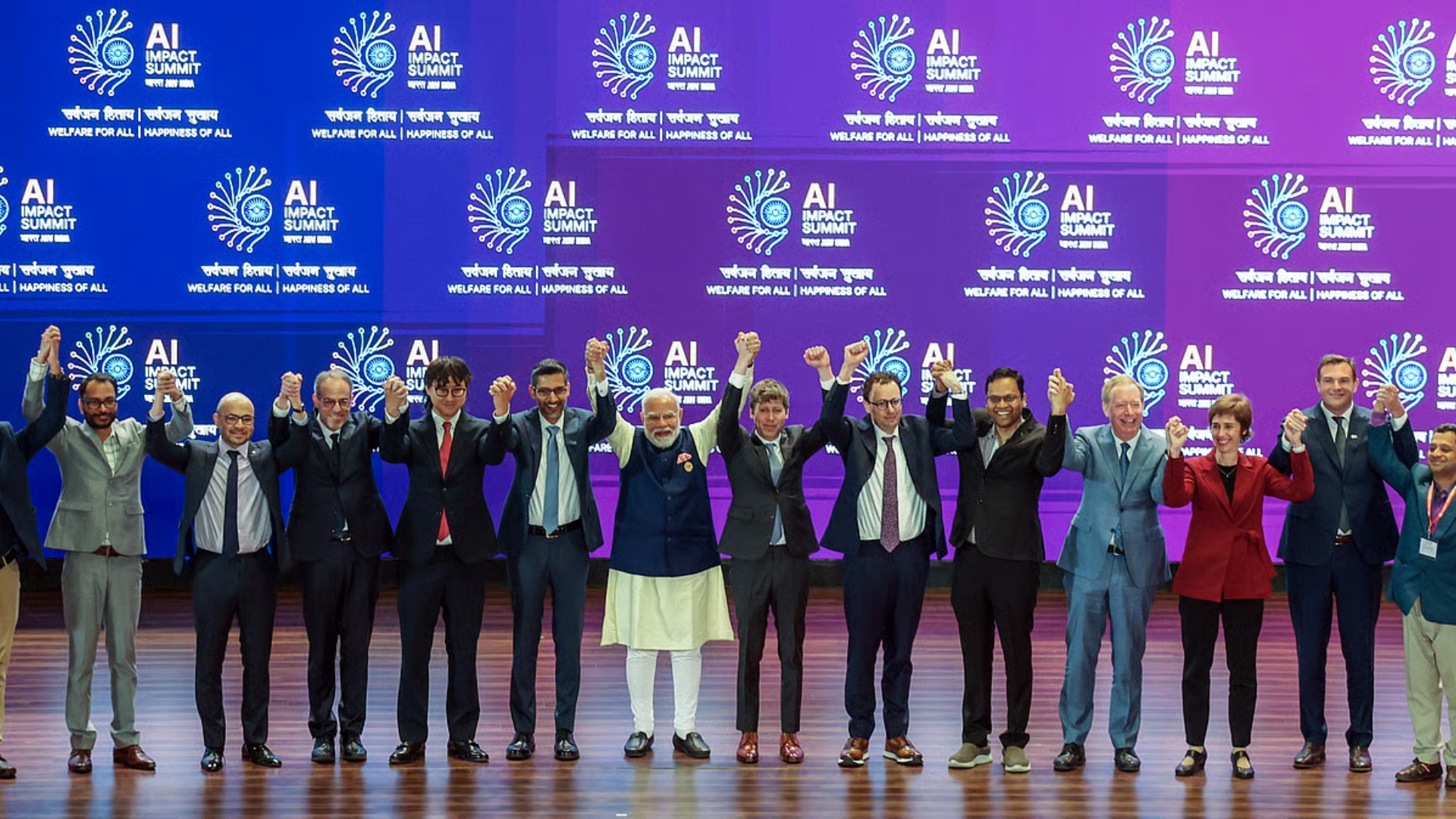
At the AI Impact Summit, global technology leaders framed artificial intelligence (AI) as a once-in-a-generation opportunity capable of accelerating economic growth, particularly in emerging economies. The discussion reflected both optimism about AI’s transformative power and urgency regarding infrastructure, investment, and governance readiness.
Sundar Pichai described the present moment as the cusp of “hyperprogress,” suggesting AI could enable countries to leapfrog legacy development gaps. However, he cautioned that such outcomes are not automatic and require responsible and collaborative development.
“Technology brings incredible benefits, but we must ensure everyone has access to them.” — Sundar Pichai
The summit underscored that AI’s developmental dividend depends on bridging digital divides and ensuring inclusive access.
AI can accelerate productivity and innovation, but without deliberate policy support and inclusive access, technological gains may remain concentrated and deepen inequalities.
2. India’s Strategic Position in the Global AI Landscape
India’s scale, democratic framework, and technical depth were repeatedly highlighted as key strengths. Sam Altman emphasised India’s role not only in building AI systems but also in shaping their trajectory, given its position as the world’s largest democracy.
Dario Amodei pointed to India’s rare combination of technical capacity and growth potential, suggesting the possibility of 20–25% growth in an AI-driven economy — an unusually high projection by global standards.
India’s demographic dividend and expanding digital ecosystem position it as a critical actor in the global AI value chain. Yann LeCun noted that countries with young populations, such as India and African nations, could generate creative AI breakthroughs.
India’s scale and talent base offer a competitive edge. However, demographic advantage must be matched with skilling, research capacity, and infrastructure investment to translate potential into sustained growth.
3. Infrastructure, Capital, and Institutional Readiness
Microsoft President Brad Smith outlined a three-pronged approach for AI development:
- Scaling up digital infrastructure
- Mobilising public and private capital
- Building inclusive, multilingual AI systems for the Global South
AI requires substantial investments in computing infrastructure, data ecosystems, and energy resources. Without adequate infrastructure, emerging economies risk becoming consumers rather than producers of AI technologies.
Public–private collaboration is essential for funding, while institutional readiness ensures effective deployment in sectors such as healthcare, education, governance, and logistics.
AI competitiveness depends on ecosystem development, not just innovation. Infrastructure deficits or capital shortages can limit a country’s ability to harness AI for productivity gains.
4. Governance, Safety, and Responsible AI Development
AI governance and safety were central themes. Alexandr Wang emphasised that AI systems must function reliably and securely, highlighting safety as a core principle.
“Our AI needs to work the way we say it does, as well as we say it does and as safely and securely as we need it to.” — Alexandr Wang
The debate also extended to Artificial General Intelligence (AGI). While some leaders suggested early forms of superintelligence could emerge in the coming years, Yann LeCun characterised AGI discussions as “hype,” instead framing AI as an amplifier of human intelligence.
The divergence reflects broader policy challenges: balancing innovation with regulation, managing risks without stifling growth, and ensuring global coordination.
Unchecked AI deployment can create systemic risks, including ethical, economic, and security concerns. Therefore, governance frameworks must evolve alongside technological advancement.
5. Inclusion and Diffusion: AI for the Global South
A recurring theme was the need for inclusive AI systems tailored to diverse linguistic and socio-economic contexts. Brad Smith stressed the importance of multilingual AI models for the Global South.
India’s scale is evident from digital platform usage:
- 3.5 billion people globally use at least one Meta app daily
- Over 500 million users are in India alone
Such scale creates both opportunity and responsibility. AI systems deployed in populous countries influence global digital norms and practices.
Julie Sweet emphasised that AI must drive broad-based growth and workforce reinvention, with humans leading the transformation.
Inclusive diffusion ensures that AI augments human capabilities rather than replacing them in a disruptive manner. Without equitable access and skill development, technological progress may trigger social backlash.
6. Economic Implications: Growth, Productivity, and Structural Change
AI has the potential to significantly enhance productivity, innovation, and economic growth. Leaders projected that AI could transform enterprise models, workforce structures, and sectoral efficiencies.
However, such growth depends on policy choices regarding investment, skilling, digital infrastructure, and governance mechanisms. Emerging economies must decide whether to focus on adoption, innovation, or platform development.
AI-driven growth also intersects with broader issues such as employment patterns, digital sovereignty, and global competitiveness.
AI-led economic transformation requires coordinated reforms in education, infrastructure, and regulation. Without strategic planning, growth opportunities may be uneven or externally driven.
Conclusion
The AI Impact Summit highlighted artificial intelligence as both an extraordinary opportunity and a complex governance challenge. For India, demographic strength, digital scale, and democratic institutions provide a strong foundation to shape AI’s global trajectory.
However, realising AI’s economic promise will require sustained investments in infrastructure, inclusive diffusion, responsible governance, and institutional capacity. The challenge is not merely to adopt AI technologies, but to integrate them into a development strategy that balances innovation, equity, and long-term sustainability.*