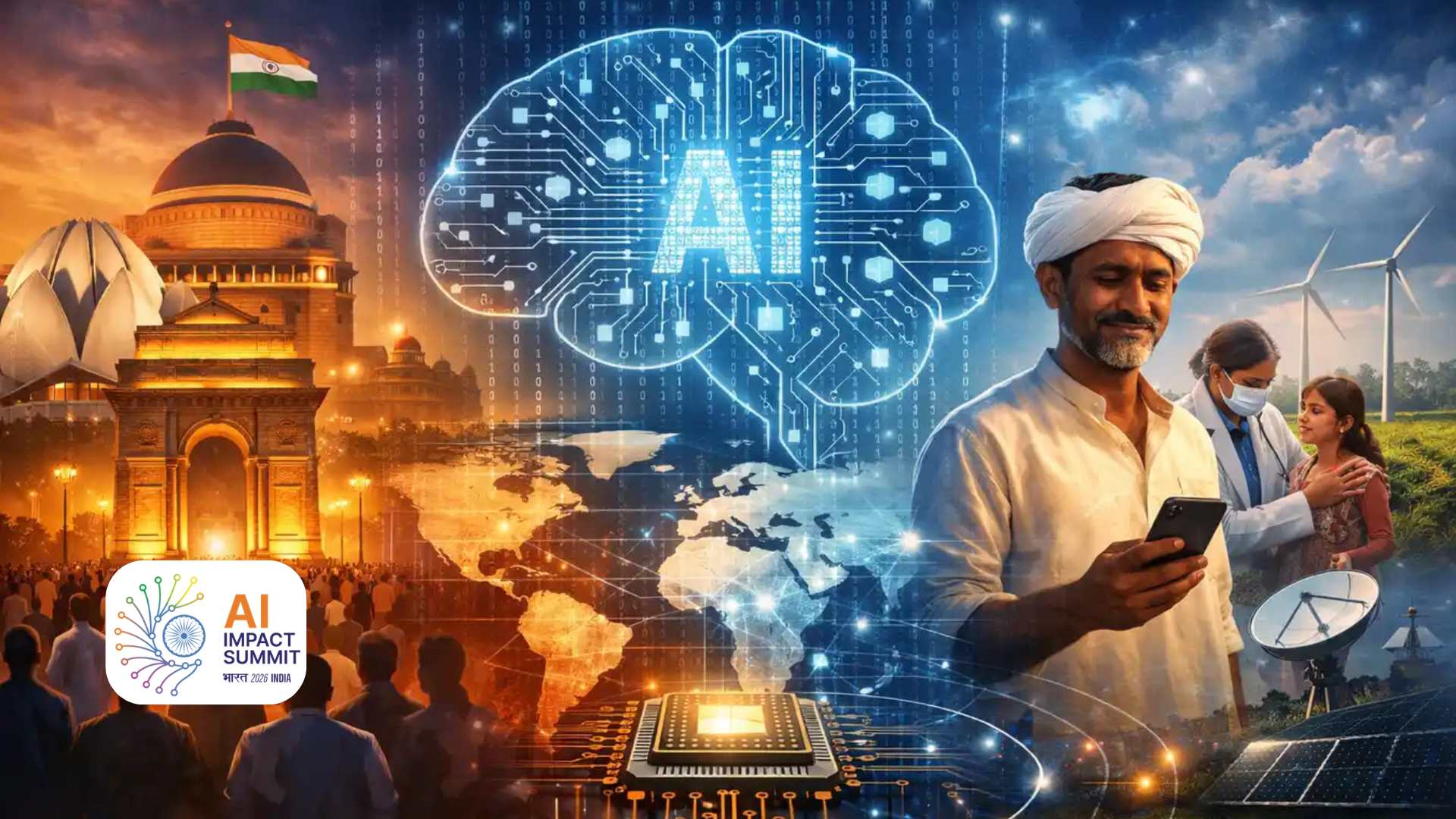
AI Impact Summit 2026: India’s Strategic Positioning in the Global AI Order
1.India’s AI Diplomacy and Global Positioning
The AI Impact Summit in New Delhi comes at a time when artificial intelligence is rapidly transforming economies, governance, and geopolitics. With participation from over 100 countries, India seeks to position itself as a credible and independent voice in a domain largely dominated by the United States and China.
The Summit aims to amplify the Global South’s perspective in shaping AI governance norms. Rather than merely adopting Western market-led approaches or Chinese state-led models, India seeks to influence global standards in a manner aligned with developmental priorities.
This reflects a broader shift in India’s foreign policy—from rule-taker to rule-shaper—especially in emerging technologies. If India fails to engage actively at this stage, it risks long-term technological dependence and diminished regulatory influence.
AI governance is increasingly linked to strategic autonomy and economic competitiveness. Proactive participation allows India to shape norms; passive engagement could result in externally imposed standards misaligned with domestic needs.
2. India’s AI Demand Advantage and Investment Momentum
India is one of the world’s largest consumer markets for AI tools, with rapid adoption across firms and households. This strong domestic demand creates a “demand pull” that attracts global capital and technology investments.
Major global technology firms have announced substantial commitments:
- Amazon: $35 billion through 2030
- Microsoft: $17.5 billion over four years
- Google: $15 billion for its largest AI and data-centre hub outside the US
India’s digital public infrastructure (DPI), low-cost data ecosystem, and regulatory clarity after the Digital Personal Data Protection Act have strengthened investor confidence.
These developments link GS3 (Science & Technology, Economy) with GS2 (Governance & Regulation). Sustained investment could enhance India’s digital economy, but policy predictability and infrastructure readiness remain critical.
Domestic market scale provides leverage in global tech competition. However, without regulatory stability and infrastructure depth, capital inflows may not translate into sustainable technological capability.
3. Frontier Models vs Application-Led Strategy
India faces a strategic trade-off between investing in expensive frontier-scale AI models and focusing on domain-specific, application-led deployment aligned with domestic priorities.
The Economic Survey flagged the asymmetry between frontier-model development and application deployment, warning that closing the frontier gap with global leaders could entail prohibitive costs. Therefore, India’s approach emphasises sectoral AI use cases in governance, agriculture, health, and education.
Structural initiatives include:
- Expansion of compute access via 38,000 GPUs
- Creation of the AI Kosha dataset repository
- Establishment of an AI Safety Institute
- Development of an AI incidents database
This approach prioritises diffusion and inclusion over technological prestige.
Allocating scarce resources toward application-led systems can maximise developmental impact. Chasing frontier parity without fiscal and ecosystem readiness may crowd out essential social investments.
4. Governance Architecture: Accountability and Data Regulation
The editorial underscores that voluntary compliance by firms will not suffice in AI governance. As incentives often push firms toward opacity, enforceable accountability mechanisms, robust data governance, and clear redress systems are essential.
The Digital Personal Data Protection Act provides regulatory stability, but AI-specific risks—bias, wrongful exclusion, and opaque decision-making—require institutional safeguards. Algorithmic systems can produce exclusionary outcomes that affect welfare delivery, credit access, and employment.
This connects to GS2 themes of transparency, accountability, and institutional capacity. Effective governance must balance innovation with rights protection.
Without enforceable oversight, AI diffusion may amplify systemic bias and erode public trust. Regulatory credibility is essential for both citizen protection and sustained investor confidence.
5. Infrastructure Constraints and Environmental Trade-offs
India’s data-centre capacity remains a small fraction of the global total. Moreover, India lacks homegrown AI firms that have achieved meaningful global scale.
Hyperscale AI infrastructure demands:
- Uninterrupted power supply
- Advanced cooling systems
- High-capacity fibre connectivity
- Significant water usage
The design choices made today will determine whether AI expansion deepens environmental stress or aligns with sustainable development goals (SDGs).
This issue integrates GS3 (Environment, Infrastructure) with technology policy. Compute expansion without sustainable planning may increase energy and water pressures.
AI competitiveness depends not only on algorithms but also on physical infrastructure. Ignoring environmental and energy constraints could create long-term sustainability risks.
6. Fragmented Global Governance and the Need for Cooperation
The Summit takes place amid a fragmented global AI governance landscape. The 2023 Bletchley Park AI Safety Summit produced declarations but did not achieve consensus on long-term risks or enforcement mechanisms.
Even stringent regulation of large technology firms cannot fully prevent diffuse misuse by numerous developers worldwide. International spillovers complicate harmonised standards, yet global dialogue remains essential.
India’s convening role can enhance its diplomatic profile and strengthen multilateral engagement in emerging technologies (GS2 & IR).
In the absence of coordinated governance, AI risks could transcend borders. Active participation in global standard-setting enhances both technological and diplomatic leverage.
7. Employment, Skilling and Social Adjustment
AI’s rapid evolution raises concerns about labour market disruption. While the editorial does not quantify job displacement, it highlights the need for AI-skilling to absorb an expanding workforce.
This links to India’s demographic profile and skilling imperatives (GS3: Human Capital). Without proactive skilling strategies, technological adoption may widen inequality and exacerbate structural unemployment.
The debate must therefore include workforce adaptation, reskilling frameworks, and educational reforms aligned with AI-driven sectors.
Technological change without human capital adaptation can produce social instability. Aligning AI growth with skilling policies ensures inclusive economic transformation.
8. Measuring Success Beyond Investment Announcements
The Summit’s success should not be measured solely by headline investment figures. While capital commitments are important, institutional depth, regulatory clarity, sustainability planning, and workforce readiness are equally critical.
India’s challenge is to convert diplomatic visibility and financial pledges into durable ecosystem capability—compute access, innovation ecosystems, governance mechanisms, and skilled manpower.
Therefore, the Summit can serve as a starting point for defining long-term direction and standards rather than an endpoint marked by announcements.
Symbolic leadership must translate into structural capability. Without institutional consolidation, investment inflows may not yield enduring technological sovereignty.
Conclusion
The AI Impact Summit reflects India’s ambition to shape global AI governance while strengthening its domestic technological ecosystem. With strong demand, significant global investments, and emerging institutional frameworks, India possesses important advantages.
However, strategic choices between frontier ambitions and application-led deployment, infrastructure sustainability, enforceable governance, and workforce adaptation will determine long-term outcomes. If integrated coherently, India can emerge not merely as a large AI market, but as a responsible rule-shaper and innovation-driven economy aligned with inclusive and sustainable development goals.