Google Uncovers Radiation Threat to Quantum Computers

Introduction
"The future of quantum computing will not be decided by ambition alone — it will be decided by the ability to tame errors at the subatomic level."
-
Quantum computing represents one of the most consequential technological frontiers of the 21st century — promising to solve calculations exponentially faster than classical computers in fields ranging from drug discovery to cryptography.
-
Yet a May 2026 study by Google Quantum AI, published in Physical Review X, has revealed a new class of error — correlated phase error bursts — that could set a hard upper limit on the reliability of current quantum systems.
| Technology Frontier | Potential Application |
|---|---|
| Quantum Computing | Cryptography, drug discovery, climate modelling, logistics |
| Artificial General Intelligence | Autonomous reasoning, scientific research |
| Programmable Biology | Gene editing, synthetic organisms |
| Metamaterials | Stealth, sensing, structural engineering |
| Sustainable Energy | Grid storage, fusion power |
Background & Context
Classical vs. Quantum Computing
Classical computers process information in bits — binary states of 0 or 1. Quantum computers use qubits, which exploit quantum mechanical properties (superposition and entanglement) to process multiple states simultaneously — enabling speed and complexity classical machines cannot match.
Why Quantum Matters for Governance and Security
→ Cryptography — quantum computers can break current encryption standards; nations with quantum capability gain asymmetric intelligence advantages
→ Drug discovery — simulate molecular interactions beyond classical computational reach
→ Climate modelling — process atmospheric data at resolutions impossible today
→ Logistics and supply chains — solve optimisation problems at national scale
India's National Quantum Mission (2023) — with an outlay of ₹6,003 crore over 8 years — reflects the strategic recognition that quantum capability is a sovereign necessity.
Key Concepts
1. The Qubit and Its Fragility
A qubit is the fundamental unit of quantum information. Unlike a classical bit, it can exist in superposition — representing 0, 1, or both simultaneously. This power comes with extreme physical sensitivity:
→ Quantum chips operate at temperatures lower than outer space
→ The slightest vibration, heat, or electromagnetic disturbance causes decoherence — the qubit loses its quantum state
→ Most advanced quantum chips are built on superconducting circuits — materials that conduct electricity without resistance at near-absolute-zero temperatures
2. The Ionising Radiation Problem
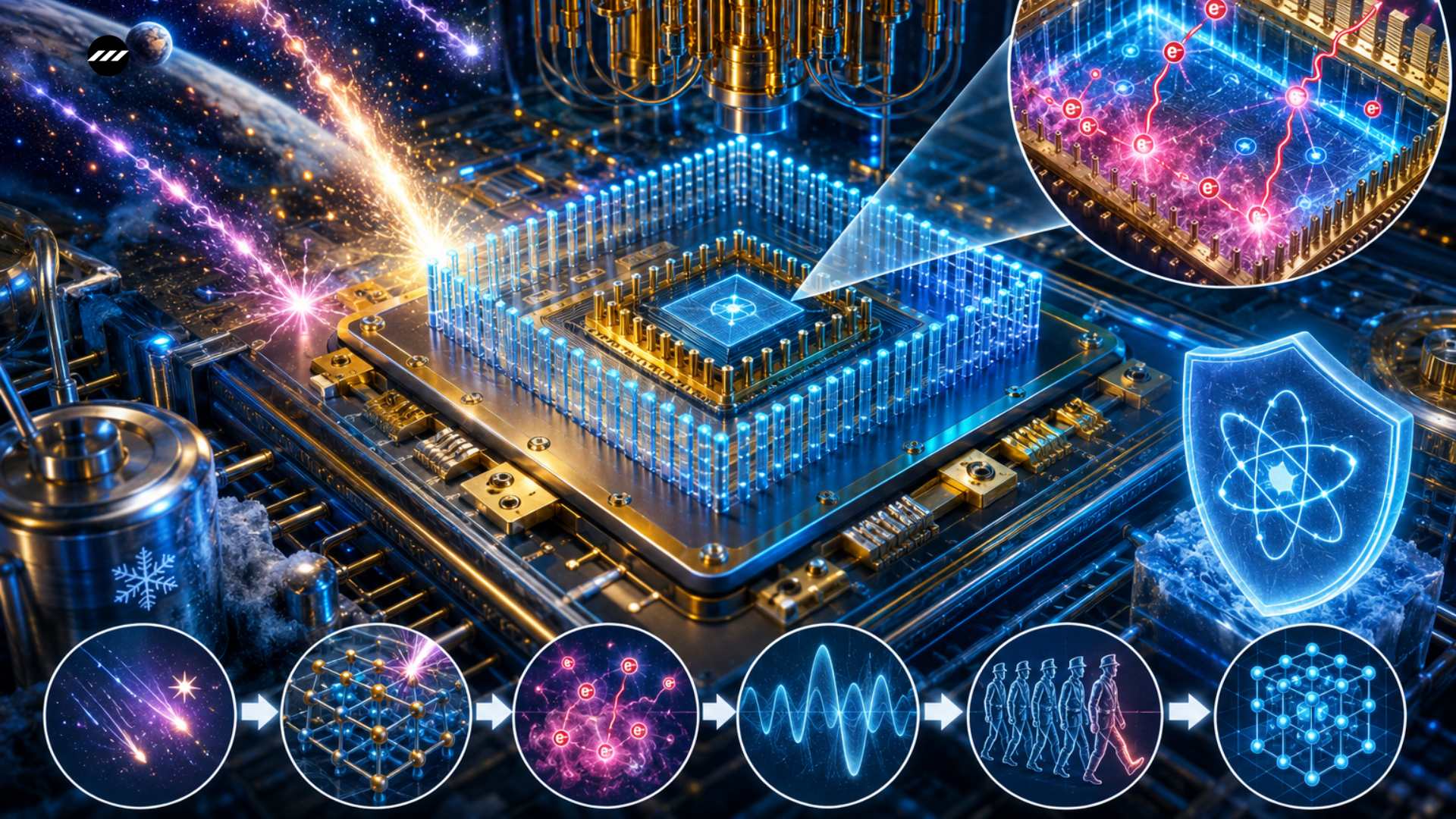
Both cosmic rays (high-energy particles from outer space) and trace radioactive elements in Earth's crust emit ionising radiation. When this radiation strikes a quantum chip's silicon substrate:
→ It creates a splash of vibrations (phonons) rippling across the chip
→ These vibrations break apart Cooper pairs — the electron pairs that enable superconductivity
→ The break-up generates a swarm of quasiparticles — electronic debris flooding the chip
3. Correlated Phase Error Bursts — The New Threat
| Error Type | Nature | Impact |
|---|---|---|
| Independent qubit error | Single qubit fails randomly | Manageable via quantum error correction |
| Correlated phase error burst | Many qubits shift frequency simultaneously | Undermines error correction assumptions entirely |
A single radiation event can shift qubit frequencies by up to 3 megahertz for 1 millisecond — an eternity in quantum timescales. Because the shift hits multiple qubits simultaneously, the computer loses coordination across its entire processing architecture at once.
4. Quantum Error Correction (QEC) — And Its Limitation
Quantum Error Correction is a set of techniques that allow a quantum computer to continue functioning even when individual qubits fail — analogous to redundancy systems in aircraft or nuclear plants.
QEC's foundational assumption: errors in different qubits are independent of each other.
Correlated phase error bursts directly nullify this assumption — multiple qubits fail in concert, not independently. The Google study suggests this could set a hard reliability ceiling on current quantum architectures.
Implications & Challenges
1. Technological Ceiling Risk
If correlated errors cannot be mitigated, current superconducting quantum architectures face a fundamental reliability limit — not a engineering problem to be iterated away, but a physics-level constraint requiring architectural rethinking.
2. National Security Implications
Nations investing in quantum computing for cryptography and signals intelligence must factor reliability limits into their strategic timelines. An unreliable quantum computer is not merely inefficient — in security applications, it is dangerous.
3. India's Quantum Mission — Timing and Risk
India's ₹6,003 crore National Quantum Mission targets quantum computers with 50–1000 physical qubits by 2031. The correlated error problem directly bears on this target:
→ Qubit count alone is insufficient — error rates per qubit determine real-world utility
→ India must invest simultaneously in error mitigation research, not merely hardware scaling
→ Academic-industry-government linkages (IITs, IISc, TIFR) must be deepened for indigenous error correction capability
4. Solutions in Development
Researchers have identified at least two mitigation pathways:
→ Quasiparticle traps — engineered structures that absorb ionising radiation's splash before it reaches sensitive qubit components
→ Vibration dampening technologies — materials and design approaches that attenuate phonon propagation across the chip substrate
These are promising but not yet production-ready — meaning the reliability ceiling remains active for the near term.
Comparison: Quantum Hardware Approaches
| Architecture | Basis | Strength | Vulnerability |
|---|---|---|---|
| Superconducting (Google, IBM) | Cooper pairs at near-0K | Fast gate operations | Ionising radiation, correlated errors |
| Trapped Ion (IonQ, Honeywell) | Laser-manipulated ions | Low error rates | Slow gate speed |
| Photonic | Light-based qubits | Room temperature operation | Scalability challenges |
| Topological (Microsoft) | Majorana fermions | Theoretically error-resistant | Not yet demonstrated at scale |
Way Forward
→ Radiation-hardened chip design — develop substrate materials and chip architectures that absorb or deflect ionising radiation before it triggers correlated errors
→ Diversify quantum hardware approaches — India's National Quantum Mission should fund multiple architectural pathways, not exclusively superconducting systems
→ Error correction research as sovereign priority — indigenous quantum error correction algorithms reduce dependence on foreign IP in a strategically sensitive domain
→ Underground quantum labs — shielding quantum chips from cosmic radiation may require purpose-built underground facilities, as with particle physics experiments
→ International collaboration with safeguards — quantum research benefits from global collaboration (CERN model) but requires IP and security protocols given dual-use implications
Conclusion
"Quantum computing sits at the intersection of physics, engineering, national security, and economic competitiveness."
-
The correlated phase error burst discovery is a reminder that frontier technology does not progress linearly: each solution reveals the next layer of complexity.
-
India's National Quantum Mission represents a serious sovereign commitment, but hardware ambition must be matched by equally serious investment in error mitigation, indigenous algorithm development, and research infrastructure.
-
The race to quantum advantage will ultimately be won not by the nation that builds the most qubits, but by the one that builds the most reliable ones.
Attribution
Original content sources and authors
.jpeg)

Syllabus classification
How this article maps to GS papers
Main syllabus
GS3Science & TechnologyQuick Q&A
What is quantum computing, and how does it differ from classical computing?
Structural differences:
- Classical computers rely on semiconductors, while quantum computers often use superconducting circuits.
- Quantum systems require extreme conditions, such as temperatures colder than outer space, to maintain coherence.
- They are highly sensitive to environmental disturbances like heat, vibration, and radiation.
Example: Google’s quantum processor Sycamore demonstrated "quantum supremacy" by solving a problem in minutes that would take classical supercomputers thousands of years. However, such achievements are still experimental.
Limitations: Despite their promise, quantum computers are fragile and prone to errors. The recent discovery of issues like correlated phase error bursts highlights that scaling up quantum systems for practical use remains a major scientific and engineering challenge.
Why is quantum computing considered a critical frontier in future technology?
Strategic importance:
- In pharmaceuticals, it can simulate molecular interactions to accelerate drug development.
- In climate science, it can improve predictive models for weather and environmental changes.
- In cybersecurity, it poses both opportunities (quantum encryption) and threats (breaking classical encryption).
Geopolitical implications: Countries like the U.S., China, and members of the EU are investing heavily in quantum technologies to gain technological supremacy. For India, initiatives like the National Quantum Mission reflect recognition of its strategic importance.
Challenges: Despite its promise, quantum computing faces hurdles such as hardware fragility, error correction limitations, and high costs. The discovery of radiation-induced errors underscores the complexity of making quantum systems reliable.
Conclusion: Thus, quantum computing is not just a technological innovation but a strategic asset that could redefine economic and military power in the coming decades.
How do radiation-induced quasiparticles affect the functioning of quantum computers?
Mechanism of disruption:
- The radiation creates vibrations that break apart Cooper pairs (paired electrons essential for superconductivity).
- This results in the formation of quasiparticles, which act like electronic disturbances.
- These quasiparticles spread across the chip, interfering with qubit operations.
Impact on performance: Even if physical barriers prevent quasiparticles from directly entering sensitive regions, their presence can alter the frequency of qubits. This leads to loss of synchronization, similar to soldiers falling out of step in a parade.
Example from research: The Google Quantum AI study found that a single radiation event could disrupt multiple qubits simultaneously for up to a millisecond—a significant duration in quantum operations.
Implications: This phenomenon challenges the assumption that errors occur independently, complicating error correction strategies and limiting the scalability of quantum systems.
What are correlated phase error bursts, and why do they pose a significant challenge to quantum error correction?
Why they are problematic:
- Quantum error correction (QEC) relies on the assumption that errors occur independently across qubits.
- Correlated errors violate this assumption, making it difficult for QEC algorithms to detect and correct them effectively.
- They can cause a sudden loss of coherence across the system, leading to computational failure.
Scientific insight: The study by Google Quantum AI demonstrated that such bursts could shift qubit frequencies by several megahertz for a relatively long duration, disrupting coordinated operations.
Broader implications:
- They may impose an upper limit on the reliability and scalability of current quantum architectures.
- They highlight the need for new error models and robust hardware solutions.
Conclusion: Addressing correlated phase error bursts is essential for achieving fault-tolerant quantum computing, which is a prerequisite for real-world applications.
Critically analyse the challenges and potential solutions for improving the reliability of quantum computers.
Key challenges:
- Fragility: Quantum systems require अत्यंत low temperatures and isolation.
- Error rates: High susceptibility to decoherence and operational errors.
- Correlated errors: Newly discovered phenomena like phase error bursts complicate error correction.
Potential solutions:
- Development of quantum error correction (QEC) techniques to detect and fix errors.
- Use of quasiparticle traps to absorb unwanted disturbances.
- Engineering solutions to dampen vibrations and shield chips from radiation.
Case study: Researchers at Jülich Research Centre have proposed using traps and damping technologies to mitigate radiation effects. These innovations aim to improve coherence times and system stability.
Critical perspective: While these solutions are promising, they add complexity and cost to quantum systems. Moreover, no solution fully addresses correlated errors yet, indicating that fundamental breakthroughs may still be required.
Conclusion: Ensuring reliability in quantum computing will require a combination of hardware innovation, theoretical advances, and scalable engineering solutions.
Can you provide a real-world example illustrating the challenges faced in scaling quantum computing systems?
Key issue observed:
- The discovery of correlated phase error bursts caused by ionising radiation.
- A single radiation event could disrupt multiple qubits simultaneously.
- This leads to synchronization loss and computational errors.
Implications for scaling:
- Larger systems with more qubits are more susceptible to such correlated disturbances.
- Error correction becomes increasingly complex as the number of qubits grows.
- Infrastructure requirements (cooling, shielding) become more demanding and expensive.
Broader context: Similar challenges are faced by other organizations like IBM and Rigetti, which are also working on superconducting qubit systems.
Conclusion: This example illustrates that while quantum computing has achieved theoretical breakthroughs, practical scalability remains constrained by physical and engineering limitations, necessitating continued research and innovation.
Practice questions
2 questions for mains preparation