Introduction
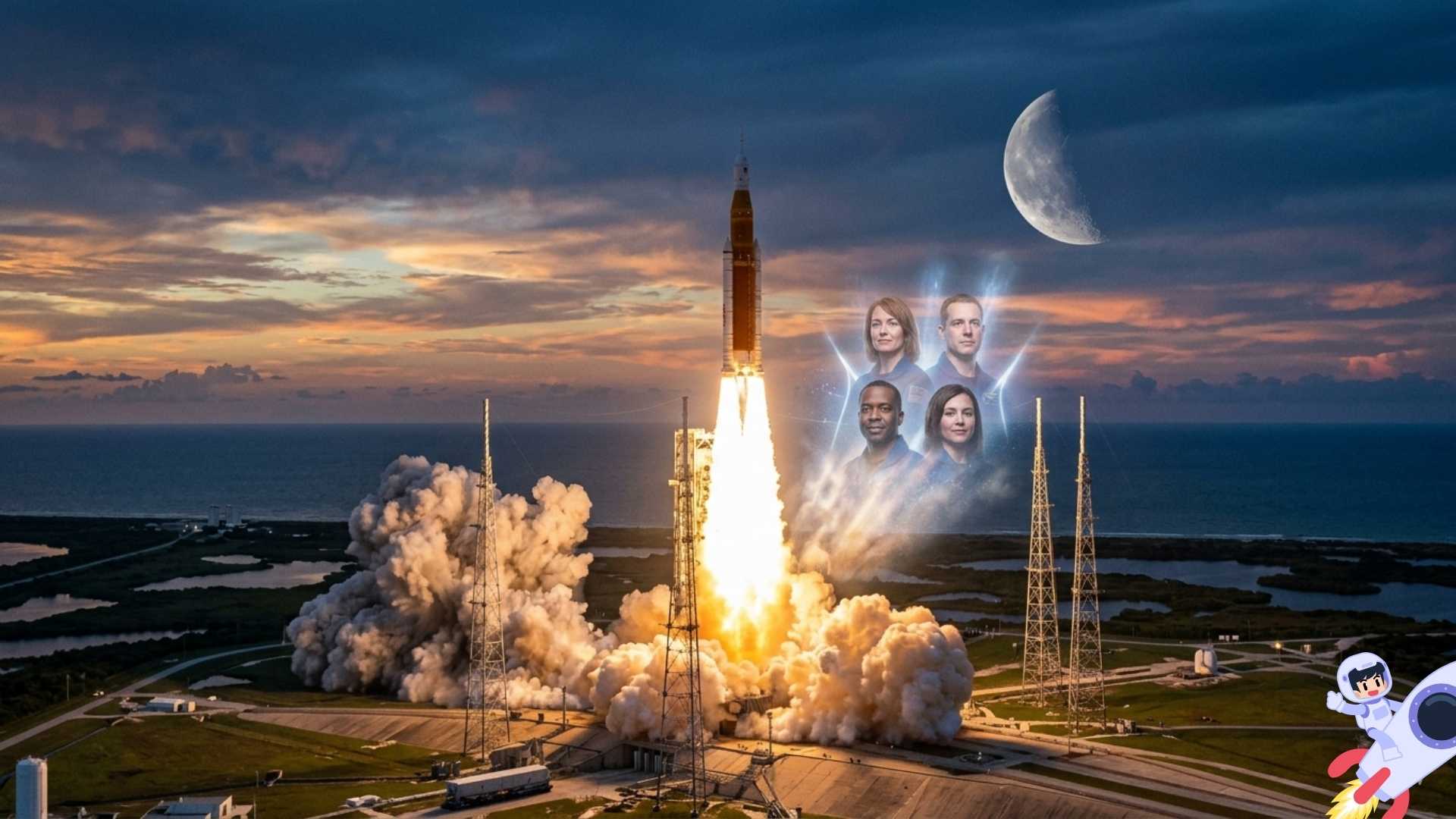
For the first time since Apollo 17 in 1972, humans are set to travel beyond low-Earth orbit — marking a defining moment in space exploration and geopolitics alike. NASA's Artemis II mission, launching no earlier than April 2026, represents not just a technological milestone but a strategic response to China's rapidly advancing lunar programme. With the moon's south pole holding potentially game-changing water ice deposits, the race to establish a permanent human presence on the moon has become inseparable from 21st-century great power competition.
"With credible competition from our greatest geopolitical adversary increasing by the day, we need to move faster, eliminate delays, and achieve our objectives." — Jared Isaacman, NASA Administrator
| Indicator | Detail |
|---|---|
| Last crewed beyond low-Earth orbit | Apollo 17, 1972 (54 years ago) |
| Artemis programme total cost so far | $93 billion+ |
| Cost per Artemis launch | ~$2 billion |
| Closest approach to moon (Artemis II) | ~7,500 km from surface |
| Re-entry speed | ~40,000 km/hr |
| Re-entry heat shield temperature | Up to 5,000°C |
Key Concepts
| Term | Meaning |
|---|---|
| SLS (Space Launch System) | NASA's most powerful rocket, designed for deep-space missions |
| Orion Capsule | Crew module designed for beyond-low-Earth-orbit travel |
| Free-Return Trajectory | Flight path using gravity to loop around the moon and return to Earth without propulsion |
| Trans-Lunar Injection (TLI) | Engine burn that propels a spacecraft from Earth orbit toward the moon |
| Low-Earth Orbit (LEO) | Orbit within ~2,000 km of Earth — where ISS operates |
| Lunar Gateway | Planned (now cancelled) space station in lunar orbit |
| Artemis Accords | US-led framework for international cooperation in lunar exploration; 50+ signatory nations |
Mission Profile: What Artemis II Will Do
Artemis II is a crewed test flight — not a lunar landing. Its objectives are to validate the entire system before committing to surface operations.
Crew (Historic Firsts):
- Reid Wiseman — Commander
- Victor Glover — Pilot; first person of colour on a lunar trajectory
- Christina Koch — Mission Specialist; first woman on a lunar trajectory
- Jeremy Hansen (Canadian Space Agency) — first non-US citizen on a lunar trajectory
Mission Sequence:
- SLS launches Orion; core stage separates
- Crew spends 24 hours in high Earth orbit checking life-support systems
- Trans-lunar injection burn sends Orion toward the moon
- Free-return trajectory loops around the far side; reaches ~7,500 km from the surface
- Earth's gravity pulls Orion back; re-entry at ~40,000 km/hr
- Splashdown in the Pacific Ocean after ~10 days
Data Collection Priorities:
- Physiological and biological responses to deep-space travel
- Heat shield performance (modified re-entry trajectory after Artemis I erosion issue)
- Communications, navigation, and manual piloting systems
The Artemis Programme: Revised Roadmap
NASA Administrator Isaacman overhauled the Artemis timeline in 2025, restructuring missions to increase cadence and reduce risk:
| Mission | Original Plan | Revised Plan | Timeline |
|---|---|---|---|
| Artemis II | Crewed lunar flyby | Crewed lunar flyby (unchanged) | 2026 |
| Artemis III | First lunar landing (21st century) | Crewed Earth-orbit docking test with SpaceX/Blue Origin lunar landers | 2027 |
| Artemis IV | Follow-on mission | First actual lunar landing | 2028 |
| Thereafter | Periodic missions | At least one surface landing per year | 2028+ |
Key structural changes:
- SLS flew in same configuration as Artemis I (abandoned planned upgrade to avoid delays)
- Lunar Gateway cancelled — resources reallocated to south pole surface infrastructure
- Mission frequency increased to prevent workforce attrition and institutional memory loss
The China Factor: Geopolitical Dimension
China's lunar programme is advancing on a disciplined, state-driven timeline — in sharp contrast to the US's commercially distributed, coalition-based model.
| Parameter | USA (Artemis) | China (CLEP) |
|---|---|---|
| Model | Commercial + multilateral (50+ Artemis Accords nations) | State-directed, incremental |
| Key Rocket | SLS (operational) | Long March-10 (test flight Feb 2025) |
| Crew Capsule | Orion | Mengzhou (test flight planned 2026) |
| Lunar Lander | SpaceX Starship / Blue Origin Blue Moon | Lanyue (maiden flight 2028–29) |
| Crewed Moon Landing Target | Artemis IV — 2028 | 2030 |
| Robotic Missions | Artemis precursor missions | Chang'e 7 (2026), Chang'e 8 (~2029) |
| Long-term Plan | Artemis base at south pole | International Lunar Research Station (2030s) |
The Strategic Prize: Water Ice at the Lunar South Pole
The moon's south pole contains permanently shadowed craters that have never been exposed to sunlight. These are expected to harbour water ice — a resource of immense strategic value:
- Water can be split into hydrogen and oxygen — rocket propellant for deeper space missions
- It enables in-situ resource utilisation (ISRU) — reducing dependence on Earth resupply
- Control over these deposits could shape scientific, commercial, and geopolitical rules for future lunar activity
The country that establishes infrastructure first at the south pole gains a first-mover advantage analogous to controlling strategic maritime chokepoints. This is why China's Chang'e 7 (2026) is specifically targeting south pole resource mapping, and why NASA cancelled the Lunar Gateway in favour of direct south pole infrastructure.
Scenario Analysis: Stakes of Artemis II
If Artemis II Succeeds:
- Validates SLS-Orion system; builds institutional and political confidence
- Accelerates partner nations' commitment to Artemis III and IV
- Signals US technological credibility in the space race
If Artemis II Is Delayed Again:
- Erodes public and partner confidence (already delayed 3+ times)
- Cascading complications for ESA, JAXA, and other partners
- Renews debate about programme cost-effectiveness ($93 billion+)
If Artemis II Fails Catastrophically:
- Multi-year programme halt; political and budgetary crisis
- Partners may suspend involvement
- Could trigger a more aggressive, less methodical US response to China
Broader Significance for Science & Technology
- Deep-space medicine: Data on human physiological responses to radiation and microgravity beyond LEO — critical for future Mars missions
- Materials science: Heat shield technology enduring 5,000°C re-entry temperatures
- In-orbit refuelling: SpaceX must demonstrate this for Artemis III — a technology with broad implications for satellite servicing and space logistics
- Public-private partnerships in space: Artemis is the most ambitious test of the commercial space model, with SpaceX and Blue Origin as mission-critical contractors
India's Relevance
- India is a signatory to the Artemis Accords, committing to norms of transparency, interoperability, and peaceful lunar exploration
- ISRO's Chandrayaan-3 (2023) confirmed water ice presence near the lunar south pole — directly validating the strategic rationale for the US-China race
- India's growing space capability positions it as a potential partner in future lunar infrastructure, though it is not part of the Artemis crewed mission architecture currently
Conclusion
Artemis II is simultaneously a test of hardware, institutional resilience, and geopolitical will. The moon has returned to the centre of great power competition — not for ideological symbolism as in the Cold War, but for concrete strategic and resource advantages. Water ice at the lunar south pole is the 21st century's equivalent of a contested maritime strait. For a rising space power like India, the unfolding US-China lunar rivalry offers both lessons and opportunities: the value of incremental, reliable mission design; the strategic importance of space diplomacy through frameworks like the Artemis Accords; and the long-term imperative of developing indigenous deep-space capability. The race is not just to the moon — it is to shape the rules of the space economy for decades to come.