Introduction
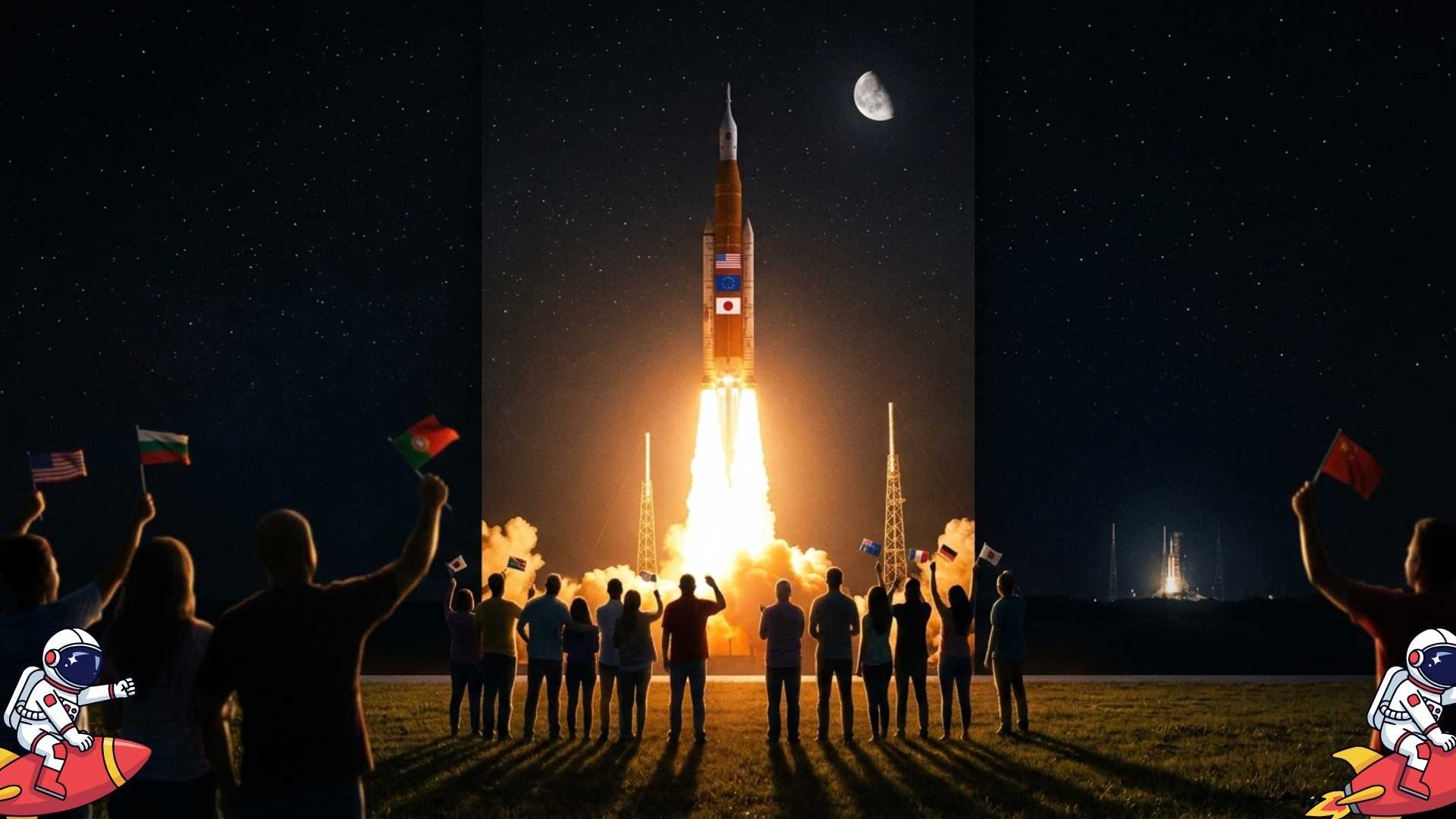
The successful launch of NASA's Artemis II on April 2, 2025 (IST) marks a turning point in humanity's return to the moon — and in the intensifying geopolitical contest over lunar resources. The US and China are building not just missions but permanent lunar infrastructure: refuelling depots, research outposts, communication relays, and resource extraction sites that could confer decisive advantages in cis-lunar space and beyond. With water ice at the lunar south pole as the central strategic prize, the moon has become the newest theatre of great power competition — raising fundamental questions about the governance of outer space as a celestial commons.
"Extending geopolitical borders into space and projecting national prestige have been considerable driving forces of the new Space Age."
Key Concepts
| Term | Meaning |
|---|---|
| Cis-Lunar Space | Region between Earth and the moon, including lunar orbit — increasingly strategic for future deep-space missions |
| Celestial Commons | Principle that outer space belongs to all humanity and cannot be appropriated by any nation |
| In-Situ Resource Utilisation (ISRU) | Using resources found on the moon (water, regolith) to support missions — reducing Earth dependence |
| Artemis Accords | US-led multilateral framework for peaceful, transparent, and interoperable lunar exploration; 50+ signatories |
| ILRS | China's International Lunar Research Station — planned permanent lunar base for the 2030s |
The Strategic Logic of Lunar Infrastructure
Both the US (Artemis) and China (ILRS) are designing their lunar programmes around permanent infrastructure, not one-off landings. This is qualitatively different from the Apollo era.
Lunar bases are planned to include:
- Research outposts for scientific experimentation
- Refuelling depots using water ice converted to rocket propellant
- Communication relays for deep-space navigation
- Resource extraction sites for ISRU operations
The consequence: whichever power establishes this infrastructure first gains a compounding first-mover advantage — every subsequent mission by any actor that depends on lunar resources or infrastructure would operate in a landscape already shaped by the early arrival.
Two Models of Lunar Exploration
| Parameter | USA — Artemis | China — ILRS |
|---|---|---|
| Approach | Multilateral + commercial | State-directed, largely autonomous |
| Partners | 50+ Artemis Accords nations + SpaceX, Blue Origin | Limited international partners (Russia, some others) |
| Pace | Slower; subject to commercial and political dependencies | Faster; disciplined state-driven timeline |
| Governance Framework | Artemis Accords (transparency, interoperability, data sharing) | No equivalent open multilateral framework |
| Long-term Vision | Artemis base at lunar south pole | ILRS — permanent research station by 2030s |
| Crewed Landing Target | 2028 (Artemis IV) | 2030 |
The US model trades speed for breadth of commitment — a larger coalition means greater legitimacy and shared investment, but also greater coordination complexity. China's model is more agile but less inclusive.
The Governance Problem: Who Owns the Moon?
The Outer Space Treaty (OST), 1967 — the foundational document of international space law — establishes that outer space is not subject to national appropriation. The moon is, in principle, a celestial commons.
However, critical ambiguities remain:
- The OST prohibits sovereign territorial claims but does not explicitly prohibit resource extraction
- The US Commercial Space Launch Competitiveness Act (2015) and similar national laws assert the right of nationals to own resources extracted from space
- The Moon Agreement (1979) — which would have established a common heritage regime for lunar resources — was never ratified by major spacefaring nations
The result is a governance vacuum: competing national frameworks, no binding international resource-sharing regime, and a race dynamic that incentivises rapid infrastructure establishment before norms are settled.
India's Position and Strategic Opportunity
India signed the Artemis Accords in 2023, committing to peaceful, transparent, and interoperable use of outer space, and to data and resource sharing under Accords norms.
India's current lunar and deep-space programme:
- Chandrayaan-3 (2023): Confirmed water ice presence near the lunar south pole — a scientifically and strategically significant finding
- Gaganyaan: India's crewed spaceflight programme, currently in development
- Planned space station: India aims to establish its own orbital station
- Lunar mission target: Indians on the moon by 2040
Strategic options available to India under the Accords:
Rather than building a standalone lunar programme from scratch, India can leverage Artemis membership to:
- Provide payloads and scientific experiments for future Artemis launches
- Explore joint Artemis-Gaganyaan mission architectures
- Co-develop lunar surface activities under the Accords framework
- Shape governance norms for resource use from within the coalition rather than as an outsider
This is a cost-effective strategy that builds capability, preserves strategic autonomy, and ensures India has a seat at the table when lunar resource governance rules are eventually negotiated.
Challenges & Concerns
1. The "Winning and Losing" Problem Framing lunar exploration as a race with winners and losers contradicts the celestial commons principle. Infrastructure lock-in by early arrivals could structurally disadvantage late-coming spacefaring nations — including most of the Global South.
2. Reliability of US Commitments The Artemis Accords are an executive arrangement, not a treaty. Their durability depends on sustained US political will — a concern given the programme's history of delays and budget pressures ($93 billion+ spent so far).
3. Exclusion of China from the Framework China is not part of the Artemis Accords. A bifurcated lunar governance architecture — one US-led, one China-led — risks replicating terrestrial geopolitical divisions in space, making a unified resource-sharing regime harder to achieve.
4. Commercial Interests vs. Commons Governance SpaceX and Blue Origin are mission-critical Artemis contractors with their own commercial interests in lunar resources. Balancing these with the commons principle is an unresolved tension.
Conclusion
Artemis II's successful launch is more than a triumph of engineering — it is a signal that the contest for the moon's strategic geography is now in earnest. The moon is neither a Cold War trophy nor a purely scientific frontier; it is the first node in humanity's expansion into the solar system, and its governance will set precedents for everything that follows. India's alignment with the Artemis Accords is a pragmatic choice — but it must be an active one. Simply signing the Accords is insufficient; India must use its growing space capability, its Chandrayaan data, and its diplomatic weight to help shape equitable governance norms for lunar resources before the infrastructure race forecloses that possibility. The celestial commons must not become the celestial enclosure.