
Introduction
"We are the first generation to feel the impact of climate change and the last generation that can do something about it." — Barack Obama (the same logic now applies to orbital sustainability)
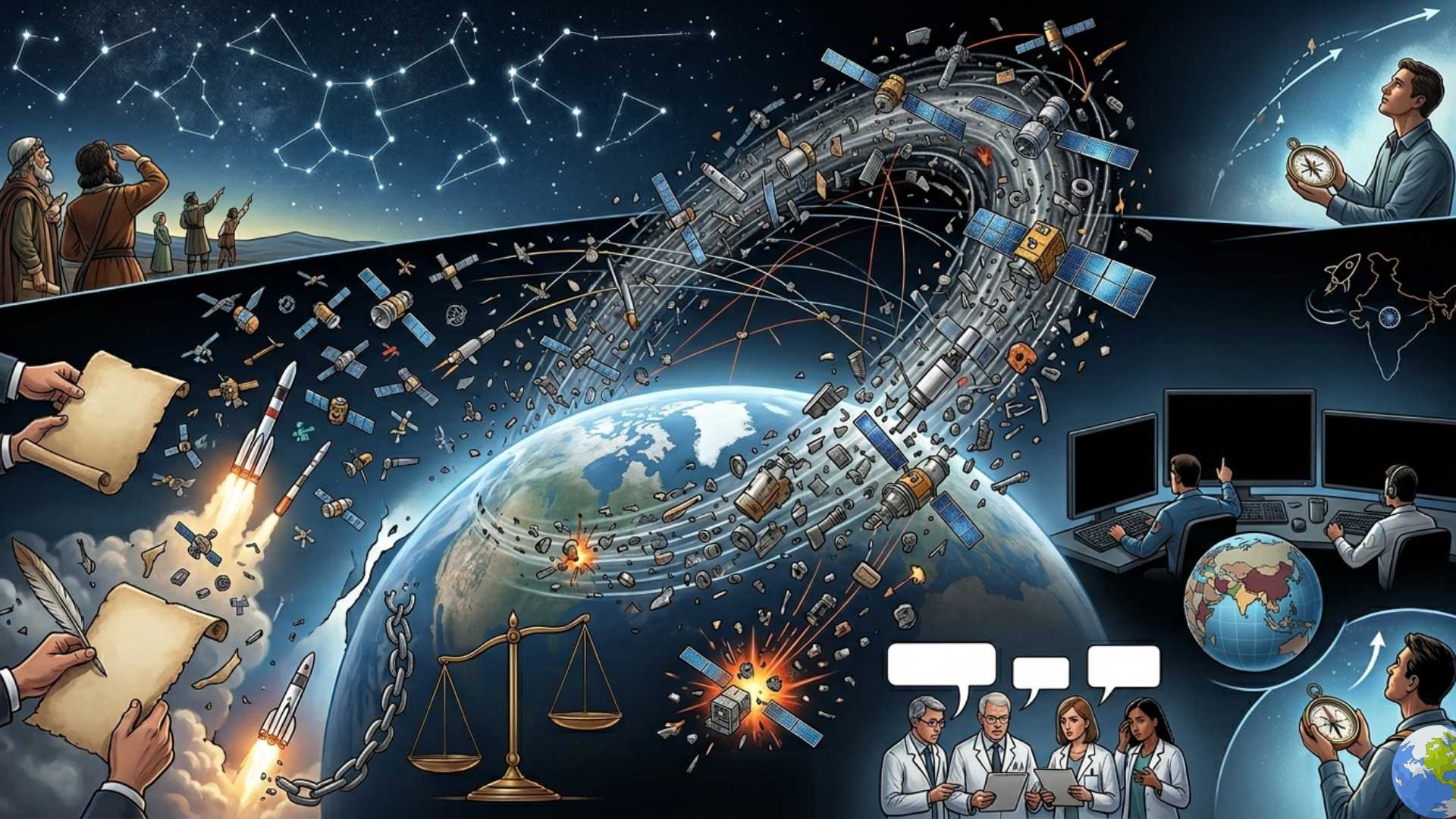
Earth's orbital environment — once the exclusive domain of superpowers — now hosts over 9,000 active satellites and an estimated 36,500+ pieces of debris larger than 10 cm, with millions of smaller fragments travelling at 28,000 km/h. A single collision can trigger a catastrophic chain reaction known as Kessler Syndrome, potentially rendering entire orbital shells unusable for centuries. Yet international governance of this shared commons remains fragmented, voluntary, and anchored in treaties written for a Cold War-era space landscape — before SpaceX, mega-constellations, and commercial launch democratisation changed the rules entirely.
| Metric | Figure |
|---|---|
| Active satellites in orbit | ~9,000+ |
| Trackable debris objects (>10 cm) | 36,500+ |
| Estimated debris pieces (>1 cm) | ~1 million |
| Orbital velocity of debris | ~28,000 km/h |
| Energy of coin-sized debris at orbital velocity | Enough to destroy a satellite |
Background and Context
Space activity was historically state-controlled, slow-paced, and bilaterally managed — making the 1967 Outer Space Treaty (OST) and the 1972 Liability Convention adequate frameworks for their time. The commercial revolution — led by private players like SpaceX (Starlink: 6,000+ satellites), Amazon (Project Kuiper), and OneWeb — has fundamentally altered the orbital environment. Launch costs have dropped from 3,000/kg (Falcon 9), accelerating deployment while governance has stood still.
Key Concepts
Kessler Syndrome: A cascading collision scenario proposed by NASA scientist Donald Kessler (1978), where orbital debris density becomes self-sustaining — each collision generates fragments that cause further collisions, eventually making certain orbits permanently unusable.
Space Situational Awareness (SSA): The capacity to track, catalogue, and predict the movement of objects in orbit. Currently dominated by the US Space Surveillance Network; access is uneven and often withheld for commercial or security reasons.
Passivation: Depleting residual energy sources (fuel, batteries, pressurised systems) in a satellite at end-of-life to prevent accidental explosions — a basic debris mitigation measure.
Intergenerational Equity: A principle from international environmental law — present users of a shared resource must not foreclose future generations' access to it. Directly applicable to orbital commons.
The Governance Gap: Why Existing Frameworks Fall Short
Outer Space Treaty (1967) — Structural Limitations:
| Article | Provision | Limitation |
|---|---|---|
| Article VI | States responsible for national space activities, including private actors | Does not address cumulative harm |
| Article VII | Liability for damage caused by space objects | Reactive — applies after damage, not before |
| No provision | — | No duty-of-care standard; no 'acceptable congestion' threshold |
The OST was designed for bilateral state actors and slow innovation cycles — not for mega-constellations, short-duration missions, or private operators registered in permissive jurisdictions to avoid stricter licensing.
The Voluntary Compliance Problem: Existing UN COPUOS debris mitigation guidelines are technically sound but rely on self-reporting before launch rather than verifiable post-launch compliance. Responsible operators absorb higher costs; non-compliant ones gain competitive advantage — a classic race to the bottom.
Regulatory Arbitrage: Operators register satellites in jurisdictions with minimal licensing requirements — mirroring the flag of convenience phenomenon in maritime law — undermining national licensing regimes as an enforcement tool.
Implications and Challenges
Technical: Debris smaller than a coin, at orbital velocity, carries enough kinetic energy to destroy an active satellite. Tracking objects below 10 cm remains beyond current technology, creating an unmonitorable threat layer.
Economic: Satellite-dependent services — GPS, weather forecasting, broadband, financial transactions, military communications — are worth trillions of dollars globally. Orbital congestion threatens this entire infrastructure stack.
Ethical: Choosing not to mitigate debris risk is itself a decision — one that externalises costs onto other operators and future generations. The absence of an international duty-of-care norm makes this externalisation consequence-free.
Geopolitical: Anti-satellite (ASAT) weapons tests — by the US (2008), China (2007), India (Mission Shakti, 2019), and Russia (2021) — generate large debris clouds, with the 2007 Chinese ASAT test alone creating over 3,000 trackable fragments. Military competition in space directly worsens the debris environment.
India's Position and Opportunity
India's IN-SPACe (Indian National Space Promotion and Authorisation Centre) and the Space Activities Bill (under development) represent an opportunity to embed orbital responsibility as a legal requirement — not merely a policy aspiration.
India's space programme has historically operated under tight resource constraints while delivering global-standard services (ISRO's cost-efficiency is globally recognised). As commercial participation expands under the post-2020 privatisation push — with players like Skyroot, Agnikul, and Pixxel entering the market — India can shape ethical norms from a position of credibility.
Specific steps India can take: mandatory debris mitigation plans as licensing conditions, compulsory SSA data sharing, verifiable end-of-life disposal strategies, and advocating for standardised international licensing thresholds at UN COPUOS.
Way Forward: From Voluntary to Enforceable
Three principles from international environmental law offer a governance template:
Precautionary Principle — uncertainty about debris impact does not excuse inaction; prevention must precede damage.
Proportionality — the scale of orbital use must be proportionate to demonstrated mitigation capacity.
Intergenerational Equity — orbital slots and frequency spectrum are finite resources; present operators owe future spacefarers unencumbered access.
Concretely, the international community needs: a binding debris mitigation treaty with verification mechanisms, standardised national licensing regimes, a multilateral SSA data-sharing platform, and financial instruments (orbital use fees, insurance mandates) that internalise the cost of congestion.
Conclusion
The orbital commons is approaching an inflection point — beyond which self-reinforcing debris cascades may render critical orbital shells permanently hazardous. The governance failure is not one of knowledge or technology but of political will and institutional design. Voluntary commitments have proven structurally inadequate in the face of commercial competition and geopolitical rivalry. India, at the cusp of its commercial space era, has a rare window to be a norm-setter rather than a norm-taker — embedding enforceable orbital responsibility into its national space law before the permissive habits of the early commercial era calcify into irreversible precedent. In space, as on Earth, governance that waits for damage before assigning responsibility will always arrive too late.