
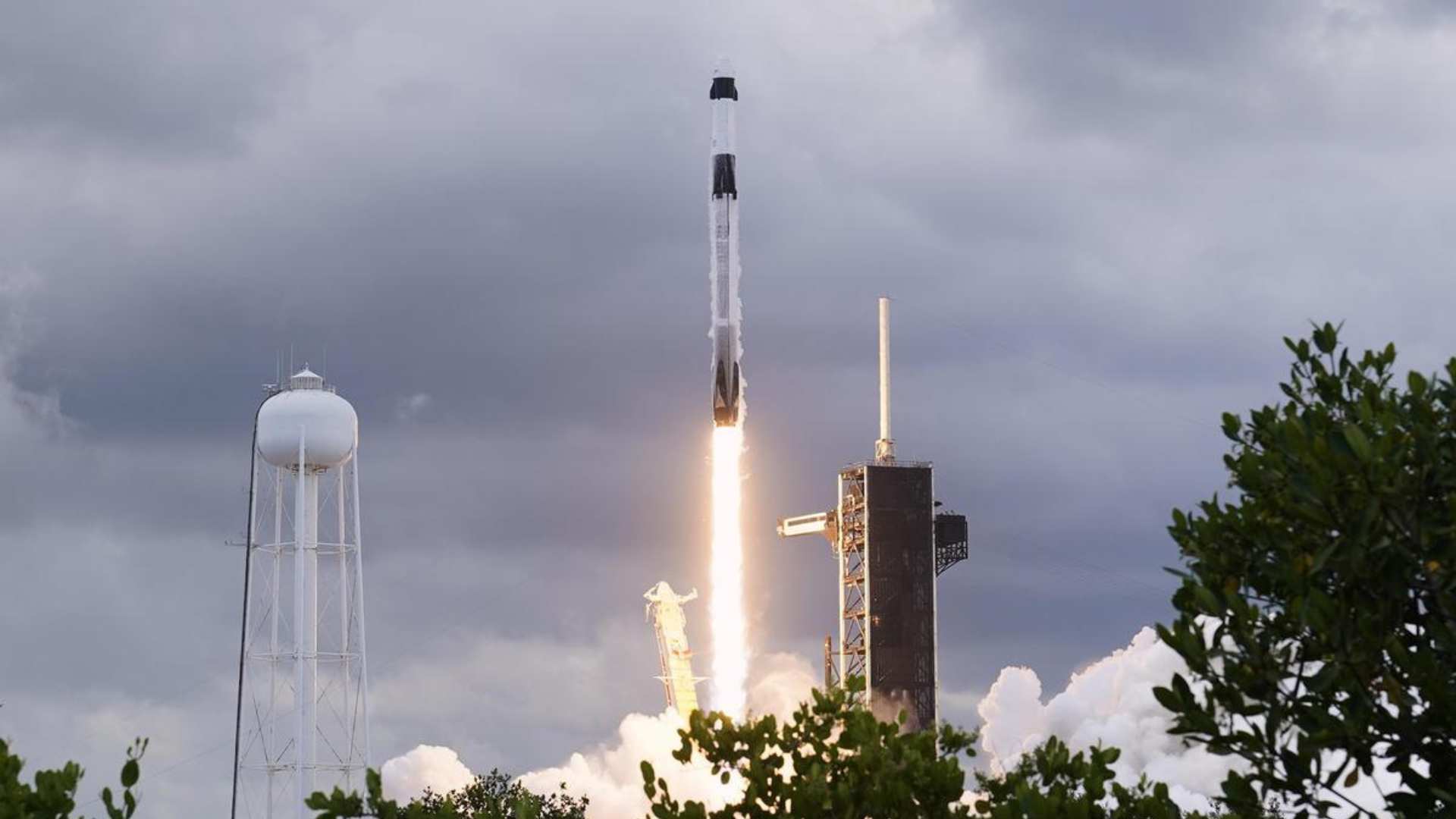
1. Commercialisation of Space: Changing Global Paradigm
For nearly four decades, space exploration was dominated by government agencies, driven by strategic, scientific, and prestige considerations. In the 21st century, this model has undergone a fundamental shift, with private companies emerging as the primary drivers of innovation, investment, and launch activity.
Space has transformed into a fast-growing commercial industry, expected to exceed $1 trillion by 2030. This growth is anchored in technological innovation, especially the partial reusability of rockets, which has reduced the cost of access to space by 5–20 times compared to traditional expendable launch vehicles.
Lower launch costs and higher launch cadence have expanded access to space for communication, navigation, earth observation, and scientific missions. If this transition is not leveraged strategically, countries risk losing competitiveness in the emerging space economy.
“The future of space is commercial.” — NASA Administrator Jim Bridenstine
The governance logic is that technological leadership increasingly flows from private-sector innovation. Ignoring this shift risks strategic and economic marginalisation.
2. Economics of Space Missions: Crewed vs Uncrewed Launches
Human spaceflight missions are inherently more expensive than satellite launches, costing 3–5 times more due to stringent requirements for life support, safety, redundancy, and mission assurance. These factors significantly raise technological and infrastructural costs.
In contrast, satellite missions are largely one-way, designed with simpler hardware and software architectures. Their relative simplicity allows for faster development cycles and cost efficiency, making them attractive for commercial applications.
Understanding this cost differential is essential for policy prioritisation, especially for countries balancing human spaceflight ambitions with economic constraints.
The development logic is that resource allocation must match mission objectives. Ignoring cost asymmetries can distort national space priorities.
3. Physics of Rocket Launch and the Mass Constraint
Rockets face two principal challenges during ascent: gravity and aerodynamic drag. With no external medium to push against, rockets rely on Newton’s third law, ejecting exhaust at supersonic speeds to generate thrust.
The Tsiolkovsky rocket equation mathematically links velocity, fuel mass, and total weight, revealing a structural limitation of space travel. Because fuel itself is heavy, rockets require additional fuel just to lift fuel, creating a compounding mass problem.
As a result, over 90% of a rocket’s mass is typically propellant and tankage, leaving less than 4% for payload. If unaddressed, this severely limits efficiency and payload capacity.
“Earth is the cradle of humanity, but one cannot live in the cradle forever.” — Konstantin Tsiolkovsky
The governance logic is that physical constraints drive engineering solutions. Ignoring mass efficiency restricts sustainable space access.
4. Staging as an Engineering Solution
Rocket staging divides a launch vehicle into independent propulsion units that are discarded sequentially. This reduces dead weight during ascent and improves the propellant-to-mass ratio of the remaining vehicle.
Traditional expendable rockets, including PSLV and LVM-3, discard each stage after single use, usually into the ocean. While effective, this model is resource-intensive and costly.
Staging represents a foundational engineering response to the limitations imposed by rocket physics, but expendability limits long-term cost reduction.
The development logic is that efficiency gains come from shedding inefficiency mid-flight. Ignoring optimisation leads to escalating launch costs.
5. Reusability: The Major Disruptive Innovation
Reusability has emerged as the single most transformative innovation in space launch systems, shifting the industry from a disposable model to a transportation-based paradigm. SpaceX pioneered this approach by combining vertical integration, modular design, and advanced automation.
The Falcon 9 first stage returns to Earth using retro-propulsion and aerodynamic drag to dissipate kinetic energy. This approach has enabled SpaceX to recover first stages over 520 times, dramatically reducing costs and increasing launch frequency.
Reusability has redefined industry benchmarks and intensified global competition in launch services.
“Reuse is the key to making humanity a spacefaring civilisation.” — Elon Musk
The governance logic is that cost reduction enables scale. Ignoring reusability risks technological obsolescence.
6. Limits and Economics of Multiple Reuse
The number of times a rocket stage can be reused is constrained by structural fatigue, thermal cycling, pressure stresses, and material degradation. Engines and fuel tanks are particularly vulnerable to microfractures caused by repeated extreme conditions.
Beyond a point, refurbishment costs, inspection time, and acceptable risk levels outweigh savings from reuse. SpaceX has nonetheless demonstrated reuse of a first stage over 30 times, setting a new industry benchmark.
Balancing safety, reliability, and economics is essential for sustainable reuse strategies.
The development logic is that reusability has diminishing returns. Ignoring lifecycle economics can compromise safety and efficiency.
7. Global Landscape of Reusable Launch Vehicles
More than a dozen private companies worldwide are developing reusable rocket technologies. At least three are pursuing the more complex goal of fully reusable launch vehicles.
Comparative examples:
- SpaceX: Falcon 9 (partially reusable), Starship (fully reusable, under development)
- Blue Origin (USA): Successful booster recovery for New Glenn
- China: Companies like LandSpace attempting recovery of Zhuque-3 components
This global momentum signals an irreversible shift toward reusability as an industry standard.
The governance logic is that technological diffusion is rapid. Falling behind becomes difficult to reverse.
8. India’s Position and ISRO’s Reusability Efforts
The Indian Space Research Organisation (ISRO) is actively developing recovery technologies through two main pathways. One is the Reusable Launch Vehicle (RLV), a winged, shuttle-like system capable of runway landings after re-entry.
The second approach involves recovering spent rocket stages using aerodynamic braking and retro-propulsion for landing on land or barges. These efforts align with global trends but remain at a developmental stage.
For India to remain competitive in the evolving space market, cost reduction and reusability must move from experimentation to operational reality.
“Self-reliance in space is not optional; it is strategic.” — Vikram Sarabhai
The governance logic is that indigenous capability underpins strategic autonomy. Ignoring reusability risks commercial and strategic dependence.
9. Future Launch Vehicle Design Priorities
Advances in propellant density and engine efficiency now allow two-stage systems to perform missions that earlier required three or more stages. Future launch vehicles must prioritise minimal staging combined with partial or full recovery.
Key design considerations include balancing energy distribution across stages, recovery mechanisms, refurbishment cycles, and launch cadence. Reuse must be treated as a non-negotiable design driver rather than an add-on.
Such systemic redesign is essential for affordability and scalability in the next phase of space exploration.
The development logic is that design choices lock in long-term costs. Ignoring integration leads to inefficiency.
Conclusion
The global space sector is undergoing a structural transformation driven by private innovation and reusable launch technologies. Reusability has fundamentally altered the economics of space access, making scale, frequency, and affordability central to competitiveness. For India, aligning launch vehicle design with these global shifts is critical to sustaining strategic autonomy, commercial relevance, and long-term leadership in space governance and development.