GS3 Science & Technology

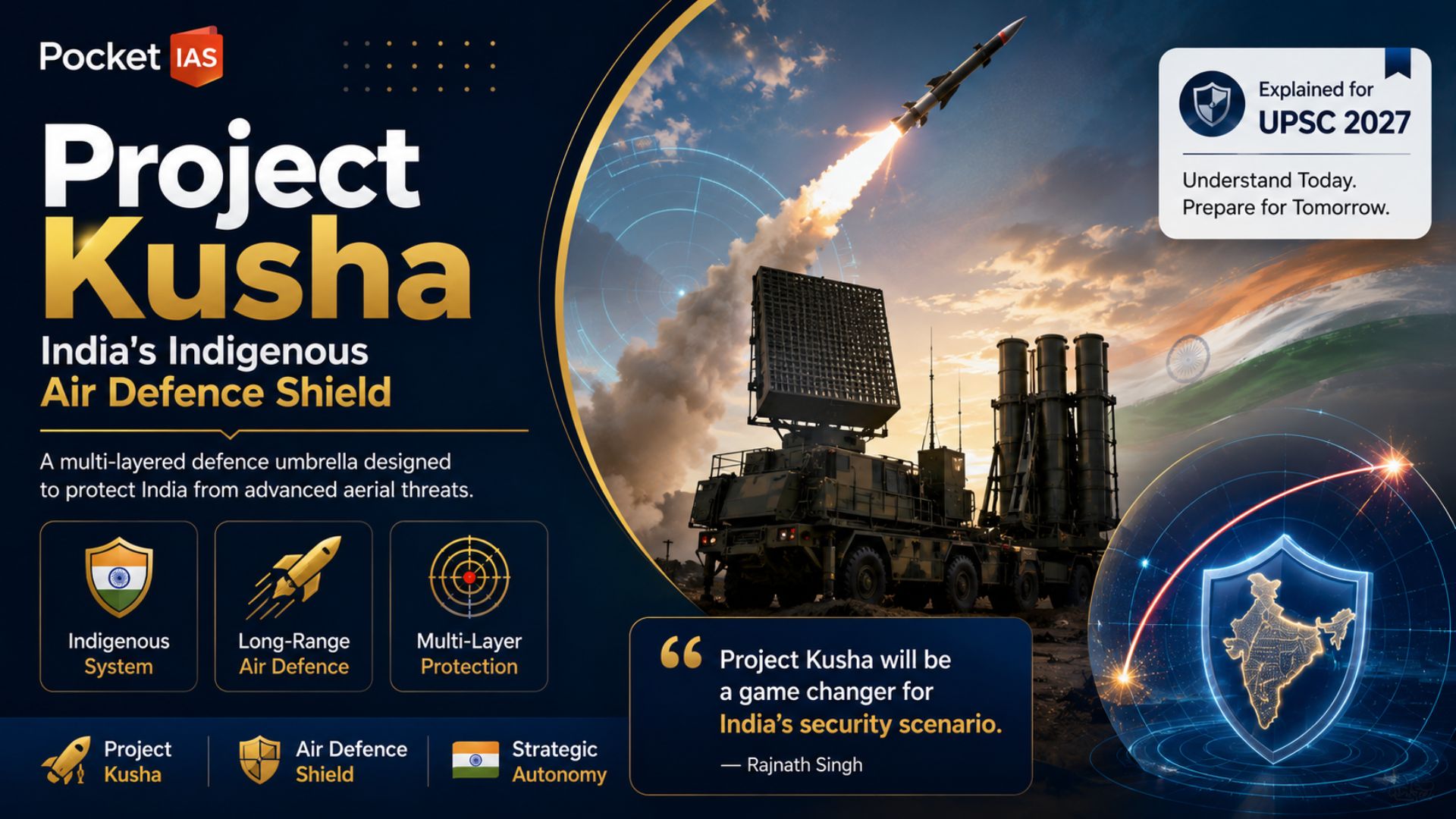
More than a missile system, Project Kusha represents India's growing pursuit of strategic autonomy and layered national security.

Project Kusha: A Game Changer for India's Air Defence

Defence Minister Rajnath Singh highlights the significance of Project Kusha in enhancing India's security during Operation Sindoor.
Gopi Gopi
3 mins read

India's defence preparedness is increasingly centred on indigenous technologies capable of addressing emerging aerial threats. In this context, Project Kusha, a long-range indigenous air defence missile system under development by DRDO, is being projected as a major pillar of India's future security architecture.

"Project Kusha will be a game changer for India's security scenario." — Defence Minister Rajnath Singh

Why Air Defence Matters

Modern warfare is no longer confined to conventional military engagements.

Emerging Threats

  • Ballistic missiles
  • Cruise missiles
  • Armed drones
  • Hypersonic weapons
  • Precision-guided munitions
  • Electronic warfare systems
Emerging Aerial Threats
          ↓
Need for Detection
          ↓
Interception
          ↓
Layered Air Defence
          ↓
National Security

The growing sophistication of threats requires integrated and multi-layered defensive systems.

What is Project Kusha?

Project Kusha is an indigenous long-range air defence missile system being developed by DRDO.

Key Objective

To provide a comprehensive shield against multiple aerial threats through long-range interception capabilities.

FeaturePurpose
Long-range interceptionNeutralise threats before impact
Indigenous developmentStrategic autonomy
Multi-threat capabilityProtection from diverse aerial systems
Integrated architectureLayered national defence

The system is expected to strengthen India's ability to protect military installations, critical infrastructure and population centres.

Lessons from Operation Sindoor

According to the Defence Minister, indigenous air defence systems demonstrated their effectiveness during Operation Sindoor.

Role of Indigenous Systems

  • Countered enemy intentions
  • Enhanced defensive resilience
  • Demonstrated operational readiness
  • Validated indigenous technological capabilities

"Our air defence system provided a protective umbrella." — Rajnath Singh

The experience reinforced the importance of self-reliant defence technologies.

Building on Existing Indigenous Successes

Project Kusha is part of a broader ecosystem of indigenous missile systems.

Notable Examples

SystemRole
AkashSurface-to-air air defence
BrahMosSupersonic cruise missile
Project KushaLong-range air defence

These programmes demonstrate India's increasing capability in advanced defence technologies.

Mission Sudarshan Chakra: Towards a Multi-Layered Shield

The government's broader vision includes Mission Sudarshan Chakra, announced in 2025.

Proposed Objectives

  • Multi-layered missile defence network
  • Protection of military assets
  • Safeguarding critical infrastructure
  • Security for civilian establishments
Outer Layer
      ↓
Long-Range Interceptors
      ↓
Medium-Range Defence
      ↓
Short-Range Defence
      ↓
Critical Asset Protection

The concept mirrors global trends where multiple interception layers create higher defence effectiveness.

Changing Nature of Warfare

The Defence Minister highlighted that modern battlefields are being transformed by technology.

Key Technologies Reshaping Warfare

  • Precision-strike systems
  • Integrated air defence networks
  • Hypersonic weapons
  • Artificial Intelligence (AI)
  • Autonomous platforms
  • Electronic warfare systems
Traditional WarfareModern Warfare
Platform-centricNetwork-centric
Human-dominatedAI-assisted
Conventional weaponsPrecision systems
Limited domainsMulti-domain operations

In such an environment, resilience and deterrence become equally important.

Importance of Defence Self-Reliance

Project Kusha aligns with India's broader objective of Aatmanirbhar Bharat in Defence.

Strategic Benefits

  • Reduced import dependence
  • Technological sovereignty
  • Indigenous manufacturing ecosystem
  • Greater operational flexibility
  • Enhanced export potential

Indigenous defence capability strengthens both national security and strategic autonomy.

Challenges Ahead

For indigenous systems to achieve their full potential, several bottlenecks must be addressed.

Key Areas Requiring Attention

  • Faster induction into armed forces
  • Reduced development-to-production timelines
  • Increased indigenous content
  • Expansion of industrial participation
  • Enhanced mass-production capabilities
Research
   ↓
Development
   ↓
Testing
   ↓
Production
   ↓
Military Induction

Delays at any stage can affect operational preparedness.

Way Forward

  • Accelerate Project Kusha development and deployment.
  • Strengthen collaboration among DRDO, armed forces and industry.
  • Expand domestic defence manufacturing capacity.
  • Invest in AI-enabled and network-centric defence systems.
  • Improve indigenous component sourcing.
  • Develop integrated multi-layered missile defence architecture.
  • Enhance research in hypersonic and next-generation interception technologies.

Conclusion

Project Kusha represents India's transition from a defence importer to a technology-driven defence power. Combined with Mission Sudarshan Chakra and existing indigenous missile systems, it can significantly strengthen India's air defence architecture. Its success, however, will depend not only on technological development but also on rapid production, seamless integration and sustained investment in indigenous innovation.

Attribution

Original content sources and authors

Saurabh Trivedi Author Saurabh Trivedi The Hindu Source The Hindu

Syllabus classification

How this article maps to GS papers

Main syllabus

GS3Science & Technology

Quick Q&A

What is Project Kusha and how does it strengthen India’s evolving air defence architecture in the context of modern warfare?
Project Kusha is an indigenous long-range air defence missile system being developed by the Defence Research and Development Organisation (DRDO) to provide a comprehensive shield against a wide spectrum of aerial threats, including fighter aircraft, cruise missiles, drones, stand-off weapons and potentially advanced missile systems. It represents a significant step in India's effort to establish a multi-layered and self-reliant air defence architecture. The project is expected to complement existing systems such as Akash, MR-SAM, S-400, and other integrated air defence assets. The significance of Project Kusha lies in the changing nature of warfare. Modern conflicts increasingly involve precision-guided munitions, swarm drones, hypersonic weapons, electronic warfare and network-centric operations. Traditional defence systems are often insufficient against such diverse threats. Project Kusha aims to create a robust protective umbrella capable of detecting, tracking and neutralizing multiple aerial targets simultaneously. Historically, India relied heavily on imported defence systems. However, initiatives such as Atmanirbhar Bharat and Make in India have accelerated indigenous defence development. Project Kusha reflects this transition from dependence to strategic autonomy. Defence Minister Rajnath Singh described it as a potential “game changer,” highlighting its relevance during Operation Sindoor and its role in future national security planning. For UPSC aspirants, Project Kusha is relevant to GS Paper III topics including Defence Technology, Internal Security, Science and Technology, and Indigenous Innovation. It also illustrates broader themes such as technological sovereignty, military modernization, defence industrialization and strategic deterrence. The project demonstrates how technological advancements can directly influence national security, geopolitical positioning and India's aspiration to emerge as a major defence technology power.
Why is indigenous air defence capability becoming increasingly important for India’s strategic autonomy and national security objectives?
Indigenous air defence capability has become a strategic necessity for India due to evolving security threats, geopolitical uncertainties and the need for technological self-reliance. Air and missile threats today include advanced fighter aircraft, drones, cruise missiles, ballistic missiles and emerging hypersonic weapons. In such an environment, dependence on foreign suppliers can create vulnerabilities during crises, sanctions or diplomatic disagreements. Strategic autonomy is a central objective of India's foreign and defence policy. Indigenous systems such as Akash, BrahMos and the upcoming Project Kusha reduce reliance on external sources and enable greater operational independence. Domestic production also allows customization according to India's unique security requirements, including challenges along the northern and western borders. Economically, indigenous defence manufacturing supports the Atmanirbhar Bharat initiative by creating jobs, promoting research and development and fostering a domestic defence ecosystem involving public and private sectors. According to government estimates, India's defence exports have increased significantly over the past decade, reflecting growing technological capabilities. From a national security perspective, indigenous air defence systems ensure continuous availability of spare parts, upgrades and maintenance support during wartime. They also protect critical infrastructure such as military bases, nuclear facilities, power grids, ports and major urban centers. There are debates regarding the cost, timelines and technological challenges associated with indigenous projects. Critics argue that imported systems may offer quicker deployment. However, supporters emphasize long-term strategic benefits and technological independence. For UPSC preparation, this topic connects GS Paper III areas such as Defence Technology, Security Challenges, Science and Technology, Economic Development and Government Policies. It also relates to international relations because defence self-reliance enhances India's bargaining power and reduces external strategic dependence. Thus, indigenous air defence capability is both a security imperative and a developmental strategy.
How do integrated and multi-layered missile defence systems function, and what role can Mission Sudarshan Chakra play in India’s security framework?
Integrated and multi-layered missile defence systems are designed to detect, track, intercept and destroy aerial threats at different ranges and altitudes. Rather than relying on a single weapon system, they combine radars, command-and-control networks, surveillance assets and multiple interceptor missiles to create overlapping layers of protection. Such systems improve the probability of interception and reduce the chances of enemy penetration. A typical multi-layered defence architecture includes long-range surveillance radars, early-warning systems, medium-range interceptors and short-range point-defence systems. When a threat is detected, data from multiple sensors are integrated through network-centric command systems. Appropriate interceptors are then deployed based on the type, speed and trajectory of the incoming threat. Mission Sudarshan Chakra, announced in 2025, seeks to establish a nationwide missile defence shield capable of protecting military assets, critical infrastructure and civilian populations. The initiative aligns with global trends where countries are investing heavily in layered defence systems due to the increasing availability of precision-strike weapons and unmanned platforms. The project is expected to integrate indigenous systems such as Akash, Project Kusha and other advanced technologies. It can significantly enhance deterrence by reducing the effectiveness of adversary attacks. A strong defensive shield also provides strategic confidence to policymakers during crises. However, missile defence systems are not without challenges. They require substantial financial investment, constant technological upgrades and protection against cyber and electronic warfare attacks. Critics also argue that extensive missile defence networks may trigger arms races as adversaries seek new methods to overcome them. For UPSC aspirants, this topic links GS Paper III themes such as Defence Technology, Internal Security, Cyber Security, Space-Based Surveillance and Science and Technology. It also demonstrates the intersection of technology, strategy and public policy in ensuring national security.
What are the major technological and strategic factors driving the transformation of warfare in the twenty-first century?
The transformation of warfare in the twenty-first century is being driven by rapid technological innovation, changing geopolitical competition and the increasing importance of information dominance. Traditional wars centered on large-scale troop movements are increasingly supplemented by precision strikes, autonomous systems, cyber operations and real-time intelligence networks. One major factor is the development of precision-guided munitions, which enable accurate targeting with minimal collateral damage. Another is the rise of unmanned systems such as drones and loitering munitions, which have demonstrated their effectiveness in conflicts ranging from Nagorno-Karabakh to Ukraine. Artificial intelligence is improving battlefield decision-making, target recognition and autonomous operations. Electronic warfare and cyber warfare have become critical dimensions of modern conflict. Disrupting communication networks, navigation systems and command structures can significantly weaken an adversary without conventional military engagement. Hypersonic weapons, capable of travelling at speeds greater than Mach 5, pose new challenges because they are difficult to detect and intercept. Integrated air defence systems have gained importance because modern threats emerge from multiple domains simultaneously. This explains India's focus on initiatives such as Project Kusha and Mission Sudarshan Chakra. Strategically, warfare is becoming increasingly network-centric. Success depends not only on weapons but also on data integration, situational awareness and rapid decision-making. Nations are investing heavily in indigenous technologies to avoid dependence on foreign suppliers during crises. Some experts argue that technological superiority alone cannot guarantee victory, emphasizing the continued importance of doctrine, leadership and human judgment. Nevertheless, technology remains a decisive force multiplier. For UPSC candidates, this topic is relevant to GS Paper III, Defence and Security Studies, Science and Technology, Artificial Intelligence, Cyber Security and International Relations. Understanding these trends helps explain contemporary military modernization efforts and evolving national security policies.
Critically analyse the significance of defence indigenisation in India, highlighting both its achievements and continuing challenges.
Defence indigenisation refers to the development, production and maintenance of military equipment within the country. It has emerged as a central pillar of India's national security strategy, particularly under initiatives such as Atmanirbhar Bharat and Make in India. The objective is to reduce import dependence, strengthen strategic autonomy and build a globally competitive defence industrial base. India has achieved notable successes in recent years. Indigenous platforms such as the Akash missile system, BrahMos missile, Tejas Light Combat Aircraft and various naval assets demonstrate growing technological capability. Programmes such as Project Kusha further reflect India's ambition to develop advanced strategic systems domestically. Defence exports have also risen substantially, indicating increasing international acceptance of Indian defence products. The benefits of indigenisation extend beyond security. It promotes innovation, generates employment, strengthens manufacturing ecosystems and encourages collaboration among DRDO, academia, startups and private industry. Indigenous production also ensures greater control over upgrades, maintenance and supply chains during emergencies. However, significant challenges remain. Many projects face delays, cost overruns and technological bottlenecks. Critical technologies such as advanced jet engines, semiconductor components and certain sensor systems still require foreign collaboration. Coordination between research institutions, armed forces and industry can sometimes be inadequate. Questions are also raised regarding procurement efficiency and the speed of technology transfer. A balanced assessment suggests that while complete self-sufficiency may not be immediately achievable, gradual enhancement of indigenous capability is strategically essential. International partnerships should complement rather than replace domestic development. For UPSC, this topic links GS Paper III areas including Science and Technology, Defence, Industrial Development, Economic Growth and National Security. It also reflects broader themes of strategic autonomy, innovation-led development and India's aspiration to become a major global defence manufacturing hub.
How can Operation Sindoor and India’s recent missile development initiatives be examined as case studies of evolving national security preparedness?
Operation Sindoor, as referenced by the Defence Minister in discussions surrounding Project Kusha, provides an important lens through which India's evolving national security preparedness can be examined. Although specific operational details remain limited in the public domain, the operation was highlighted as an example of the effectiveness of indigenous air defence capabilities in countering hostile intentions. The case study demonstrates several important aspects of modern security management. First, it highlights the growing role of integrated air defence networks in protecting military and civilian assets. Effective air defence today requires coordination among radars, command systems, missile batteries and intelligence networks. The operation reportedly showcased how indigenous technologies can contribute to this objective. Second, the case reflects the broader policy shift toward defence self-reliance. Systems such as Akash, BrahMos and Project Kusha symbolize India's effort to reduce strategic dependence on foreign suppliers. Their development aligns with long-term national objectives of technological sovereignty and operational flexibility. Third, the operation underscores the importance of preparedness in an era characterized by drones, precision-guided weapons and electronic warfare. Future conflicts may be short, technology-intensive and multidimensional. Therefore, investments in advanced missile systems, artificial intelligence and surveillance capabilities are increasingly necessary. At the same time, a critical perspective requires recognition that technology alone does not guarantee security. Training, doctrine, logistics, industrial capacity and inter-agency coordination remain equally important. Successful implementation depends on the ability to rapidly translate research into deployable military capability. For UPSC aspirants, this case study integrates GS Paper III themes such as Defence Technology, Internal Security, Science and Technology, Disaster Preparedness and Strategic Affairs. It demonstrates how indigenous innovation, operational readiness and policy planning collectively contribute to strengthening national security in a complex geopolitical environment.

Practice questions

1 question for mains preparation

"In an era of technology-driven warfare , effective air defence systems are essential for ensuring strategic autonomy and national security." Analyse this statement in the context of India's evolving indigenous missile defence capabilities .

10 marks · 150 words · 8 mins