
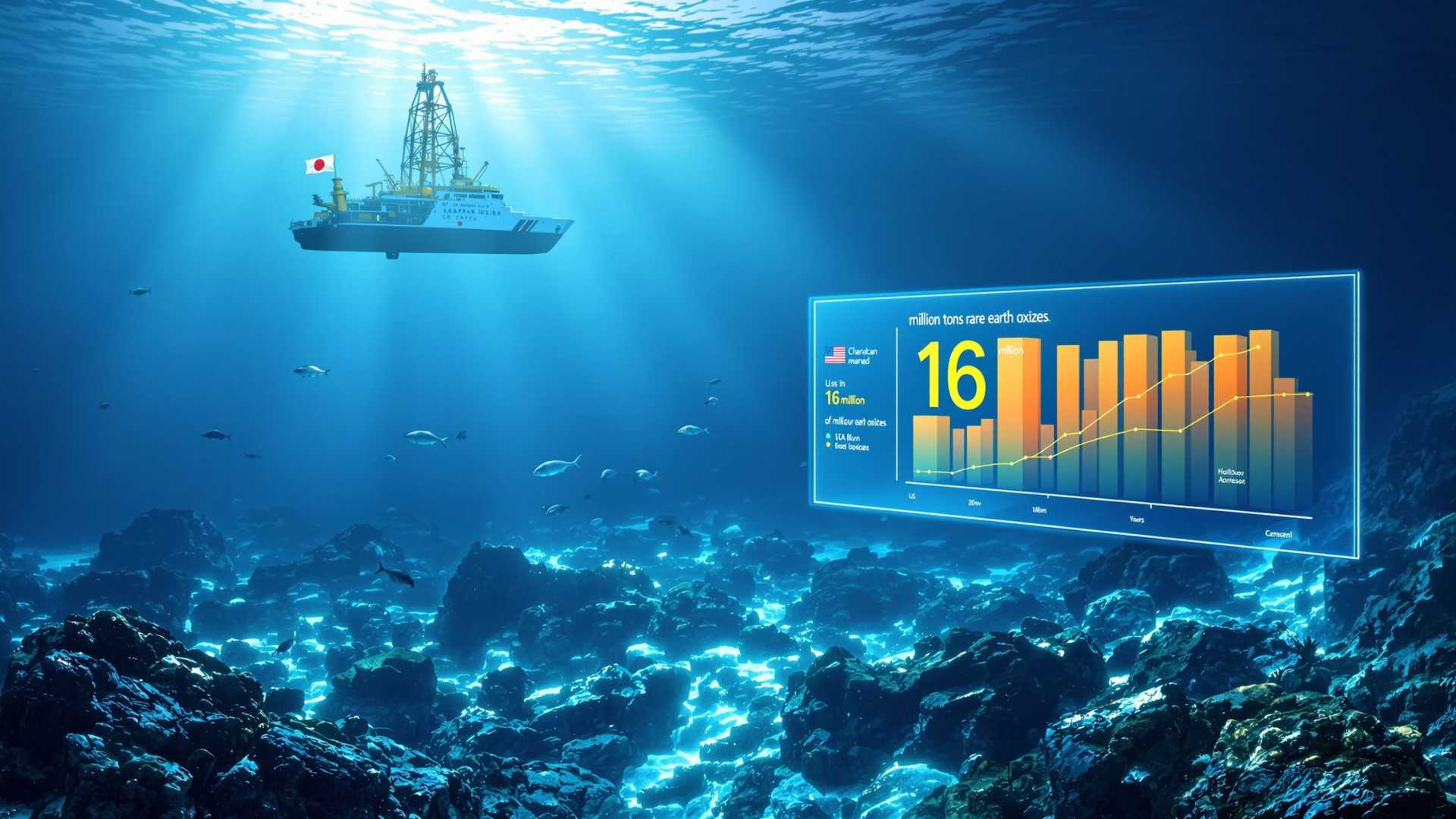
Japan Ventures to the Deep: Mining Rare-Earths from the Ocean Floor

As Beijing tightens its grip on critical minerals, Tokyo embarks on a high-stakes, first-of-its-kind mission to secure domestic supplies from 6 km beneath the Pacific
GopiGopi
4 mins read
Japan’s research vessel Chikyu sets out for Minamitori Island to conduct the world’s first deep-sea rare-earth extraction from 6 km below sea level
Not Started

Japan’s Deep-Sea Rare-Earth Mining Mission:


1. Strategic Context and Rationale

Japan has launched a historic project to extract rare-earth minerals from seabed mud near Minamitori Island, about 1,900 km southeast of Tokyo, at a depth of 6 km. The initiative is part of Tokyo’s long-term strategy to reduce dependence on China, which dominates global rare-earth supplies essential for electronics, electric vehicles, and defense.

Key features:

  • Government-backed vessel Chikyu with 130 researchers and crew
  • Month-long testing mission returning February 2026
  • Investment of 40 billion yen (~$250 million) since 2018

Geopolitical drivers:

  • China’s export restrictions on dual-use minerals targeting Japan
  • Historical precedent: 2010 East China Sea dispute led to rare-earth export halt
  • Strategic need: Domestic sourcing reduces vulnerability to supply shocks

Governance reasoning: Securing critical minerals proactively ensures industrial resilience and national security. Ignoring this can expose Japan to external supply shocks, affecting key sectors.


2. Supply-Chain Diversification and Industrial Implications

Japan has actively reduced dependence on Chinese rare-earths from 90% to 60% using multiple approaches:

  • Overseas partnerships: e.g., Sojitz with Australia’s Lynas Rare Earths
  • Domestic recycling initiatives and manufacturing processes using fewer rare-earths
  • Stockpiling of strategic minerals to buffer supply disruptions

Challenges:

  • Heavy rare-earths for electric-vehicle motors remain almost entirely China-dependent
  • Companies may revert to single-source reliance once immediate disruptions subside

Governance reasoning: Diversified supply chains reduce geopolitical leverage of a single supplier and strengthen industrial and defense sectors. Ignoring diversification risks repeated vulnerability.


3. Geopolitical Dimensions and International Engagement

Seabed mining occurs amid rising regional tensions:

  • Chinese naval ships monitored Japanese surveys in 2025
  • Export restrictions and dual-use bans by China threaten industrial stability
  • Japan engages in multilateral discussions, including G7 finance ministers, on rare-earth supply security

Implications:

  • Necessitates coordination in multilateral forums to stabilize global mineral supply
  • Influences regional power dynamics in East Asia
  • Encourages domestic self-sufficiency while balancing diplomacy

Governance reasoning: Incorporating geopolitical strategy into resource planning ensures national and industrial security. Ignoring it can disrupt critical industries and weaken strategic autonomy.


4. Technological and Economic Considerations

Seabed mining was previously considered uneconomical. The project now tests feasibility due to evolving market conditions and potential supply disruptions:

  • Continuous extraction from 6 km depth is a global first
  • Full-scale mining trial planned for February 2027 if testing succeeds
  • Potential to create domestic source of critical minerals

Governance reasoning: Investing in high-cost, high-reward technology ensures sustainable access to strategic resources. Neglecting innovation limits strategic flexibility and economic competitiveness.

  • Policy measures:

    • Government investment: 40 billion yen (~$250 million)
    • Full-scale mining contingent on test outcomes
    • Continuous monitoring of costs and global supply conditions

5. Institutions and Stakeholders

Effective collaboration between public and private sectors underpins project success:

  • Japanese Government / Trade Ministry: Policy oversight, stockpiling, and strategic direction
  • Research Institutions: Nomura Research Institute, Mitsubishi UFJ Research – feasibility and economic analysis
  • Private Companies: Sojitz, Lynas Rare Earths – overseas diversification and supply-chain support

Governance reasoning: Institutional coordination ensures efficient implementation of strategic resource projects. Weak engagement leads to delays, cost overruns, and unachieved objectives.


6. Implications for Governance and Development

Securing domestic rare-earth sources impacts economic, industrial, and defense sectors:

  • Strengthens industrial competitiveness and technological leadership
  • Supports EV and hybrid vehicle production
  • Reduces reliance on a single supplier nation, mitigating geopolitical risks
  • Promotes recycling and sustainable supply-chain practices

Governance reasoning: Strategic foresight in resource governance ensures national security and industrial stability. Ignoring vulnerabilities can compromise growth, technological leadership, and defense preparedness.

  • Impacts:

    • Rare-earth self-reliance
    • Advanced deep-sea mining capabilities
    • Mitigation of geopolitical coercion risks

7. Conclusion and Way Forward

The Minamitori Island project combines technology, policy, and strategic governance.

  • Success could reduce reliance on China, foster domestic innovation, and enhance resilience across industries

  • Future policy focus:

    • Continued diversification
    • Investment in technological innovation
    • Active engagement in multilateral frameworks

"The fundamental solution is to be able to produce rare earths inside Japan." — Takahide Kiuchi, Nomura Research Institute


Quick Q&A

Everything you need to know

Japan's rare earth exploration near Minamitori Island represents a strategic attempt to reduce its reliance on China for critical minerals. Rare earths are essential for the production of electric vehicles, smartphones, and military equipment. By attempting to extract these minerals from seabed mud located 6 km below the ocean surface, Japan is aiming to secure a domestic source of these critical resources.

The project is also technologically significant. Continuous lifting of seabed sludge from such depths has never been attempted before, making this mission a pioneering effort. Success would enhance Japan's technological capability in deep-sea mining and could serve as a model for other nations looking to secure critical minerals while reducing dependency on geopolitically sensitive sources.

Japan's dependence on China for rare earth minerals poses both economic and strategic risks. Historically, China has leveraged its dominance in rare earth supply as a diplomatic tool, as seen in 2010 when it restricted exports following tensions over disputed islands. Such measures can disrupt supply chains for Japan's key industries, including automotive and electronics.

By diversifying sources through domestic exploration and overseas investments, Japan aims to mitigate these risks. For example, Japan's partnership with Australia's Lynas Rare Earths and promotion of recycling technologies are efforts to secure alternative supply. This strategy not only ensures industrial stability but also strengthens national security by reducing vulnerability to geopolitical coercion.

The Minamitori Island project is a long-term initiative aimed at securing domestic sources of rare earth minerals while advancing Japan's technological capabilities. Extracting minerals from seabed mud at 6 km depth requires sophisticated engineering and deep-sea mining technology, which, if successful, will significantly enhance Japan's research and industrial expertise.

Economically, the project provides a hedge against potential supply disruptions from China. It complements Japan's investments in overseas mining projects and recycling, creating a diversified supply chain. Moreover, by pioneering high-cost but technologically advanced extraction methods, Japan positions itself as a global leader in next-generation mineral sourcing.

Domestic rare earth extraction in Japan faces multiple challenges. First, the technical difficulty of lifting seabed mud from 6 km below sea level is unprecedented, requiring specialized machinery, skilled personnel, and robust safety measures. Second, the economic feasibility has historically been low; high operational costs made seabed mining uneconomical compared to importing minerals from China.

Additional challenges include environmental concerns and uncertain reserves. The Minamitori Island project has not disclosed estimated reserves or production targets, which adds financial risk. Political and strategic pressures also require careful management of international relations, as Chinese naval activity near survey areas demonstrates. Thus, success depends on a combination of technological innovation, economic viability, and diplomatic navigation.

Japan's move to mine rare earths domestically has direct geopolitical implications. China has historically used its dominant position in rare earth exports as leverage, evident in past export restrictions following diplomatic disputes. By pursuing independent sources, Japan signals a desire to reduce vulnerability to such coercion, potentially decreasing China's leverage.

However, the initiative also carries the risk of escalating tensions. Chinese naval presence near Minamitori Island surveys indicates Beijing's sensitivity to Japan’s activities. Strategically, Japan must balance securing resources with avoiding unnecessary confrontation. Regionally, if successful, Japan's project could prompt other countries to explore deep-sea resources, potentially reshaping maritime security dynamics and economic competition in the Indo-Pacific.

Apart from domestic efforts, Japan has actively diversified rare earth sources through international partnerships. One notable example is the collaboration between the Japanese trading house Sojitz and Australia's Lynas Rare Earths. This partnership allows Japan to secure a reliable supply of rare earths outside China, including heavy rare earths critical for magnets in electric vehicle motors.

Additionally, Japan has promoted rare-earth recycling technologies and manufacturing processes that minimize mineral dependency. These measures have reduced its reliance on China from around 90% to 60% over the past decade. Such strategies illustrate Japan's comprehensive approach to economic security by combining domestic initiatives with global sourcing and technological innovation.

In a scenario where China halts rare earth exports, Japan's industrial and technological sectors could face immediate shortages, particularly in automotive and electronics manufacturing. The Minamitori project, if successful, provides a domestic supply that could partially offset the disruption. While initial production may not meet full demand, it demonstrates a strategic contingency plan and strengthens Japan's bargaining position internationally.

Additionally, the project complements other measures such as overseas partnerships and stockpiling. Combined, these strategies create a diversified supply chain capable of mitigating short-term shocks. Over time, successful domestic extraction could reduce long-term dependence on imports, enhance industrial resilience, and signal to global partners that Japan is capable of sustaining critical technological production under geopolitical pressure.

Attribution

Original content sources and authors

Sign in to track your reading progress

Comments (0)

Please sign in to comment

No comments yet. Be the first to comment!