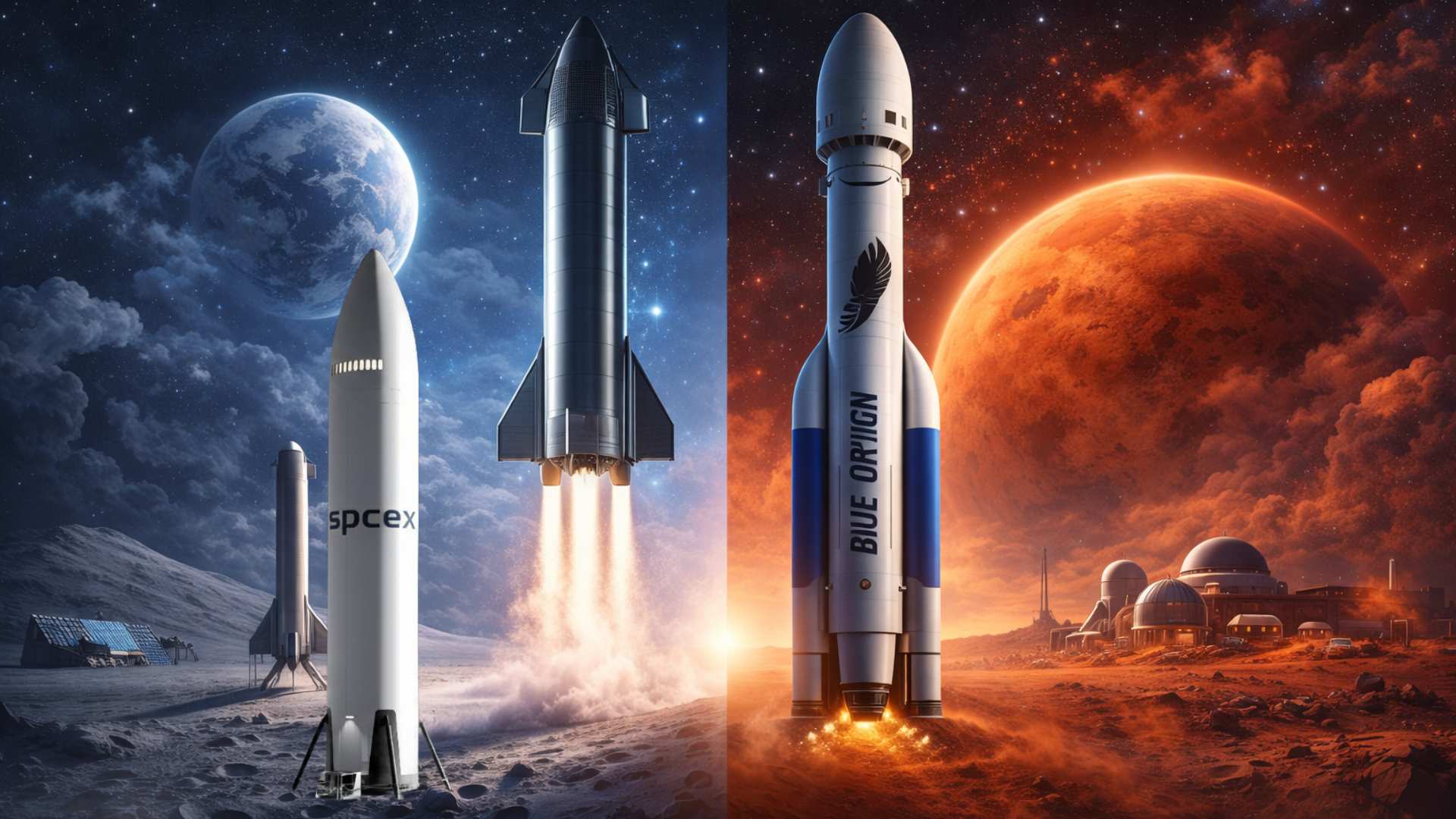
Shift in Private Space Sector Priorities: Moon Missions Over Mars
1. Emerging Shift in Global Private Space Exploration Priorities
Private space companies such as SpaceX and Blue Origin are increasingly redirecting technological and financial resources toward lunar missions. While both firms continue to articulate long-term ambitions regarding Mars and deep-space exploration, their immediate operational focus has clearly shifted to the Moon. This indicates a recalibration from visionary expansion to incremental capability-building.
Historically, SpaceX’s institutional identity was closely tied to the idea of establishing a self-sustaining human civilisation on Mars. Elon Musk has repeatedly framed Mars colonisation as a safeguard against existential risks to humanity. Blue Origin, in contrast, envisioned relocating heavy industry into space to preserve Earth’s environment.
However, both companies now recognise the Moon as a strategically and technologically viable near-term milestone. The shift reflects the growing influence of geopolitical competition, technological feasibility, investor accountability, and government-led space priorities.
“The mission of SpaceX remains the same: extend consciousness and life as we know it…” — Elon Musk
Space exploration follows phased technological maturation. Ignoring intermediate milestones such as lunar missions may delay readiness for deeper space exploration and weaken commercial sustainability.
2. SpaceX’s Lunar Pivot and Strategic Roadmap
SpaceX has reportedly targeted an uncrewed lunar landing by March 2027 and aims to build a “self-growing city” on the Moon within less than 10 years, while suggesting that a Mars settlement could take over 20 years.
The Starship programme remains central to its interplanetary ambitions. However, upcoming IPO considerations and its merger with xAI have subjected the company to heightened investor scrutiny, necessitating more tangible near-term achievements.
The Moon offers major logistical and operational advantages over Mars, enabling faster iteration and reduced mission risk.
-
Key Differences: Moon vs Mars Missions
-
Travel Time
- Moon: Less than 1 week
- Mars: Several months
-
Launch Windows
- Moon: Around 3 per month
- Mars: Once every 26 months
-
Communication
- Moon: Near real-time
- Mars: Significant delay
-
These factors make the Moon an ideal testing ground for life-support systems, habitation modules, and transport technologies.
Lunar missions enable iterative learning and cost reduction. Skipping such technological stepping stones could magnify risks and delays in long-duration Mars missions.
3. Blue Origin’s Strategic Realignment Toward Lunar Capabilities
Blue Origin has suspended its suborbital tourism programme for at least two years to accelerate development of human-rated lunar systems under NASA’s Artemis programme. It continues to develop the New Glenn heavy-lift rocket and a lunar lander.
Compared to SpaceX, Blue Origin faces execution credibility challenges. The Artemis lander contract provides defined timelines, accountability, and an opportunity to demonstrate capability in complex human spaceflight systems.
Lunar exploration is also politically more defensible than space tourism. Success in Artemis would enhance Blue Origin’s institutional legitimacy and strengthen its long-term market position.
Government-linked missions provide technological credibility and structured accountability. Failure to demonstrate execution capability can marginalise firms in future large-scale space infrastructure projects.
4. NASA’s Moon-First Strategy and Political Drivers
NASA’s Artemis programme aims to establish sustained human presence on the Moon. However, domestic political debates in the United States have intensified over whether priority should be given to Mars or the Moon.
Congressional oversight has reinforced the Moon-first approach, particularly amid rising geopolitical competition with China. Lawmakers have demanded clarity on Artemis timelines and measurable progress.
Although NASA leadership has stated that Moon and Mars missions can proceed in parallel, lunar exploration currently defines contractor performance and funding priorities.
This reflects how public policy frameworks shape private sector innovation trajectories.
When national strategic priorities are clearly articulated, private innovation ecosystems align accordingly. Ignoring political signals may reduce access to funding and regulatory support.
5. Geopolitical Competition and the Emerging Lunar Race
The renewed focus on lunar missions is embedded within intensifying U.S.–China strategic competition. Returning humans to the Moon is increasingly viewed as a demonstration of technological supremacy and geopolitical influence.
Lunar infrastructure has implications beyond symbolism. It may enable future resource extraction, space-based industrial capacity, and strategic positioning in cislunar space.
The present competition resembles the Cold War space race, but with stronger private sector integration and commercial objectives. The Moon is now a gateway to deep-space missions and a domain of strategic leverage.
Space capability increasingly translates into geopolitical influence. Weak participation in lunar technologies may constrain a nation’s role in shaping future space governance norms.
6. Public Narratives vs Operational Realities
For years, both companies centred public messaging around Mars to attract talent, capital, and public imagination. However, internally they were already deeply engaged in lunar-related work through NASA contracts.
The recent pivot reflects convergence between aspirational branding and operational pragmatism. The Moon serves as a feasible stepping stone toward eventual Mars ambitions.
Corporate communication strategies often highlight long-term visions while incremental technological progress occurs through achievable milestones.
Ambitious narratives sustain innovation ecosystems. However, misalignment between aspiration and execution risks credibility erosion under investor and political scrutiny.
7. Implications for Global Space Governance and India
The growing dominance of private corporations in strategic space missions marks a structural shift from state-led exploration to hybrid public-private governance models. This raises questions about regulation, liability, space resource utilisation, and equitable access.
For India, the evolving lunar race carries multidimensional implications:
Implications for India
- Need to strengthen ISRO–private sector collaboration
- Increased technological competition in space systems
- Opportunities in lunar resource research and international partnerships
- Strategic importance of shaping global space governance norms
India’s Chandrayaan missions demonstrate rising capability. However, long-term competitiveness will require deeper integration of private innovation within national space policy.
“Space is there, and we're going to climb it.” — John F. Kennedy
Countries that fail to integrate private innovation into national space frameworks risk technological marginalisation in the emerging space economy.
Conclusion
The pivot by SpaceX and Blue Origin toward lunar missions reflects technological pragmatism, investor accountability, geopolitical rivalry, and policy alignment with NASA’s Moon-first strategy.
The Moon is emerging as the next decisive arena in global space competition — not as an alternative to Mars, but as a necessary stepping stone toward it. For states and private actors alike, success will depend on balancing ambition with institutional coordination, technological maturity, and strategic foresight.