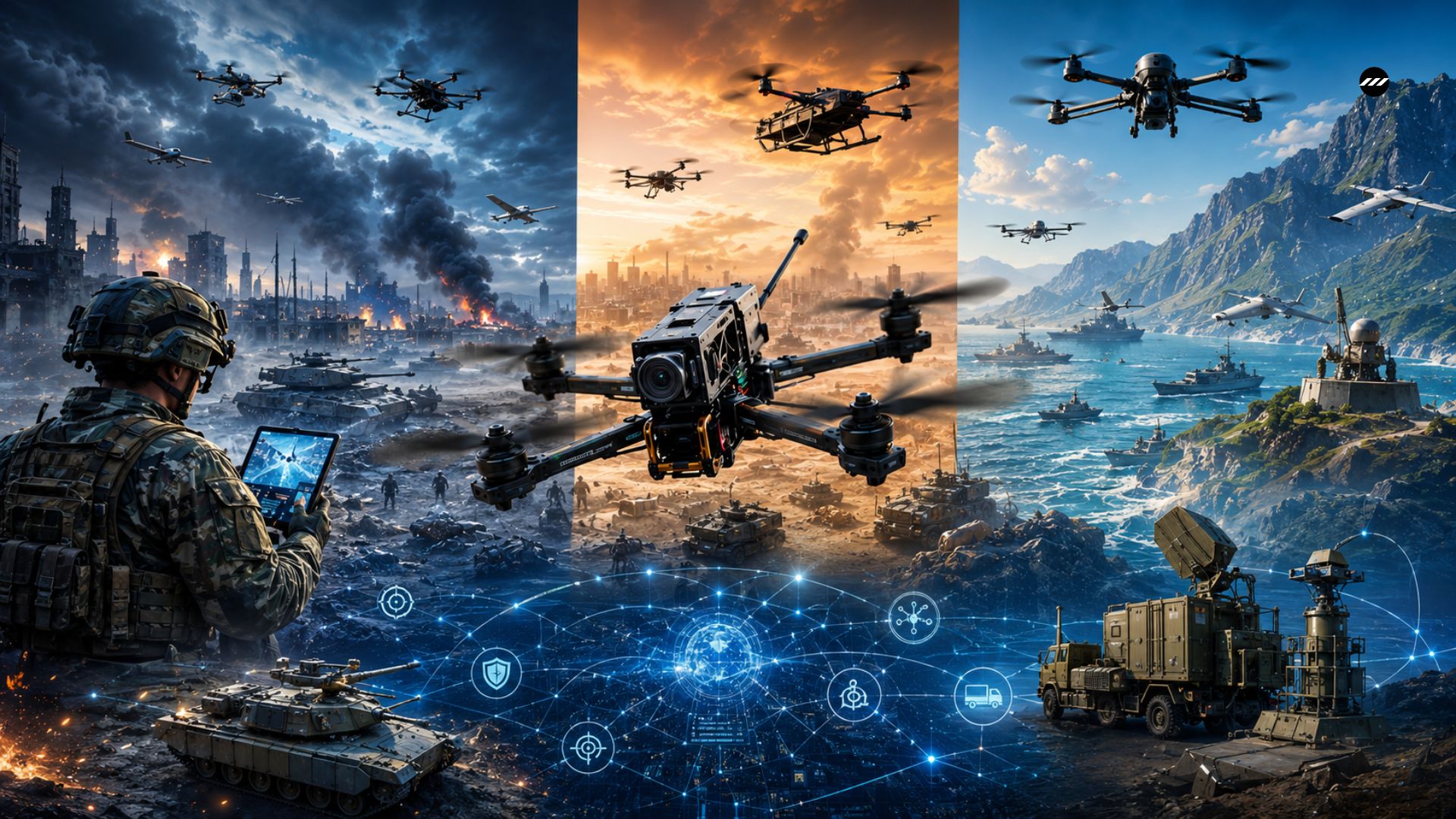
The Drone Revolution: How Unmanned Systems Are Reshaping Modern Warfare

Recent conflicts in Ukraine, Lebanon, and the wider U.S.–Israel–Iran theatre demonstrate that drones have evolved from auxiliary military tools into central instruments of warfare, fundamentally transforming the nature of combat.
From Conventional Superiority to Drone-Centric Warfare
For decades, military power depended on:
- Combat aircraft
- Tanks
- Artillery systems
- Warships
- Air-defence networks
- Precision-guided missiles
Battlefield dominance largely favoured states with:
- Advanced technology
- Large defence budgets
- Sophisticated intelligence systems
Smaller militaries and non-state actors relied on:
- Guerrilla warfare
- Ambushes
- Asymmetric tactics
Today, this paradigm is being challenged by commercially derived and mass-produced drones.
Why Are Drones Transformative?
Modern Unmanned Aerial Systems (UAS) perform multiple functions:
| Function | Role |
|---|---|
| ISR | Intelligence, Surveillance & Reconnaissance |
| Target Acquisition | Identification of enemy positions |
| Precision Strikes | Direct attacks on targets |
| Artillery Spotting | Improving artillery accuracy |
| Electronic Warfare | Operating in contested electromagnetic environments |
| Logistics Support | Battlefield supply operations |
Key Consequence
Persistent Surveillance
          +
Rapid Target Detection
          ↓
Immediate Engagement
          ↓
No Safe Frontline or Rear Area
The result is a continuous battlespace where concealment has become increasingly difficult.
Ukraine: The World's First Industrial-Scale Drone War
The Russia–Ukraine conflict began in 2022 as a conventional war but evolved into a drone-intensive conflict.
Ukraine's Adaptation
Ukraine rapidly converted commercial drones used for:
- Aerial photography
- Mapping
- Civilian surveillance
into military systems for:
- Reconnaissance
- Artillery guidance
- Precision attacks
By 2024, drones were integrated into nearly every level of combat, including:
- Tactical surveillance
- Frontline targeting
- Deep strikes on logistics hubs
- Attacks on rear infrastructure
This became a model later replicated across West Asian conflicts.
The FPV (First-Person View) Revolution
At the centre of Ukraine's success lies the FPV drone.
Characteristics
- Low-cost
- Commercially available
- Controlled through live video feeds
- Highly manoeuvrable and precise
Major Variants
| Type | Purpose |
|---|---|
| FPV Strike Drones | Direct attacks |
| Kamikaze Drones | One-way explosive missions |
| Bomber Drones | Reusable munition delivery |
| Interceptor Drones | Counter-drone operations |
| Long-range Variants | Deep-strike missions |
Battlefield Economics
Drone Cost
Few Hundred Dollars
        ↓
Can Destroy
Armoured Vehicles Worth Millions
This has fundamentally altered the cost-benefit equation of warfare.
Major Ukrainian Drone Systems
Heavy-Lift Platforms
- Vampire ("Baba Yaga") hexacopters
- Modular indigenous platforms
Loitering Munitions
- RAM II
- UJ-31 Zozulya
These systems:
- Conduct precision strikes
- Penetrate contested airspace
- Attack air-defence systems and logistics targets
Bomber Drones
Adapted from:
- DJI Mavic 3
- DJI Matrice 300 RTK
Used for:
- Dropping grenades
- Delivering anti-tank mines
- Attacking trenches and bunkers
Unlike kamikaze drones, these can be reused across multiple missions.
Fibre-Optic Drones: Countering Electronic Warfare
One of Ukraine's most significant innovations is the fibre-optic FPV drone.
How It Differs
| Conventional Drone | Fibre-Optic Drone |
|---|---|
| Uses radio signals | Uses fibre-optic cable |
| Vulnerable to jamming | Largely EW-resistant |
| Susceptible to interference | Reliable in contested environments |
This restores operational advantages in heavily jammed battlefields.
Drone Warfare in West Asia
Hezbollah's Model
Hezbollah relies heavily on Iranian-supplied systems:
- Ababil
- Mohajer
- Shahed series
These support:
- ISR missions
- Precision strikes
- Regional attack operations
More recently, Hezbollah has also adopted fibre-optic FPV drones to overcome Israeli electronic warfare measures.
Israel's Response
Israel has developed a layered counter-drone architecture comprising:
- Electronic warfare systems
- Specialized radar arrays
- AI-enabled Iron Drone Raider
The system can neutralize drones through:
- Net capture
- Direct collision interception
rather than relying solely on expensive missiles.
Israel also operates:
- Heron ISR drones
- Armed UAVs
- Loitering munitions
integrated into reconnaissance-strike complexes.
Iran's Distinct Drone Strategy
Iran employs drones not merely as battlefield tools but as instruments of:
- Deterrence
- Coercion
- Regional power projection
Key Features
-
Indigenous Shahed variants
-
Supply of drone systems to partner groups in:
- Iraq
- Syria
- Lebanon
- Yemen
This enables Iran to threaten:
- Military bases
- Critical infrastructure
- Naval assets
at relatively low cost.
The Economics of the Drone Revolution
A major shift is occurring in military economics.
Expensive Platforms
(Tanks, Aircraft, Missiles)
          ↓
Cheap, Mass-Produced Drones
          ↓
Scale + Speed + Adaptability
          ↓
New Source of Military Power
Success increasingly depends on:
- Industrial production capacity
- Rapid technological adaptation
- Ability to deploy and counter drones at scale
The focus is shifting from platform superiority to ecosystem superiority.
Way Forward
- Invest in indigenous drone ecosystems.
- Develop advanced counter-drone technologies.
- Strengthen electronic warfare capabilities.
- Integrate AI and autonomous systems into defence planning.
- Enhance domestic manufacturing and supply chains.
- Establish regulatory and ethical frameworks for drone warfare.
- Improve military adaptation to rapidly evolving technologies.
Conclusion
The conflicts in Ukraine and West Asia reveal a profound transformation in military affairs. Drones are no longer supplementary assets but have become the infrastructure of modern warfare, shaping surveillance, targeting, logistics, deterrence, and battlefield outcomes. As warfare becomes increasingly defined by technological adaptability and industrial capacity, the ability to build, deploy, and counter drone systems will be a decisive determinant of future military power.
Attribution
Original content sources and authors

Syllabus classification
How this article maps to GS papers
Main syllabus
GS3Science & TechnologyQuick Q&A
What is the drone revolution in contemporary warfare and why has it transformed traditional concepts of military superiority?
Why is the emergence of drone warfare important for UPSC aspirants studying security and international relations?
How did the Russia-Ukraine conflict evolve into the world's first industrial-scale drone war and what innovations emerged from it?
What are the major regional models and practical examples of drone warfare visible in Ukraine, Hezbollah, Israel and Iran?
What is the critical analysis of the economic and strategic consequences arising from the increasing dependence on drones in warfare?
What are the major reasons behind the rapid expansion and widespread adoption of drones across modern battlefields?
Practice questions
Practice for this topic is coming soon.