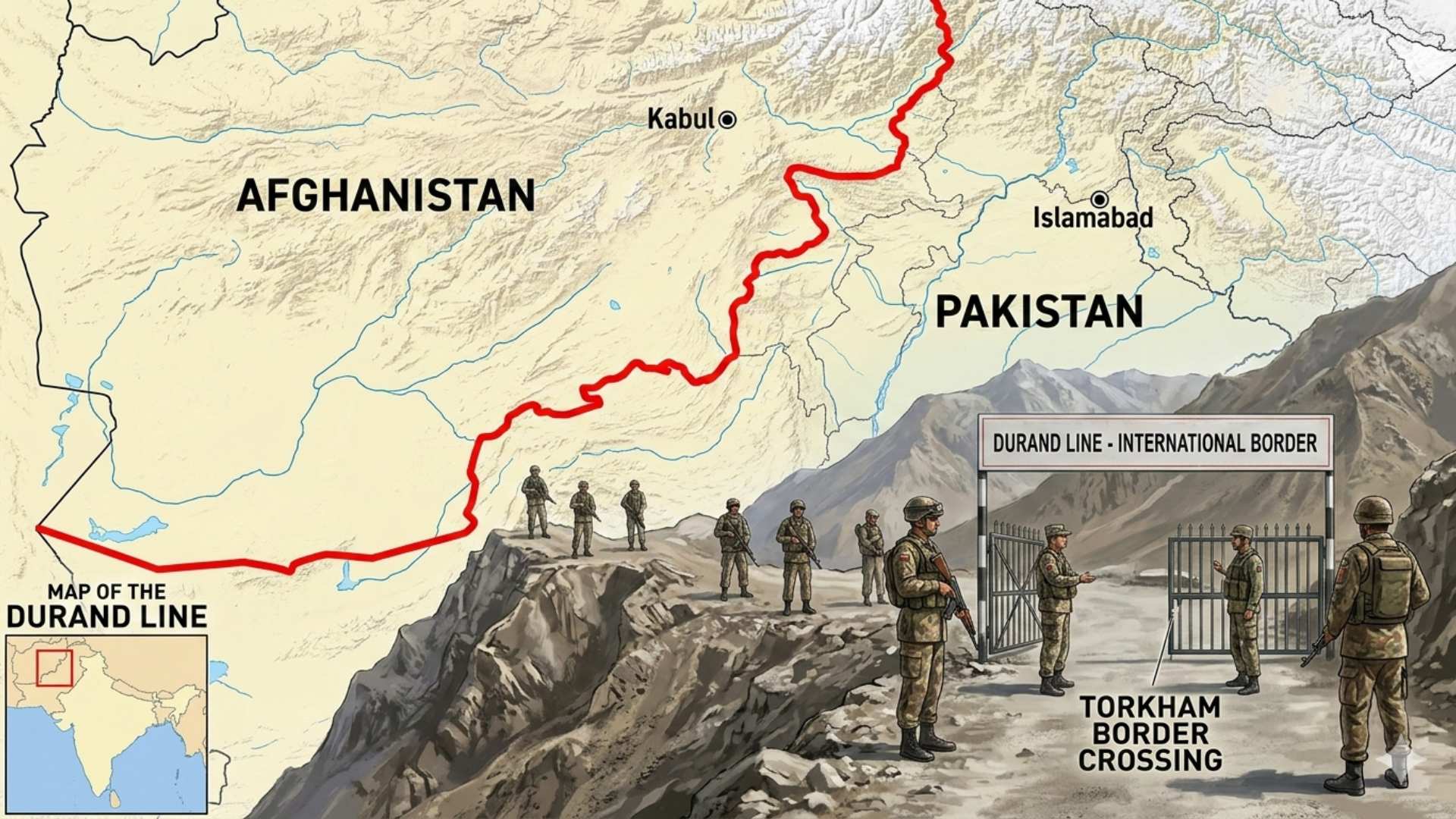
1. Escalation to Open Hostility: From Allies to Adversaries
Pakistan’s Defence Minister Khawaja Asif declared that relations with Afghanistan had reached “open war” after Pakistan carried out air strikes in Kabul, Kandahar and Paktia. These strikes followed cross-border attacks and retaliatory actions by both sides, reflecting a rapid deterioration in bilateral ties.
Until 2021, Pakistan and the Afghan Taliban were closely aligned. The Taliban leadership operated from Pakistani territory during their insurgency against U.S. and Afghan government forces. Islamabad expected that the Taliban’s return to power would secure its strategic interests in Afghanistan.
However, four years after the Taliban captured Kabul, relations have transformed from cooperation to confrontation. The shift underscores how insurgent alliances often fracture once power equations change and state-to-state issues replace ideological solidarity.
“Now it is open war between us and you.” — Khawaja Asif, Pakistan’s Defence Minister
When non-state actors transition into state authority, strategic expectations often collide with sovereignty concerns. Ignoring this transformation leads to miscalculation, as seen in Pakistan’s assumption that the Taliban would remain a pliant partner.
2. The Durand Line Dispute: Historical Legacy and Border Clashes
The Durand Line, a 2,640-km border drawn in 1893 between British India and Afghanistan, remains a core structural dispute. No Afghan government since 1973 has formally accepted this boundary, which divides Pashtun tribal regions.
While the issue was muted during the Taliban insurgency phase, it resurfaced once the Taliban assumed state power. As rulers, the Taliban adopted Afghanistan’s traditional position of rejecting the Durand Line as a legitimate international boundary.
Frequent skirmishes, including serious clashes in October 2025, illustrate how historical territorial disputes can intensify when political authority shifts. What was once a background issue has become central to bilateral tensions.
Key Structural Factor:
- 2,640-km Durand Line remains disputed
- Rejected by successive Afghan governments since 1973
- Escalated into periodic armed clashes (e.g., October 2025)
Territorial disputes acquire sharper edges when sovereignty and nationalism are invoked by ruling regimes. Failure to address such historical fault lines risks institutionalising instability along borders.
3. Tehreek-e-Taliban Pakistan (TTP): The Security Dilemma
The Tehreek-e-Taliban Pakistan (TTP), ideologically aligned but organisationally distinct from the Afghan Taliban, poses a major internal security threat to Pakistan. While Islamabad supported the Afghan Taliban, it has consistently opposed the TTP.
After the Taliban’s return to power in August 2021, the TTP gained renewed momentum. Although a ceasefire was brokered in 2022, it collapsed, leading to intensified violence in Pakistan’s border regions.
According to the Pak Institute for Peace Studies:
- At least 400 people were killed in TTP attacks last year
- Most victims were security personnel
- It was among the most violent years in a decade
Pakistan accuses the Afghan Taliban of sheltering TTP militants, an allegation Kabul denies. Cross-border strikes by Pakistan targeting alleged TTP camps have triggered retaliatory responses from Afghanistan, creating a cycle of violence.
Security Challenges:
- Cross-border militancy
- Sovereignty violations through air strikes
- Deteriorating internal security in Pakistan’s tribal areas
Supporting militant groups for external leverage while combating similar actors internally creates a strategic contradiction. If unresolved, it deepens insecurity and erodes state authority.
4. The “Strategic Depth” Doctrine and Its Reversal
Pakistan historically viewed Afghanistan through the lens of “strategic depth” — the idea of ensuring a friendly regime in Kabul to counter India’s influence and secure western borders.
The Taliban’s return in 2021 was initially perceived as a geopolitical success. Then Prime Minister Imran Khan remarked that Afghans had “broken the shackles of slavery,” reflecting Islamabad’s optimism.
However, the Taliban have asserted autonomy rather than acting as a client regime. Instead of strategic depth, Pakistan now faces:
- Border instability
- Strengthened insurgent threats (TTP)
- Reduced diplomatic leverage
This shift illustrates the limits of proxy-based regional strategies in a multipolar and sovereignty-driven environment.
Foreign policy strategies built on regime dependence rather than institutional engagement often collapse once political realities change. Overreliance on non-state proxies can generate long-term strategic costs.
5. The India Factor: Geopolitical Realignment
Another emerging dimension is the Taliban’s warming ties with India. Unlike the 1990s, Taliban 2.0 have adopted a more pragmatic foreign policy.
Key developments include:
- India hosted Taliban Foreign Minister Amir Khan Muttaqi last year.
- The Taliban appointed an envoy to head their mission in New Delhi.
- India has engaged without formal recognition.
Pakistan perceives this outreach as a dilution of its influence. The Defence Minister alleged that the Taliban had become a “proxy for India,” highlighting Islamabad’s strategic anxieties.
This evolving triangular dynamic reshapes South Asian geopolitics, particularly in the context of India–Pakistan rivalry.
Geopolitical alignments are fluid. When smaller states diversify partnerships, dominant neighbours may perceive strategic encirclement, intensifying regional competition.
6. Regional and International Implications
The escalation has drawn concern from regional powers such as Iran, Russia, and China, who have called for dialogue and offered mediation. Prolonged instability could destabilise the wider South-Central Asian region.
Potential consequences include:
- Increased cross-border militancy
- Refugee flows
- Disruption of trade corridors
- Complications for regional connectivity initiatives
For India, the situation has dual implications: security vigilance along western fronts and diplomatic engagement in Afghanistan without formal recognition.
Broader Impacts:
- Regional security volatility
- Strain on counter-terrorism cooperation
- Increased geopolitical competition in South Asia
Unchecked bilateral escalation risks transforming a border dispute into a regional security crisis. Preventive diplomacy is essential to avoid spillover effects.
7. Way Forward: Managing Conflict without Escalation
A sustainable resolution requires separating ideological alignments from state-to-state diplomacy. Structured border dialogue, intelligence-sharing mechanisms, and third-party mediation could reduce tensions.
Afghanistan must address concerns regarding TTP safe havens, while Pakistan must balance counter-terror operations with respect for Afghan sovereignty. Regional powers can facilitate de-escalation through multilateral platforms.
Engagement without formal recognition — as practised by some countries — may provide diplomatic space while maintaining normative positions.
Stable interstate relations depend on institutional mechanisms rather than informal alliances. Without structured engagement, cycles of retaliation risk entrenching hostility.
Conclusion
The Afghanistan–Pakistan crisis reflects the unintended consequences of proxy politics, unresolved historical disputes, and shifting regional alignments. The transformation of the Taliban from insurgents to rulers has altered strategic calculations in Islamabad.
For South Asia, the episode underscores the need for realistic foreign policy, border management, and multilateral conflict resolution. Long-term regional stability will depend not on tactical retaliation but on sustained diplomatic engagement and institutional trust-building.