
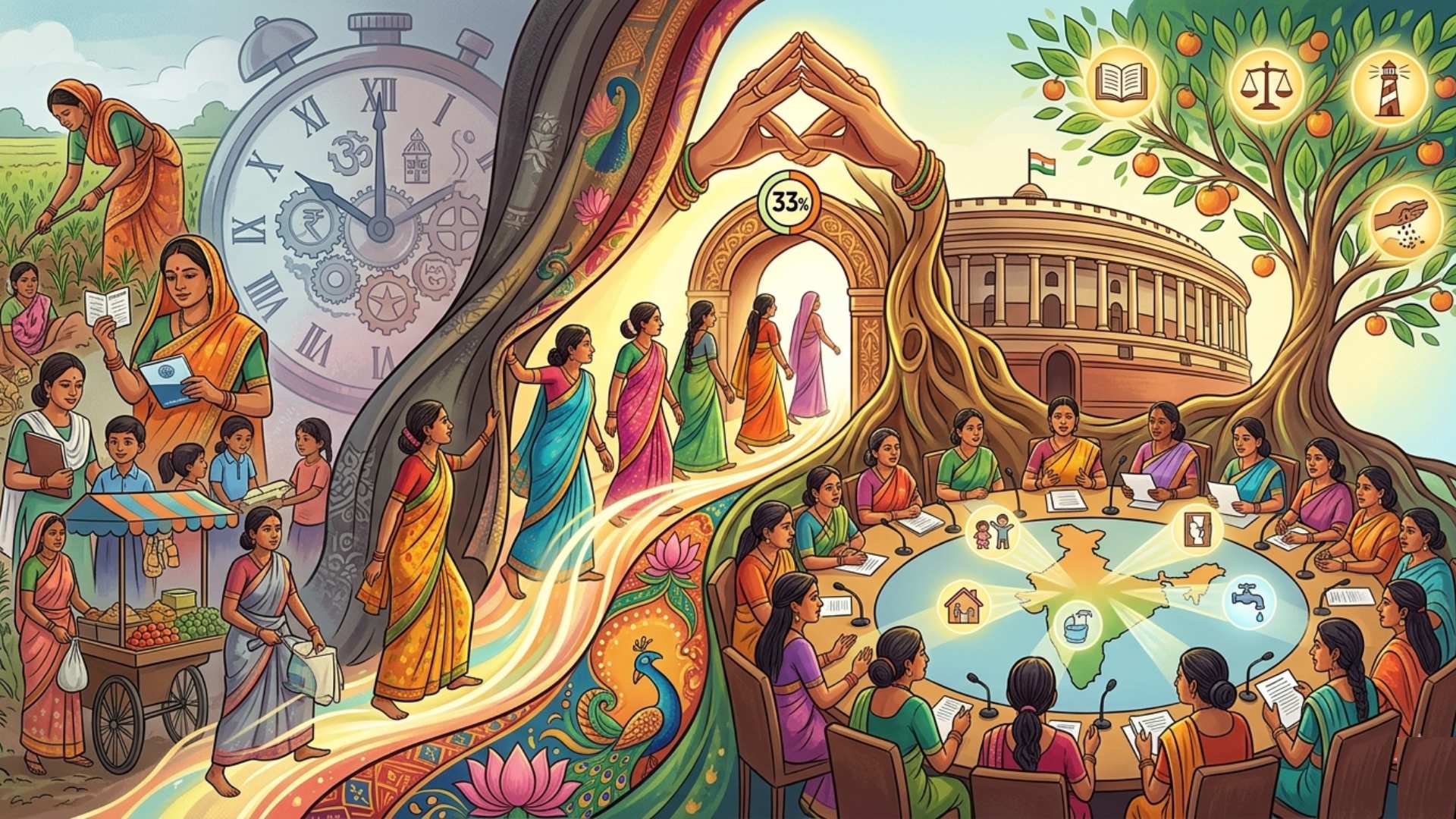
Empowering Women: The Cornerstone of True Democracy

Exploring the far-reaching impacts of women's reservation on political representation, decision-making, and democratic resilience.
SuryaSurya
3 mins read
Women reservation law reshapes democracy and policy making

"The quality of democracy is determined not just by who votes, but by who governs." — Amartya Sen


IndicatorData
Women in Lok Sabha (2024)~13.6%
Global average (women in parliament)~26.9% (IPU, 2024)
Rwanda (world leader)~61%
Reservation guaranteed under the Act33% (Lok Sabha + State Legislatures)
Seats reserved (approx. post-delimitation)~181 of 543 Lok Sabha seats

Background & Context

The demand for women's legislative reservation dates to the 1990s. The 81st, 84th, and 108th Constitution Amendment Bills all lapsed due to political disagreement. The Constitution (106th Amendment) Act, 2023, passed unanimously in a Special Session of Parliament, finally delivered this long-pending reform.

The Act reserves one-third of seats for women in the Lok Sabha, State Legislative Assemblies, and the NCT of Delhi. Seats will be rotated after every delimitation exercise. The reservation is linked to the completion of the next Census and subsequent delimitation, making its operational timeline uncertain.


Key Provisions

  • 33% reservation for women in Lok Sabha and Vidhan Sabhas
  • Includes sub-reservation for SC/ST women within the reserved quota
  • Seats to be rotated after each delimitation cycle
  • Duration: 15 years initially (subject to review)
  • Operative only after Census + Delimitation — currently delayed

Significance: Why It Matters

1. Epistemic Diversity in Governance Women legislators bring lived experience of issues long treated as "soft" — domestic violence, childcare, public sanitation, and access to services. This transforms these from peripheral concerns into core policy priorities.

2. From Procedural to Deliberative Democracy The Act represents a shift from merely ensuring institutional processes (procedural democracy) to enriching the quality of political deliberation — multiple experiences informing governance outcomes.

3. Political Economy Rationale Women constitute the backbone of India's informal economy — SHG leaders, agricultural labourers, street vendors, domestic workers. Their entry into formal decision-making shortens the feedback loop between policy and ground reality.

4. Breaking Dynastic and Networked Politics Recruitment in Indian politics has been dominated by dynasty, caste, and masculine networks. Mandatory representation forces parties to search for and nurture new talent pools.


Challenges

ChallengeNature
Census + Delimitation delayInstitutional/Administrative
Proxy candidacy ("Sarpanch Pati" syndrome)Sociocultural
Elite capture within women's quotaPolitical economy
Lack of internal party democracy for womenStructural
Mobility, time, and autonomy constraintsSocial
Performative aggression in legislaturesInstitutional culture

Comparative Context

CountryWomen in LegislatureMechanism
Rwanda~61%Mandatory constitutional quota
Sweden~46%Voluntary party quotas
UK~35%Party-level all-women shortlists
India (current)~13.6%No mandate (pre-Act)
India (post-Act)33% (target)Constitutional reservation

Critical Analysis

Strengths:

  • Constitutional backing gives it permanence over mere party-level commitments
  • SC/ST sub-reservation ensures intersectional representation
  • Proven impact at local level — 73rd/74th Amendments with 33% reservation for women in PRIs showed measurable improvements in public goods provisioning

Limitations:

  • Operational dependence on delimitation creates political uncertainty
  • Without internal party reform, women may remain "nominated" rather than "elected" in spirit
  • Does not address women in Upper Houses (Rajya Sabha, Vidhan Parishads)
  • Risk of elite capture — educated, upper-caste urban women benefiting disproportionately

Conclusion

The Nari Shakti Vandan Adhiniyam is not merely a quota mechanism — it is a structural correction to decades of democratic underrepresentation. Its true transformative value lies beyond numbers: it is about embedding diverse rationalities into the architecture of Indian lawmaking. However, legislative reservation alone cannot complete this transformation. It must be accompanied by internal party democratisation, administrative efficiency in Census and delimitation, and a deeper cultural shift in how public life accommodates women. As a long-term process of political refinement, its success will be measured not by seats filled but by the quality of deliberation those seats produce.

Quick Q&A

Everything you need to know

Concept and Provisions: The Nari Shakti Vandan Adhiniyam, 2023 (Women’s Reservation Act) mandates 33% reservation for women in the Lok Sabha and State Legislative Assemblies. While on the surface it appears as a measure to enhance representation, its deeper significance lies in reshaping the institutional design of Indian democracy. It seeks to transition women from being passive recipients of welfare to active agents of governance and decision-making.

Transformative Potential: The Act expands the social base of political participation, thereby strengthening representative democracy. By incorporating women’s lived experiences into legislative processes, it enhances epistemic diversity—the inclusion of diverse knowledge systems and perspectives in policymaking. This can improve the quality of deliberation and lead to more inclusive laws, especially on issues like health, education, sanitation, and gender justice.

Broader Implications: Beyond representation, the Act challenges entrenched political structures dominated by dynasty, caste, and masculinised networks. For example, the success of women leaders in Panchayati Raj Institutions following the 73rd Amendment demonstrates how reservation can lead to grassroots empowerment and improved governance outcomes. Thus, the Adhiniyam represents a structural innovation aimed at deepening democracy rather than merely redistributing seats.

Democratic Legitimacy: A democracy derives its legitimacy from inclusive representation. Women constitute nearly half of India’s population, yet their presence in legislatures has historically been low. Increasing their representation ensures that democracy reflects societal diversity, thereby enhancing its credibility and responsiveness.

Improved Policy Outcomes: Women bring distinct lived experiences that influence policy priorities. Issues such as domestic violence, childcare, sanitation, and public health often receive inadequate attention in male-dominated legislatures. Evidence from local governance shows that women leaders tend to prioritise public goods like drinking water, education, and welfare services. This aligns governance more closely with citizens’ everyday needs.

Deliberative Democracy: The inclusion of women promotes a shift from procedural democracy (focused on elections and institutions) to deliberative democracy, where the quality of debate and diversity of perspectives matter. For instance, women parliamentarians globally have been observed to adopt more collaborative and less adversarial approaches. Thus, representation is not merely symbolic but has substantive implications for governance quality and democratic deepening.

Understanding Epistemic Diversity: Epistemic diversity refers to the inclusion of multiple ways of knowing and understanding societal issues. Women, particularly from diverse socio-economic backgrounds, bring first-hand experiences of challenges such as informal labour, caregiving, and social discrimination. This enriches the knowledge base of policymaking.

Impact on Policy Formulation: When women participate in legislative processes, policies are more likely to reflect ground realities rather than abstract data. For example, women’s involvement in local governance has led to improved outcomes in nutrition programs, school attendance, and sanitation initiatives. Their presence creates a shorter feedback loop between citizens and the state, making governance more responsive.

Institutional Benefits: The Act compels political parties to identify and nurture new talent, thereby diversifying leadership pipelines. This breaks the monopoly of traditional power structures and fosters innovative and inclusive policymaking. Over time, such diversity can lead to more equitable and sustainable development outcomes.

Institutional Constraints: One of the primary challenges is that the Act’s implementation is contingent upon the completion of the Census and delimitation of constituencies. Delays in these processes can postpone its operationalisation, limiting its immediate impact.

Political and Structural Barriers: Political parties may resist meaningful change by treating women candidates as symbolic placeholders rather than empowering them as genuine decision-makers. Existing power structures dominated by elites and entrenched networks may continue to marginalise women, especially those from disadvantaged backgrounds.

Socio-Cultural Factors: Deep-rooted social norms, gender roles, and constraints on women’s mobility and autonomy pose significant barriers. For instance, women often face challenges in balancing domestic responsibilities with political careers. Additionally, societal attitudes may undermine their authority and participation. Addressing these challenges requires not only institutional reforms but also cultural transformation and social awareness.

Arguments in Favour: Reservation is a necessary first step to correct historical underrepresentation and create opportunities for women in politics. It ensures a minimum critical mass, which is essential for influencing legislative outcomes. Evidence from Panchayati Raj Institutions shows that reservation has led to increased participation and leadership among women.

Limitations: However, reservation alone may not guarantee substantive empowerment. There is a risk of proxy representation, where women elected representatives are controlled by male family members. Additionally, without changes in party structures and political culture, women may remain excluded from key decision-making processes.

Way Forward: For meaningful empowerment, reservation must be complemented by capacity building, leadership training, and institutional reforms. Political parties need to democratise their internal structures and provide equal opportunities for women. समाज-wide changes in attitudes towards gender roles are equally important. Thus, reservation is a necessary but not sufficient condition for achieving gender equality in politics.

Indian Context: The experience of Panchayati Raj Institutions provides strong evidence of the positive impact of women’s participation. Studies have shown that women-led panchayats prioritise issues like drinking water, sanitation, education, and health. For instance, in states like Bihar and Rajasthan, women sarpanches have been instrumental in improving school infrastructure and implementing welfare schemes effectively.

Global Examples: Countries like Rwanda, which has one of the highest proportions of women in parliament, have witnessed significant progress in areas such as gender equality, healthcare, and social welfare. Similarly, in Nordic countries, higher female representation has contributed to inclusive and progressive policymaking.

Key Takeaway: These examples demonstrate that women’s participation is not merely symbolic but leads to tangible improvements in governance. It reinforces the argument that inclusive representation enhances policy effectiveness and societal well-being.

Administrative Measures: The first step would be to ensure the timely completion of the Census and delimitation process, which are prerequisites for implementing the Act. Strengthening institutional capacity and ensuring transparency in these processes is crucial.

Political Reforms: Political parties must be incentivised or mandated to adopt internal quotas and leadership development programs for women. This includes training, mentorship, and financial support to enable women to contest elections effectively. Ensuring diversity within women candidates, including representation from marginalised communities, is equally important.

Societal and Cultural Interventions: Public awareness campaigns should be launched to challenge gender stereotypes and promote acceptance of women leaders. Policies supporting work-life balance, such as childcare facilities and flexible working conditions, can help women participate more actively in politics. Overall, a multi-dimensional approach combining institutional, political, and social reforms is essential for translating the Act’s vision into reality.

Attribution

Original content sources and authors

Sign in to track your reading progress

Comments (0)

Please sign in to comment

No comments yet. Be the first to comment!