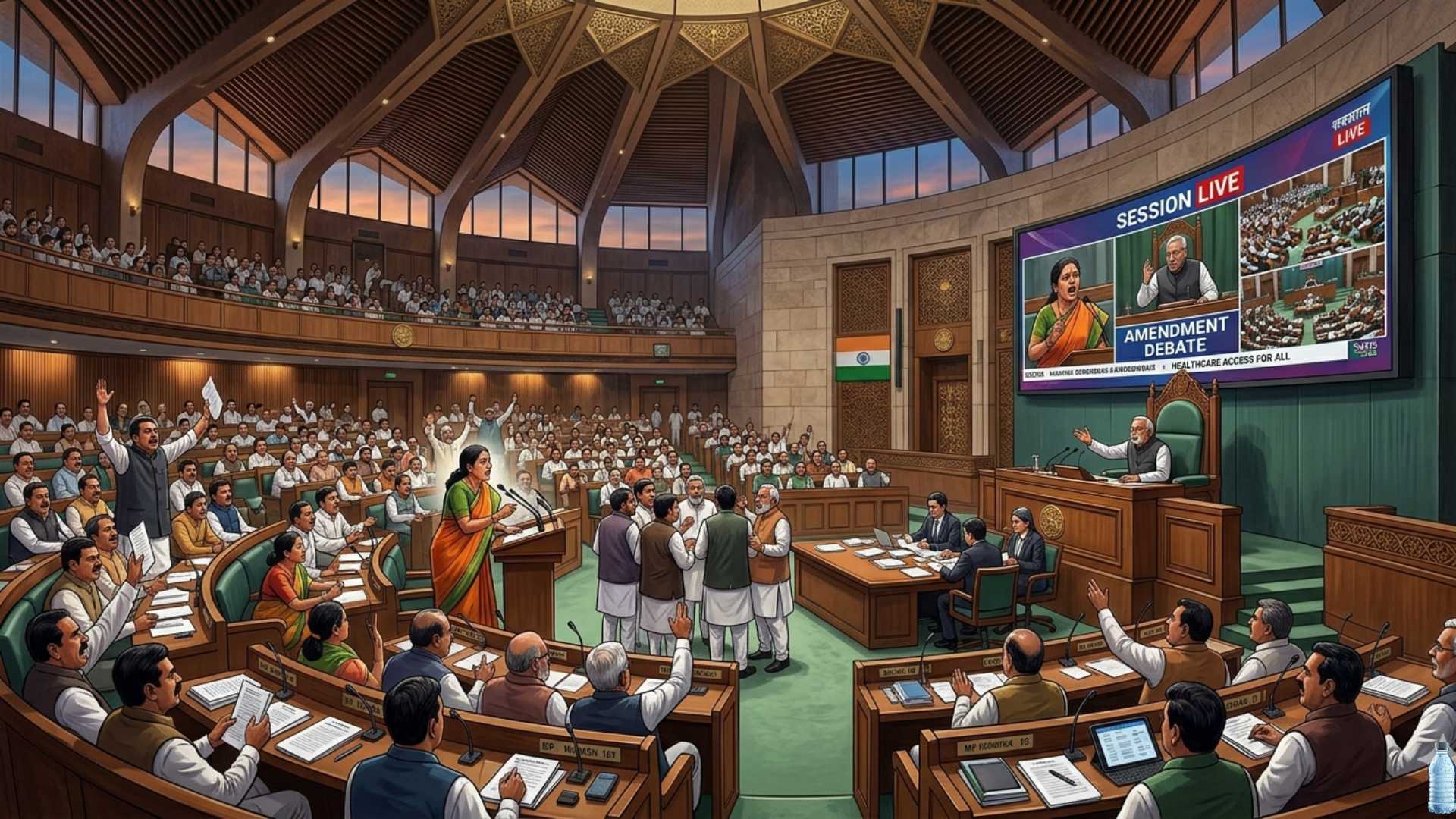
"Article 81(2)(a) rewards demographic weight, not developmental achievement." — The Hindu Analysis, April 2026
| Indicator | Data |
|---|---|
| Current Lok Sabha strength | 543 seats |
| Proposed strength | 850 seats (815 States + 35 UTs) |
| Census basis proposed | 2011 Census |
| Hindi Heartland share (current → proposed) | 38.1% → 43.1% (+5 pts) |
| South's share (current → proposed) | 24.3% → 20.7% (−3.6 pts) |
| Hindi Heartland absolute gain | +159 seats (77% increase) |
| South's absolute gain | +44 seats (33% increase) |
Background & Context
The Constitution (131st Amendment) Bill and companion Delimitation Bill (tabled April 16, 2026) propose three structural changes to India's parliamentary architecture:
a) Raise Lok Sabha ceiling from 543 → 850 seats b) Replace the 1971 Census freeze (originally imposed in 1976 to protect family-planning states) with an open-ended formula allowing Parliament to choose census basis by ordinary law c) Constitute a Delimitation Commission using the 2011 Census — the latest published census — to redraw boundaries and reallocate seats
The stated trigger is operationalising Nari Shakti Vandan Adhiniyam, 2023, which requires delimitation before women's reservation can take effect.
The 1976 Freeze — Why It Existed
The original constitutional freeze pegged seat allocation to the 1971 Census specifically to avoid penalising states that successfully reduced population growth through investment in health, education, and family planning. Removing this freeze without a compensatory mechanism directly revives this historical inequity.
Who Gains, Who Loses
| Region / State | Seats Change (vs. proportional increase) |
|---|---|
| Uttar Pradesh | +13 |
| Bihar | +10 |
| Rajasthan | +8 |
| Madhya Pradesh | +5 |
| Delhi | +5 |
| Tamil Nadu | −11 |
| Kerala | −8 |
| Andhra Pradesh | −5 |
| Odisha | −3 |
Regional Summary:
| Region | Current Share | Proposed Share | Change |
|---|---|---|---|
| Hindi Heartland | 38.1% | 43.1% | +5.0 pts |
| South | 24.3% | 20.7% | −3.6 pts |
| North-East | 4.4% | 3.8% | −0.6 pts |
| East | 14.4% | 13.7% | −0.7 pts |
| West + Northern non-Hindi | ~unchanged | ~unchanged | — |
Demographic Roots of the Asymmetry
The divergence is rooted in Total Fertility Rates (TFR) — NFHS-5 (2019–21):
| State | TFR | Status |
|---|---|---|
| Kerala | 1.8 | Below replacement |
| Tamil Nadu | 1.8 | Below replacement |
| Karnataka | 1.7 | Below replacement |
| Andhra Pradesh | 1.7 | Below replacement |
| Telangana | 1.6 | Below replacement |
| Bihar | 3.0 | Above replacement |
| Uttar Pradesh | 2.4 | Above replacement |
| Jharkhand | 2.3 | Above replacement |
| Meghalaya | 2.9 | Above replacement |
Replacement level TFR = 2.1. Southern states have been at or below replacement for over a decade — a direct result of sustained investment in women's education, healthcare, and family planning.
Core Constitutional Tension
Article 81(2)(a) mandates population-proportional seat allocation — it contains no mechanism to preserve existing seat shares or reward developmental performance.
The government's assurance of "proportional increase across the country" is politically stated but constitutionally unenforceable — the Bills contain no such guarantee. A proportional increase would preserve existing seat shares; population-proportional allocation by definition does not.
This creates a perverse incentive structure: states that lagged on HDI indicators gain parliamentary power; states that invested in human development lose it.
Key Implications
Federal Balance: Southern and North-Eastern states face structural marginalisation in the Lok Sabha — policy priorities of these regions (maritime economy, linguistic federalism, urban governance) may receive declining legislative weight.
Cooperative Federalism Under Strain: The delimitation exercise, combined with the Finance Commission's tax devolution formula (which already penalises lower-population states), creates a double penalty for demographically responsible states.
Women's Reservation Linkage: The Bills are framed as enabling Nari Shakti Vandan Adhiniyam — yet the women's reservation itself could have been operationalised through existing seat boundaries, raising questions about whether delimitation is a means or an end.
Precedent of Parliamentary Override: Allowing Parliament to choose the census basis by ordinary law removes a constitutional safeguard — future governments could selectively choose census years for political advantage.
Critical Analysis
For the Bills:
- Expanding Lok Sabha to 850 improves voter-to-MP ratio (currently among the world's most skewed)
- Women's reservation operationalisation has genuine democratic value
- 2011 Census is the only published census available — using it is administratively logical
Against the Bills:
- No compensatory mechanism for developmentally advanced states
- Removes the constitutional protection that incentivised family planning
- Concentrates political power in Hindi Heartland — structural shift in India's federal balance
- Government assurances have no legal enforceability
Conclusion
The delimitation exercise presents India with a foundational federal dilemma: constitutional democracy demands population-proportional representation, yet governance equity demands that developmental achievement not be punished. The 1976 freeze was a conscious policy choice to align representation with incentive structures — its removal without replacement mechanisms signals a retreat from that compact. A truly federal solution would require either a compensatory seat formula, a bicameral rebalancing (strengthening Rajya Sabha as the states' chamber), or an explicit constitutional amendment protecting existing seat shares. Without these, the expansion of the Lok Sabha risks deepening rather than deepening India's federal fault lines.