
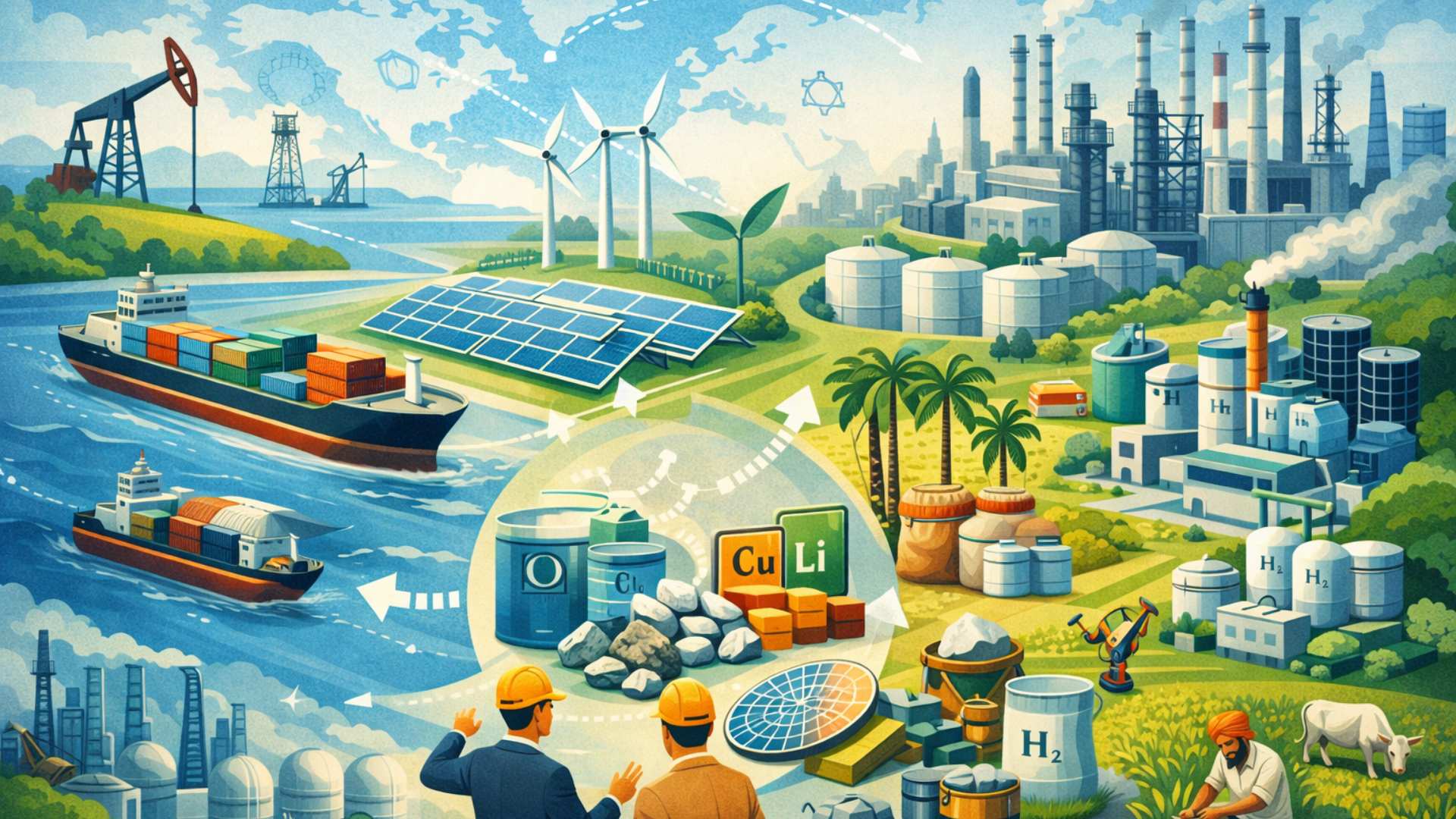
Securing India's Supply Chains for Future Resilience

Integrated strategies are essential for building robust supply chains and addressing vulnerabilities in India's economy.
SuryaSurya
5 mins read
Supply shocks expose India’s import dependence

Introduction

Global supply chain disruptions — accelerated by the COVID-19 pandemic, the Russia-Ukraine war, and West Asian geopolitical tensions — have exposed the structural vulnerabilities of import-dependent economies. India, with imports accounting for nearly 19% of GDP, remains deeply exposed across energy, food, and manufacturing intermediates.

Vulnerability AreaKey Statistic
Crude oil import dependence~85% of total requirement
Natural gas import dependenceOver 50%
Impact of $10/barrel crude price hike$13–14 billion rise in import bill
Inflation impact of same hike30–40 bps rise in consumer inflation
GDP growth impact0.2–0.3 percentage points decline
Edible oil — domestic production shareOnly 44% of demand met domestically
Pharma intermediates from China65–70% of total imports
Share of raw materials in total imports34%
Share of intermediates in total imports31%

"Supply chain resilience cannot be built through isolated interventions. It requires an integrated, forward-looking approach involving government, industry, and global partners."


Background and Context

India's manufacturing ecosystem is deeply integrated into global supply chains — benefiting from cost efficiencies but simultaneously exposed to external shocks. The concentration of critical inputs in a handful of geographies (China for pharmaceuticals and electronics, West Asia for energy, a few African nations for rare earth minerals) creates systemic risk. India dominates downstream and final assembly manufacturing but remains structurally dependent on upstream and midstream inputs — a gap that Atmanirbhar Bharat and Production-Linked Incentive (PLI) schemes have only partially addressed.


Energy Security

India is one of the world's largest energy importers. Its dependence on fossil fuel imports makes it acutely sensitive to geopolitical developments in West Asia and global oil price volatility.

Key risks: Every $10 per barrel rise in crude oil prices triggers a cascade — higher input costs across manufacturing, rising logistics expenses, inflationary pressure via diesel and fertiliser linkages, and GDP contraction.

Strategic responses:

StrategyInitiative
Renewable energy transition500 GW non-fossil capacity target by 2030
Green hydrogenNational Green Hydrogen Mission
Domestic explorationExpanding oil and gas exploration blocks
Strategic reservesExpanding Strategic Petroleum Reserves (SPR)
Import diversificationSourcing from Russia, USA, Latin America alongside Gulf

The transition to renewables addresses long-term structural dependence, but intermittency challenges require massive investment in energy storage — a gap that remains a critical bottleneck.


Food Security

Despite being a net exporter of cereals and marine products, India's food supply chain carries deep import vulnerabilities in three critical segments.

CommodityImport DependenceRisk
Edible oils56% of demand importedPrice inflation, rural income impact
PulsesSignificant import dependenceFood inflation, nutritional security
FertilisersHigh dependence on phosphatic & potassic importsAgricultural productivity risk

Policy imperatives: Oilseeds Mission must be scaled to close the domestic production gap. Strategic buffer reserves for edible oils and pulses are essential for contingency management. Fertiliser sector reform must diversify supplier mix, boost domestic phosphatic and potassic production, and promote bio-fertilisers at scale.


Manufacturing — Raw Materials and Intermediates

India's import structure reveals a critical structural weakness — dominance in final assembly but dependence on upstream inputs.

Import composition:

CategoryShare of Total Imports
Raw materials34%
Intermediates31%
Capital goods24%
Consumer goods12%

Sector-wise vulnerabilities:

SectorNature of Dependence
Pharmaceuticals65–70% of intermediates (APIs) from China
ElectronicsHigh dependence on semiconductors, displays from East Asia
Electric vehicles & advanced manufacturingLithium, cobalt, rare earths — globally concentrated
Industrial machineryLimited domestic high-end manufacturing capability

These are non-substitutable inputs in the short run — when disrupted, production halts entirely.


Strategic Imperatives for Resilience

1. Deepen domestic manufacturing in intermediates: PLI schemes have largely incentivised final assembly. The next phase must target API manufacturing, semiconductor fabrication, and industrial intermediates.

2. Diversify supply sources: Long-term supply agreements with Africa and Latin America for critical minerals; reducing single-country dependence (especially China) for pharmaceuticals and electronics.

3. Re-engineer industrial processes: Promoting direct conversion technologies, alternative materials, and input-efficient production methods to structurally reduce import intensity.

4. Strategic stockpiling: Beyond petroleum reserves, India must build buffer stocks for edible oils, pulses, and critical minerals.

5. Technology transition: National Green Hydrogen Mission and renewable energy storage investments reduce long-term fossil fuel dependence.


Challenges

  • Domestic manufacturing of semiconductors and APIs requires decades-long investment — India currently imports 65–70% of pharma intermediates from China alone, reflecting deep technological dependency.

  • Rare earth minerals critical to EVs and electronics (lithium, cobalt, copper) are geographically concentrated in Africa and Latin America, making diversification a complex geopolitical exercise rather than a market decision.

  • Renewable energy intermittency remains unresolved — India targets 500 GW non-fossil capacity by 2030, but battery storage infrastructure investment is far behind the scale required to manage grid stability.

  • Agricultural diversification towards oilseeds and pulses is structurally slow — domestic production meets only 44% of edible oil demand, and shifting farmer behaviour requires sustained MSP support, assured procurement, and region-specific crop planning.

  • India's imports account for 19% of GDP, with raw materials (34%) and intermediates (31%) dominating — making industrial output acutely sensitive to even short-term global supply disruptions.


Conclusion

India's supply chain vulnerabilities are not merely economic — they are strategic. Dependence on a narrow set of geographies for critical inputs in energy, food, and manufacturing creates pressure points that adversaries can exploit and markets can amplify. Building resilience requires a layered approach: domestic capacity creation, geographic diversification of sourcing, strategic reserves, and technological transition. The Atmanirbhar Bharat vision must evolve from incentivising final assembly to genuinely deepening upstream and midstream manufacturing ecosystems. Supply chain resilience, ultimately, is national security.


Quick Q&A

Everything you need to know

Supply chain vulnerability refers to the susceptibility of an economy or industry to disruptions in the availability of critical inputs such as raw materials, intermediates, or energy resources. In the context of India, this vulnerability arises from its heavy dependence on imports for key sectors like energy, pharmaceuticals, electronics, and fertilizers.

India’s manufacturing ecosystem is deeply integrated with global supply chains, where imports account for nearly 19% of GDP. A significant portion of these imports includes raw materials (34%) and intermediates (31%), which are essential for production. For instance, India imports 65–70% of its pharmaceutical intermediates from China and relies heavily on East Asia for semiconductors and electronic components. Such dependencies create systemic risks when geopolitical tensions, trade restrictions, or pandemics disrupt supply flows.

A recent example is the geopolitical instability in West Asia, which affects crude oil supply. Given that India imports about 85% of its crude oil, any disruption leads to cascading effects across sectors—raising manufacturing costs, increasing inflation, and slowing economic growth. Thus, supply chain vulnerability is not merely a trade issue but a macroeconomic and strategic concern, requiring diversification, domestic capacity building, and resilience planning.

Energy security is fundamental to India’s economic stability because energy serves as the backbone of all major sectors, including manufacturing, agriculture, transport, and services. India’s high dependence on imports—around 85% for crude oil and over 50% for natural gas—makes it particularly vulnerable to global price fluctuations and geopolitical disruptions.

The economic implications are significant. It is estimated that a 10perbarrelincreaseincrudeoilprices</strong>canraiseIndiasimportbillby10 per barrel increase in crude oil prices</strong> can raise India’s import bill by 13–14 billion, increase inflation by 30–40 basis points, and reduce GDP growth by 0.2–0.3 percentage points. Such shocks can destabilize fiscal planning, increase current account deficits, and affect household consumption through higher fuel and food prices.

To address these challenges, India must adopt a multi-pronged strategy:

  • Diversification of energy sources through imports from multiple regions
  • Expansion of renewable energy to reduce fossil fuel dependence
  • Strategic petroleum reserves to cushion short-term disruptions

For example, India’s push towards 500 GW of non-fossil fuel capacity by 2030 and initiatives like the National Green Hydrogen Mission aim to reduce long-term dependence on imported fuels. Thus, energy security is not only about availability but also about ensuring affordability, sustainability, and resilience.

Building long-term resilience in manufacturing supply chains requires a comprehensive and integrated approach involving domestic capacity building, diversification, and technological innovation. India must move beyond assembly-based manufacturing to strengthen its upstream and midstream capabilities.

Key strategies include:

  • Deepening domestic manufacturing: Focus on producing intermediates such as APIs, semiconductors, and industrial components
  • Supply diversification: Establish long-term trade partnerships with regions like Africa and Latin America
  • Technological innovation: Adopt input-efficient and alternative production methods to reduce dependency

For instance, the pharmaceutical sector can reduce reliance on Chinese imports by boosting domestic API production through targeted incentives. Similarly, the semiconductor mission aims to create a domestic ecosystem for chip manufacturing, reducing dependence on East Asia.

Additionally, re-engineering industrial processes—such as using alternative materials or direct conversion technologies—can lower import intensity. However, resilience cannot be achieved in isolation; it requires coordination between government, industry, and global partners.

Thus, a combination of policy support, infrastructure development, and global integration is essential for creating robust and shock-resistant supply chains.

India’s dependence on imports in critical sectors such as electronics and pharmaceuticals stems from structural, technological, and economic factors. Despite being a global leader in certain downstream industries, India lacks sufficient capacity in upstream and intermediate production.

Key reasons include:

  • Limited domestic manufacturing ecosystem: Focus has historically been on final assembly rather than component production
  • Technological gaps: High-end manufacturing like semiconductors requires advanced technology and significant capital investment
  • Global concentration of resources: Critical minerals like lithium and cobalt are geographically concentrated

For example, India imports nearly 65–70% of its pharmaceutical intermediates from China due to cost advantages and established supply chains. Similarly, the electronics sector depends heavily on East Asia for semiconductors and display units, as these regions have developed specialized ecosystems over decades.

Another factor is the lack of domestic availability of critical raw materials, which forces reliance on imports. Additionally, economies of scale and competitive pricing in global markets often make imports more viable than domestic production.

Addressing these challenges requires long-term investments in technology, infrastructure, and skill development, along with strategic policy interventions to promote self-reliance without compromising global competitiveness.

Reducing import dependence is often seen as a key strategy for enhancing supply chain resilience, but it must be approached with nuance. On the positive side, lowering dependence on imports can reduce exposure to external shocks, improve domestic industrial capacity, and enhance economic sovereignty.

Advantages include:

  • Greater stability: Reduced vulnerability to geopolitical disruptions
  • Job creation: Boost to domestic manufacturing and employment
  • Strategic autonomy: Less reliance on foreign suppliers for critical inputs

However, there are limitations. Complete self-reliance may lead to inefficiencies, higher costs, and reduced competitiveness if domestic industries are not globally competitive. Overemphasis on import substitution can also lead to protectionism, which may hinder innovation and integration with global value chains.

For instance, while promoting domestic semiconductor manufacturing is essential, it requires massive investments and time. In the interim, diversification of imports may be a more practical strategy.

Therefore, the optimal approach lies in ‘smart resilience’—combining domestic capacity building with diversified global sourcing. This ensures that India remains integrated with global trade while minimizing risks. The focus should be on critical sectors and strategic vulnerabilities, rather than blanket import substitution.

Supply chain disruptions in fertilizers and edible oils have direct and significant implications for India’s food security and inflation dynamics. Despite being a net exporter of certain agricultural commodities, India remains highly dependent on imports for key inputs like edible oils, pulses, and fertilizers.

For example, domestic production meets only about 44% of the demand for edible oils, making India vulnerable to global supply shocks. Any disruption—such as export restrictions by major producers or geopolitical tensions—can lead to sharp price increases, affecting household consumption and increasing inflation.

Similarly, the fertilizer sector relies heavily on imports of phosphatic and potassic fertilizers. Disruptions in supply can increase input costs for farmers, reduce crop yields, and ultimately impact food availability and rural incomes.

Policy responses include:

  • Promoting oilseed and pulse production through assured procurement and price support
  • Creating strategic reserves to manage short-term shortages
  • Encouraging bio-fertilizers as sustainable alternatives

A case in point is India’s response to global edible oil shortages by increasing imports and promoting domestic cultivation under oilseed missions.

Thus, ensuring supply chain resilience in these sectors is critical for maintaining food security, price stability, and rural livelihoods.

India’s dependence on semiconductor imports is a classic example of supply chain vulnerability in a high-technology sector. Semiconductors are critical inputs for electronics, automobiles, telecommunications, and defense systems, yet India relies heavily on imports, primarily from East Asia.

This dependency became evident during the global chip shortage, which disrupted production across industries, including automobile manufacturing in India. The lack of domestic fabrication facilities and ecosystem support has limited India’s ability to respond to such disruptions.

Key challenges include:

  • High capital requirements: Semiconductor fabs require billions of dollars in investment
  • Technological complexity: Advanced manufacturing processes and skilled workforce are essential
  • Global competition: Established players dominate the market

To address these challenges, India has launched initiatives like the Semiconductor Mission, offering incentives for domestic manufacturing and attracting global players. Additionally, fostering research and development, building talent pipelines, and creating supportive infrastructure are critical.

Diversifying supply sources and forming strategic partnerships with countries like the US, Japan, and Taiwan can also enhance resilience.

This case highlights the need for a long-term, ecosystem-based approach to reduce dependency and build strategic capacity in critical sectors.

Attribution

Original content sources and authors

Sign in to track your reading progress

Comments (0)

Please sign in to comment

No comments yet. Be the first to comment!