
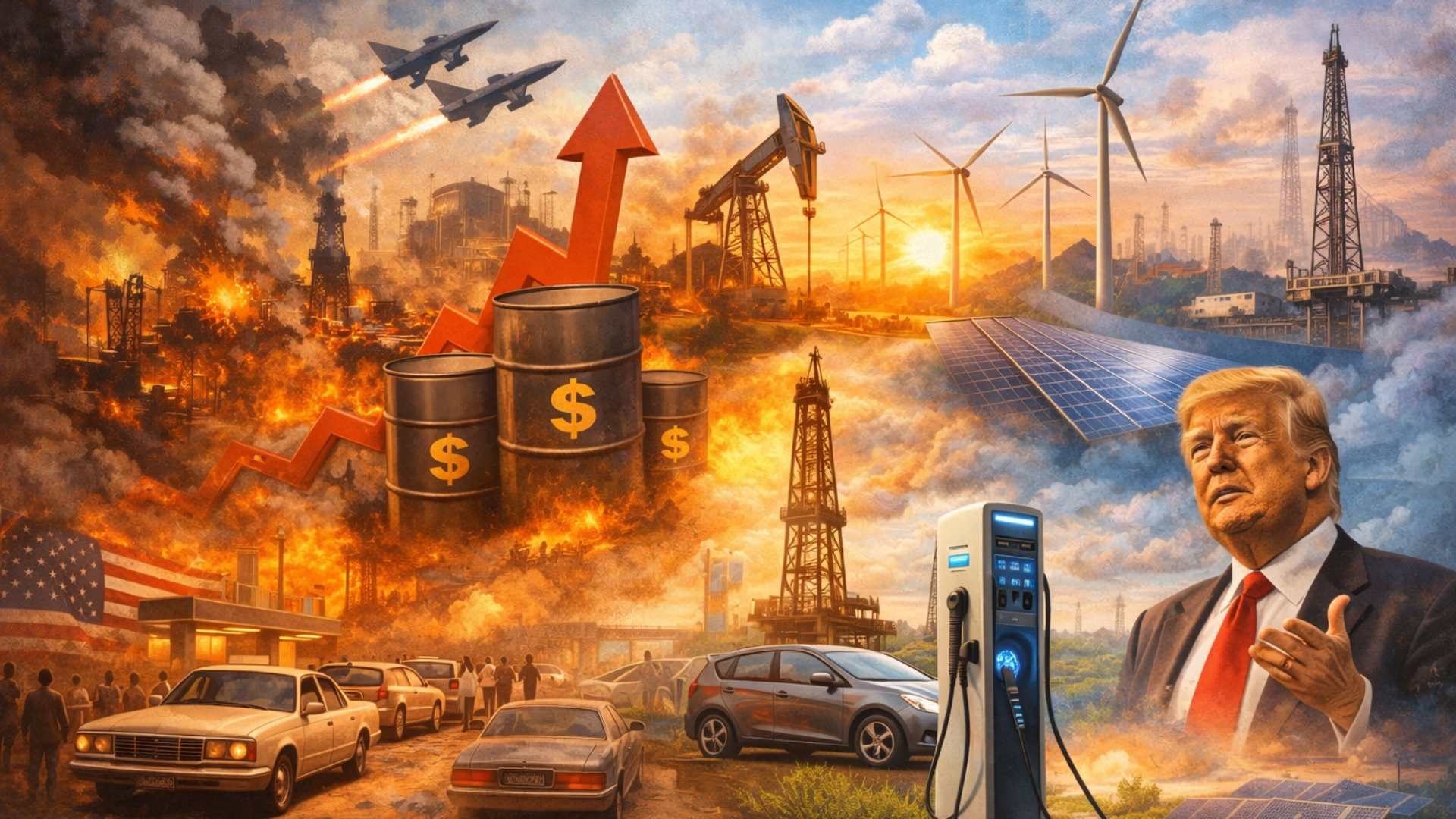
# Energy Security & Oil Shocks: Lessons for India's Transition
**GS3 | Indian Economy | Energy Security | Environment & Resource Management**
---
## Introduction
Energy security — the uninterrupted availability of energy at an affordable price — is a cornerstone of modern economic stability. The 1973 OPEC oil embargo triggered the first global "oil shock," exposing the structural vulnerability of petroleum-dependent economies. Today, with Iran's effective closure of the **Strait of Hormuz** cutting off ~15 million barrels per day (15% of global supply), the world faces its most severe oil disruption since 1973. For India — which imports **87% of its crude oil needs** and is the world's third-largest oil consumer — the stakes are existential.
> *"A disruption anywhere affects the price everywhere — the transportation sector is still overwhelmingly reliant on petroleum."* — Sam Ori, University of Chicago Energy Policy Institute
---
## Key Data Points
| Indicator | Data |
|---|---|
| Global oil supply through Strait of Hormuz | 20 million barrels/day (20% of global production) |
| Supply disrupted (current crisis) | ~15 million barrels/day (15%) |
| 1973 embargo disruption | ~6% of global supply |
| Oil's share of world energy (1973) | 46% |
| Oil's share of world energy (2023) | 30% (IEA) |
| Global oil consumption today | 100+ million barrels/day |
| India's crude oil import dependence | ~87% |
| India's crude oil import bill (2023-24) | ~$132 billion |
| U.S. fuel economy improvement | 13.1 mpg (1975) → 27.1 mpg (2023) |
---
## Historical Context: The Oil Shocks
**First Oil Shock (1973):**
- OPEC embargo targeting Israel-supporting nations during Yom Kippur War
- Triggered stagflation — simultaneous inflation + economic stagnation
- Led to petrol rationing, speed limits, and demand-side conservation globally
**Second Oil Shock (1979):**
- Iranian Revolution disrupted Persian Gulf supplies
- Accelerated Western energy diversification strategies
**Policy responses that followed:**
| Country | Response |
|---|---|
| USA | Fuel economy standards (1975); Strategic Petroleum Reserve; fracking revolution |
| Japan | "Sho-ene" laws; LNG transition; nuclear expansion |
| France | Aggressive nuclear programme (now 70%+ of electricity) |
| UK | North Sea oil development |
| Global | International Energy Agency (IEA) established 1975 |
---
## Structural Shifts That Cushioned the Blow
**1. Energy Mix Diversification**
Oil's share of global energy fell from 46% (1973) to 30% (2023) — replaced by natural gas, nuclear, solar, and wind.
**2. Demand-Side Efficiency**
Vehicle fuel economy improvements account for the largest single reduction in oil intensity globally (World Bank). Japan's per capita energy consumption ranks 21st globally despite being a major industrial economy.
**3. Supply-Side Diversification**
New oil frontiers — Alaska's Prudhoe Bay, North Sea, Canada's oil sands, and U.S. shale/fracking — reduced OPEC's stranglehold. U.S. production rose from 5 million (2008) to 13.6 million barrels/day (2023).
**4. Strategic Stockpiling**
IEA's 32 members released 400 million barrels (including 172 million from U.S. Strategic Petroleum Reserve) during the current crisis to stabilise markets.
**5. Monetary Policy Learning**
Post-1970s central banks learned not to cut rates during oil shocks — doing so in the 1970s amplified inflation. The Fed's current approach is more hawkish.
---
## India's Specific Vulnerabilities
| Vulnerability | Detail |
|---|---|
| Import dependence | 87% of crude imported; Gulf accounts for ~60% |
| Remittance-energy nexus | ~9 million Indians in Gulf; dual exposure |
| Fertiliser dependence | Natural gas-based fertilisers; price transmission to agriculture |
| Transportation lock-in | Road freight overwhelmingly diesel-dependent |
| Forex pressure | Rising oil bill widens Current Account Deficit |
| Inflation transmission | Fuel price hikes trigger broad-based inflation |
---
## India's Energy Security Strategy: Initiatives & Gaps
**Government Initiatives:**
- **Strategic Petroleum Reserve (SPR):** 5.33 million metric tonnes capacity at Visakhapatnam, Mangaluru, Padur
- **PM KUSUM / SRISTI:** Solar energy for agriculture
- **National Electric Mobility Mission / FAME II:** EV adoption incentives
- **Ethanol Blending Programme:** 20% blending target by 2025
- **Renewable energy target:** 500 GW by 2030
- **Diversifying crude sources:** Russia, USA, Brazil, Africa — reducing Gulf concentration
- **IEA Association Member** since 2017
**Persistent Gaps:**
- SPR covers only ~9.5 days of consumption (IEA recommends 90 days)
- EV transition slow — charging infrastructure, battery cost barriers
- Coal still dominates power generation (~70%)
- Natural gas share in energy mix remains low (~6%) vs. global average of 23%
---
## Comparison: 1973 vs. 2025 Oil Shock
| Parameter | 1973 Shock | 2025 Shock |
|---|---|---|
| Cause | OPEC political embargo | Strait of Hormuz closure |
| Supply disruption | ~6% global supply | ~15% global supply |
| Oil in energy mix | 46% | 30% |
| Alternative energy | Negligible | Solar, wind, nuclear, gas scaled up |
| U.S. position | Net importer, vulnerable | Net petroleum exporter |
| India's position | Low consumption, less exposed | High import dependence, very exposed |
| Policy tools available | Rationing, price controls | SPR release, monetary tightening, demand management |
---
## Way Forward for India
1. **Expand SPR** to at least 30 days' cover as an immediate target
2. **Accelerate EV transition** — protect and expand FAME-equivalent incentives
3. **Scale natural gas** in the energy mix — pipeline infrastructure, city gas distribution
4. **Green hydrogen** as a long-term petroleum substitute in fertiliser and transport
5. **Diversify crude sources** further — reduce Gulf concentration below 50%
6. **Energy efficiency legislation** — mandatory fuel economy standards for commercial vehicles
7. **Regional energy cooperation** — SAARC energy grid, cross-border electricity trade
---
## Conclusion
The current West Asia crisis is both a warning and a window. Countries that invested in energy efficiency, diversification, and strategic reserves after the 1970s shocks are weathering this storm far better than those that did not. India, at a pivotal moment in its energy transition, cannot afford to be complacent. The structural shift toward renewables is underway, but import dependence remains dangerously high. The lesson from five decades of oil shocks is unambiguous: energy security is not a policy option — it is a precondition for economic sovereignty.
---
## UPSC Mains Practice Question
**Q. India's high dependence on crude oil imports poses a structural risk to its energy security and macroeconomic stability. Examine the challenges and evaluate the measures taken by India to reduce this vulnerability. (250 words / 15 marks)**
*[Hints: 87% import dependence; CAD impact; Strategic Petroleum Reserve; FAME II / EV transition; ethanol blending; renewable energy 500 GW target; IEA membership; NCERT Class 12 Geography — "Energy Resources" chapter; comparison with Japan's sho-ene model; way forward — SPR expansion, green hydrogen, gas grid]*
Quick Q&A
Everything you need to know
Oil shocks refer to sudden disruptions in the supply of oil that lead to sharp increases in prices, often causing widespread economic consequences such as inflation, reduced growth, and market instability. The 1970s witnessed two major oil shocks—during the 1973 Arab oil embargo and the 1979 Iranian Revolution—where supply restrictions led to severe global economic distress, including stagflation.
The current oil price surge, triggered by geopolitical tensions in the Middle East and disruptions in the Strait of Hormuz, mirrors the 1970s in terms of supply constraints. However, the scale is even larger, with nearly 15% of global oil supply disrupted, compared to about 6% during earlier crises. This underscores the continued vulnerability of global energy systems to geopolitical risks.
Despite similarities, the global economy today is more resilient. Oil's share in global energy consumption has declined from 46% in 1973 to about 30% in 2023. Additionally, countries have diversified energy sources, improved efficiency, and established strategic reserves. Thus, while the shock is significant, its economic impact is relatively cushioned compared to the past.
The reduced vulnerability of the global economy to oil shocks is the result of decades of structural reforms and energy diversification. After the 1970s crises, countries adopted policies to improve energy efficiency, reduce dependence on imported oil, and invest in alternative energy sources such as natural gas, nuclear, and renewables.
Key factors include:
- Energy diversification: A larger share of energy now comes from non-oil sources like solar, wind, and nuclear.
- Improved efficiency: Fuel economy standards have significantly increased vehicle efficiency, reducing oil consumption per unit of output.
- Strategic reserves: Countries maintain oil stockpiles (e.g., U.S. Strategic Petroleum Reserve) to cushion supply disruptions.
- Institutional coordination: Agencies like the International Energy Agency (IEA) coordinate global responses.
Additionally, technological advancements such as fracking have transformed countries like the United States into net energy exporters, reducing reliance on volatile regions. These combined measures have enhanced economic resilience, even in the face of large-scale disruptions.
The United States has significantly reduced its dependence on foreign oil through a combination of technological innovation, policy interventions, and energy diversification. A major turning point was the development of hydraulic fracturing (fracking), which enabled the extraction of oil and gas from previously inaccessible shale formations.
As a result, U.S. oil production increased dramatically—from about 5 million barrels per day in 2008 to over 13 million barrels per day in recent years—transforming the country into a net petroleum exporter by 2019. This shift has insulated the U.S. economy from external supply shocks, particularly those originating in the Middle East.
Policy measures also played a crucial role. The U.S. introduced fuel economy standards in 1975, improving vehicle efficiency, and enacted laws prohibiting the use of oil in electricity generation. Today, oil contributes negligibly to power generation. Together, these measures have structurally reduced oil dependence, although the transportation sector still remains heavily reliant on petroleum.
Recent policy changes in the United States raise concerns about a संभावित reversal of progress made in reducing oil dependence. The rollback of electric vehicle (EV) incentives, weakening of fuel economy standards, and removal of penalties for non-compliance may slow the transition toward cleaner and more efficient energy systems.
Potential negative impacts include:
- Increased oil consumption: Lower efficiency standards could lead to higher fuel use.
- Reduced EV adoption: Ending tax credits makes EVs less affordable.
- Higher vulnerability: Greater reliance on oil exposes the economy to global price volatility.
However, some argue that easing regulations may benefit short-term economic growth and reduce compliance costs for industries. Yet, this approach overlooks long-term risks such as energy insecurity and climate change.
Overall, while the U.S. has built strong resilience over decades, these policy reversals could undermine structural gains and increase exposure to future oil shocks, particularly given the continued dominance of petroleum in the transportation sector.
The 1970s oil crisis prompted a range of innovative and effective responses from countries, offering valuable lessons for contemporary energy policy. Nations like Japan, France, and the United Kingdom adopted aggressive measures to reduce energy consumption and diversify their energy mix.
Key examples include:
- Japan: Implemented 'sho-ene' (energy-saving) laws, improving efficiency in transport, buildings, and industry.
- France: Expanded nuclear power to reduce reliance on imported oil.
- UK: Introduced energy conservation measures, including reduced workweeks during shortages.
These strategies resulted in long-term benefits. For instance, Japan remains one of the most energy-efficient economies globally, with widespread public transport usage and lower per capita energy consumption.
The broader lesson is that crises can catalyze structural reforms. Investments in efficiency, diversification, and institutional coordination can significantly enhance resilience. These lessons remain relevant today as countries navigate new energy challenges amid geopolitical tensions.
The disruption of the Strait of Hormuz serves as a critical case study of the fragility of global energy supply chains. This narrow waterway handles nearly 20% of global oil trade, making it one of the most strategic chokepoints in the world. In the current crisis, a significant portion of this supply—around 15 million barrels per day—has been affected, triggering sharp price increases.
This situation highlights several vulnerabilities:
- Geographic concentration: Heavy reliance on specific routes increases systemic risk.
- Global interdependence: Disruptions in one region affect prices worldwide.
- Limited short-term alternatives: Rerouting options are constrained.
At the same time, the response—such as coordinated oil releases by the International Energy Agency—demonstrates improved crisis management compared to the 1970s.
The case underscores the need for diversified supply routes, strategic reserves, and reduced dependence on fossil fuels. It also reinforces the importance of geopolitical stability in ensuring energy security, especially for import-dependent countries like India.
.png)